It’s about as strong a message as the region’s mayors could give.
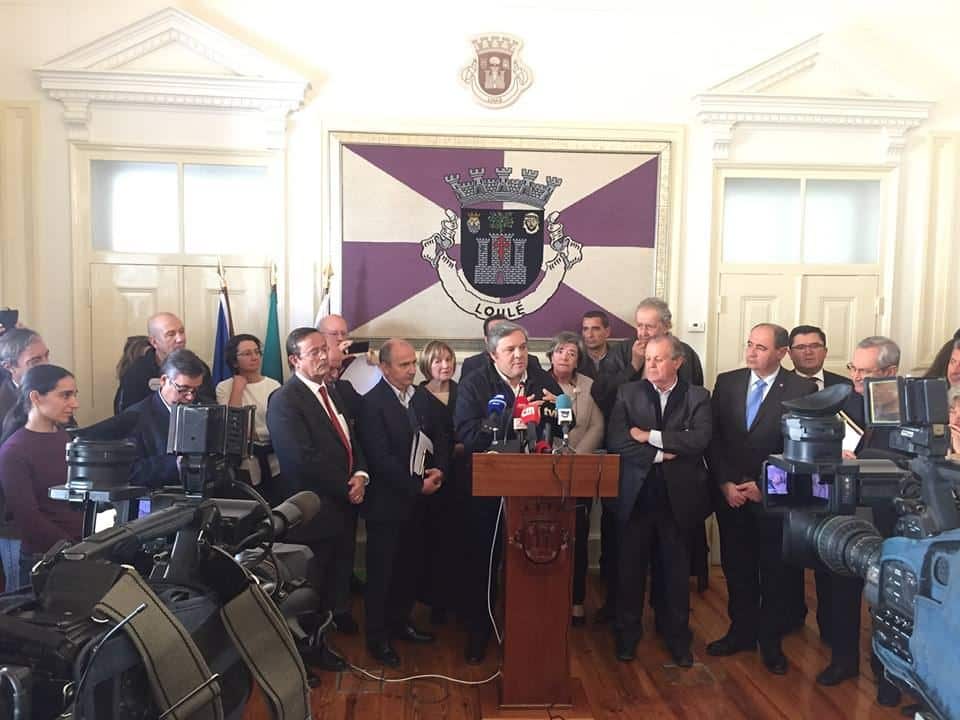
Today, in Loulé, 10 borough council presidents from the Algarve, plus one from the Alentejo joined forces with environmentalists and civic organisations to tell the government: “If you maintain drilling licenses for any part of the Portuguese coast, it will be a declaration of war”.
The actual words came from Lagos mayoress Joaquina Matos, reports Sulinformação website this afternoon, but they reflect perfectly the consensus coming out the meeting.
The event preceded the moment (tomorrow) when Loulé’s administrative court will start hearing witnesses for the ‘providência cautelar’ (bid for an embargo) lodged by anti-oil platform PALP (click here). It concluded with a joint statement, in front of assembled press people, where the various entities “listed the reasons why they believe the government should tear up contracts related to the exploration and production of hydrocarbons in Portugal – with special focus on the test well that the Eni/Galp consortium is preparing to sink off the coast of Aljezur” this spring.
Explains Sulinformação, “the arguments are diverse, namely ethical, environmental, legal and political” – and the gauntlet has been well and truly thrown down.
Next step will be the call for a meeting “as a matter of urgency” with prime minister António Costa.
A campaigning text was read out in front of clicking cameras by Francisco Ferreira of Association Zero and Rosa Neves of campaign platform PALP – “and the only response from the leader of the government that will satisfy the many entities and personalities that came together is that oil prospection and exploration will not go ahead”.
The promise that nothing will advance without an environmental impact study “is not enough.
“The government has to hear us. This well is not going to happen”, boomed Aljezur mayor José Amarelinho who has been chosen to represent the region when Costa agrees to a meeting.
In full swing, Amarelinho “was not soft on the government”, says Sulinformação.
He stressed that when his own council was called to give its opinions on the plan of works proposed by Galp/ Eni, it presented a well-founded document with technical, legal and political reasons “that would allow this well to be stopped”.
But still the government persisted in “affronting councils and their populations”.
Joaquina Matos “went even further” with her “declaration of war” speech, condemning fossil fuel exploration as “an old solution.
“The paradigm has changed”, she insisted, and the future, as public opinion in the Algarve has tried to explain time and again is “decarbonisation of the economy and investment in renewable energies”.
Representing the various business groups involved, Vítor Neto president of NERA stressed it is “fundamental” that neither oil nor gas exploration advances as “the Algarve needs tranquility, a good environment and economic dynamism”, while tourism boss Desidério Silva warned that despite Portugal’s ‘golden period’ basking in record tourist numbers, there are “other destinations” on the up. Any kind of negative news coming out of the Algarve could only play to their advantage.
But it was perhaps the mayor of Albufeira, Carlos Silva e Sousa, who alluded to the most unpalatable aspect of the government’s continued pro-oil position:
“If a south American drugs cartel proposed that Portugal should go into cocaine production in order to enrich the country, we would never accept it…”
And then, of course, there is that inconvenient study by economist Ricardo Paes Mamede which shows that even in ‘best case scenario’ the most the State could ever hope to make from gas and oil concessions “would have a minimal effect on GDP”.
Portuguese film director António Pedro Vasconcelos was one of a number of ‘public figures’ at the meeting today, and he put the situation very simply: “Even if the rewards from oil exploration were fantastic, we should continue to be against. Not because of any fanaticism. There are things that are simply toxic in themselves, which the country should not accept”.
As Sulinformação’s report concludes: “The decision to set out for war or guarantee peace is now in the government’s court”.
And Loulé judges’ considering PALP’s bid for an embargo tomorrow may well be silently thinking.
natasha.donn@algarveresident.com