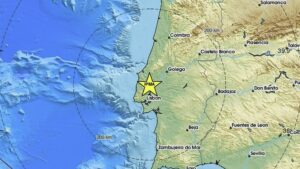
A study by the Faculty of Sciences of the University of Lisbon, published today in the journal ‘Nature Geosciences’, sheds new light on longstanding questions over why ‘very large earthquakes’ have been felt, over the centuries in Portugal (affecting Lisbon particularly).
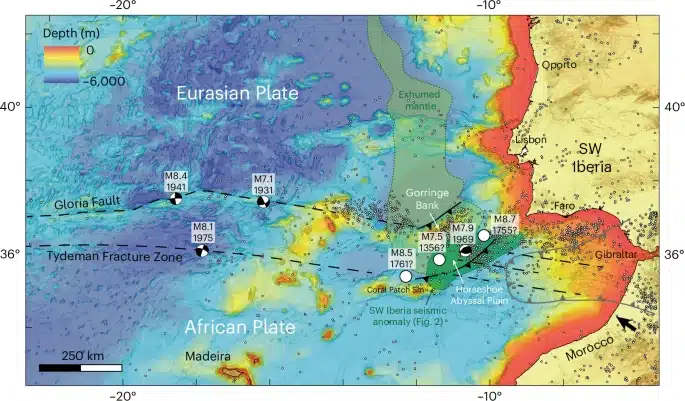
As geologists explain, the ‘geographic origin’ of these large intensity earthquakes – the 1755 ‘Great Earthquake’ (registering 9 on the Richter Scale), and the one in 1969 (registering 8 on the Richter Scale) – appears as a flat geological formation (known as the Horseshoe Abyssal Plain). It lies close to the Gorringe Bank underwater mountain, on the border between the Eurasian and African tectonic plates – but has no known major seismic faults.
Thus, the puzzle within the scientific community as to how it could have been possible ‘for a region with these characteristics’ to trigger such large-scale earthquakes.
Now, there is an explanation: “There is a portion of the tectonic plate that is separating”, in a process called ‘delamination’, says João Duarte, one of the study’s co-authors, a geologist, professor at the Faculty of Sciences at the University of Lisbon, and researcher at the Dom Luiz Institute.
‘Delamination’ implies that the plate is suffering a horizontal fracture, “as if the rock were separated by a sheet, opening a fissure that causes the lower part to sink, having already reached a depth of 200 kilometers towards the Earth’s mantle, when the normal depth is around 100 kilometers”, Duarte tells Lusa. The upper part of the plate however remains in an unchanged horizontal position, making it impossible to detect any geological changes by simply observing the seabed.
This process of horizontal plate separation will have been occurring slowly for five to ten million years, explains Duarte – and it has only been possible to identify now with the use of ‘seismic tomography’ – a kind of “ultrasound of the Earth” – and by analysing sounds captured of earthquakes themselves (which happen almost everday in this area).
“We conducted a study that placed seismometers on the seabed for eight months, recording small earthquakes. We realised that in that area there was a ‘cluster,’ a group of small earthquakes at great depth, about 30 to 40 kms deep, which is a bit unusual. And so, there’s a combination of several observations here that indicate that a process is occurring there that is generating seismicity,” said Duarte.
The team’s work of observation and data analysis was combined with the creation of computational models that allowed a simulation of the ‘delamination’ process.
“We know that the African plate is also moving very slowly, converging with the Eurasian plate. It’s as if we imagine we have two books, and one starts to slide into the other. The plates are converging, and in reality, the area where the plate begins to separate behaves a bit like a leaf, because it starts to slide into the other plate. There’s always contact, but it’s a more horizontal contact. In other words, there’s no hole left, no space. That space is then occupied by other rock,” Duarte adds.
Hopes are that this new discovery will lead to more detailed research on the Horseshoe Abyssal Plain. Duarte believes that the delamination process will now be taken into account “in characterising the hazard and seismic risk” in Portugal – already high-risk due to the confluence of two tectonic plates.
The geologist also sees “an opportunity” in the fact that the installation of a new generation of submarine cables connecting the two sides of the Atlantic will have to pass the Horseshoe Abyssal plain.
“They will have seismic sensors, so the cables will run through that area, making it possible to better monitor and characterise the seismicity. And we’ll probably also have more data, more records,” he said.
Predicting earthquakes will remain a pipe dream, he admits. AI could provide a step forward, even if the learning model based on previous events and data is difficult in this case, as large earthquakes are rare phenomena. The key may lie in a more systematic study of smaller earthquakes, which occur every day, “with some hope” of understanding the seismicity process and “making some inferences and using statistics to understand larger magnitude earthquakes.”
source: LUSA