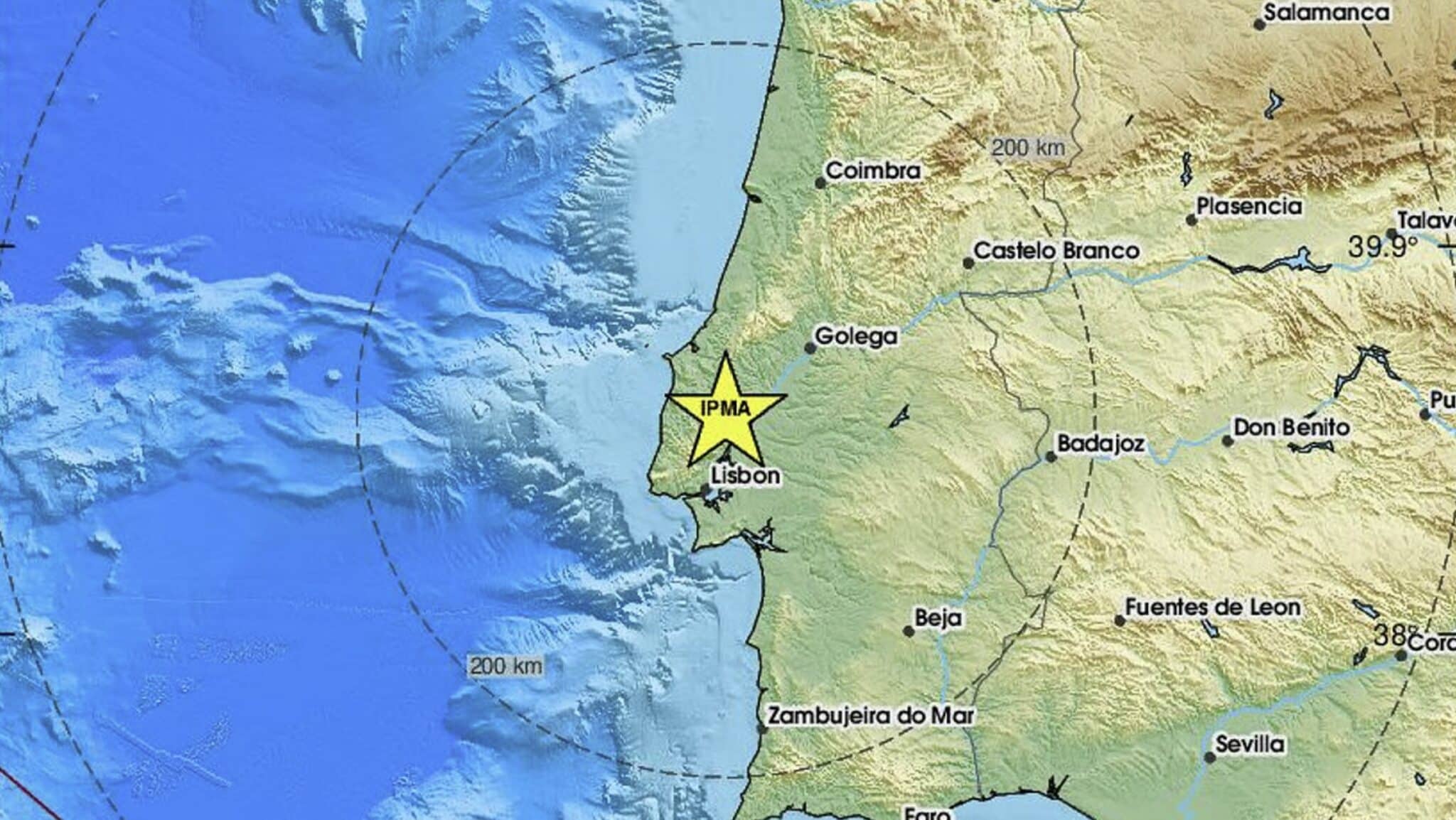
An earthquake measuring 4.1 on the Richter scale was felt in the Greater Lisbon area today (Thursday, February 19), at 12.14pm. Two minutes later, at 12.16pm, an aftershock of the same magnitude was recorded.
The tremors, which occurred in quick succession, were registered in various locations across the Lisbon, Setúbal, Santarém, Leiria, and Évora districts.
The first earthquake had its epicentre located approximately four kilometres west-northwest of Alenquer, at a depth of 15 kilometres. The aftershock was recorded north of Alenquer at a shallower depth of two kilometres.
The Portuguese Institute for Sea and Atmosphere (IPMA) reported that, based on the available information, no personal injuries or material damage had been reported. The tremors were felt with a maximum intensity of IV/V on the Modified Mercalli scale in Loures (Lisbon). The aftershock was also felt with lesser intensity in areas including Montemor-o-Novo (Évora), Peniche (Leiria), Lisbon, Sintra, Torres Vedras, Vila Franca de Xira (Lisbon), Benavente (Santarém), Almada, and Barreiro (Setúbal).
The Richter scale categorises earthquakes based on magnitude as follows: micro (<2.0), very small (2.0-2.9), slight (3.0-3.9), light (4.0-4.9), moderate (5.0-5.9), strong (6.0-6.9), major (7.0-7.9), great (8.0-8.9), extreme (9.0-9.9).
This recent tremor follows a similar event on February 17, 2025, when a 4.7 magnitude earthquake was felt in the Greater Lisbon area. Its epicentre was located in the Atlantic Ocean, around 14 kilometres west-southwest of Seixal, at a depth of seven kilometres.
Another significant earthquake occurred in August 2024, when a 5.3 magnitude tremor struck Portugal’s mainland, with its epicentre around 60 kilometres west of Sines.
_______________________________________________
What to do during an earthquake
Although earthquakes cannot be predicted, there are steps you can take to minimise risk during a tremor:
- Inside a building: Do not use lifts. Take shelter under a table or bed, or stand in a doorway. Avoid windows, mirrors, and falling objects. Stay inside until the shaking stops, then leave calmly while being mindful of hazards.
- On the street: Move to an open area, away from buildings, power lines, and other structures that may collapse. Avoid wandering the streets during or immediately after the tremor.
- While driving: Stop the vehicle in a safe location, away from buildings, walls, and high-voltage cables. Stay inside the vehicle until the shaking stops.
After the tremor
Remain calm, as aftershocks are common. Avoid rushing to exits or using lifts. Use battery-powered torches and listen to radio broadcasts for further instructions. Stay clear of areas with damaged infrastructure, such as loose electrical wires or fallen debris.