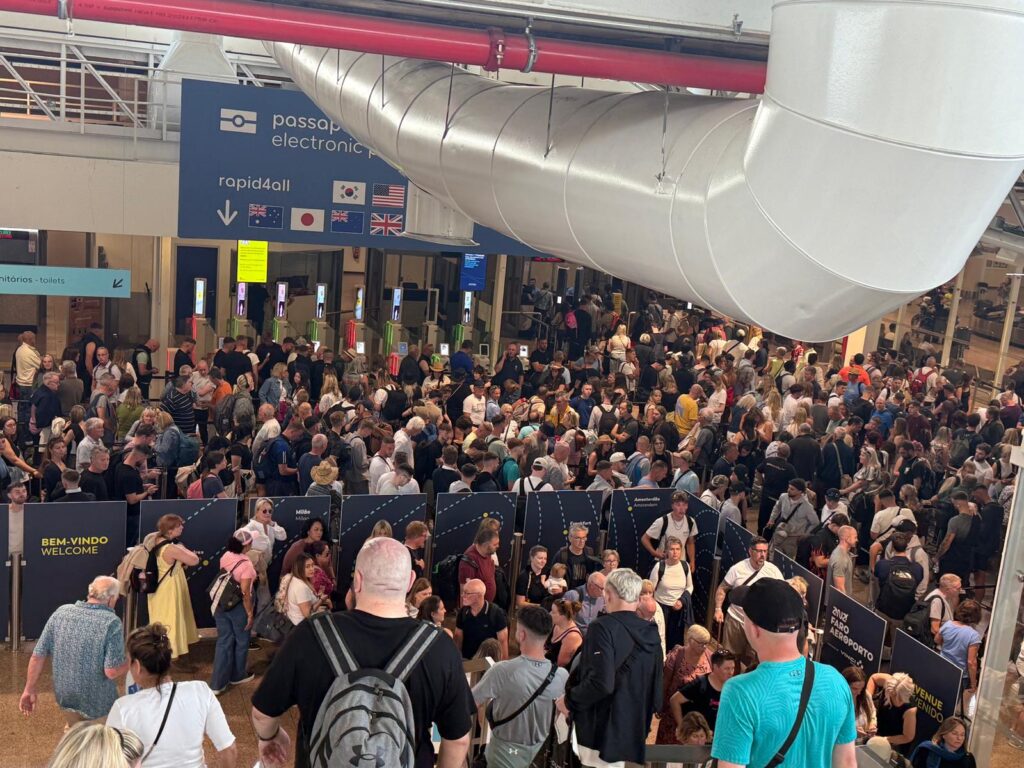
For once, it is not just Portugal failing to get to grips with a ‘new system’ of border control that is causing endless snarl-ups at the nation’s airports: countries throughout Europe are having identical issues – in some cases possibly even worse than those experienced in Portugal.
The UK’s Sun has documented the number of holidaymakers who have missed flights because they have been kept waiting in interminable queues – in the case of Milan’s Linate airport, passengers had the added trauma of a heatwave last weekend, which left many “throwing up and fainting” as they were left standing, desperate to be released from the ‘throng of humanity’ – either trying to exit the airport, or board a plane.
In some ways, one could say Portugal is dealing with this new crisis to hit tourism ‘as best it can’. Authorities have adopted a form of bureaucratic hokey-cokey: when there aren’t too many people pressing to get through passport control, the European Union’s EES (Entry/Exit System) for non-EU/Schengen citizens, which involves the taking of biometric data (fingerprints and photographs), is maintained; when queues get ‘beyond the pale’, it isn’t.
Sometimes it is ‘suspended’ for outgoing passengers but kept up for incoming visitors. Other times, it is just suspended altogether, to ‘clear the decks’.
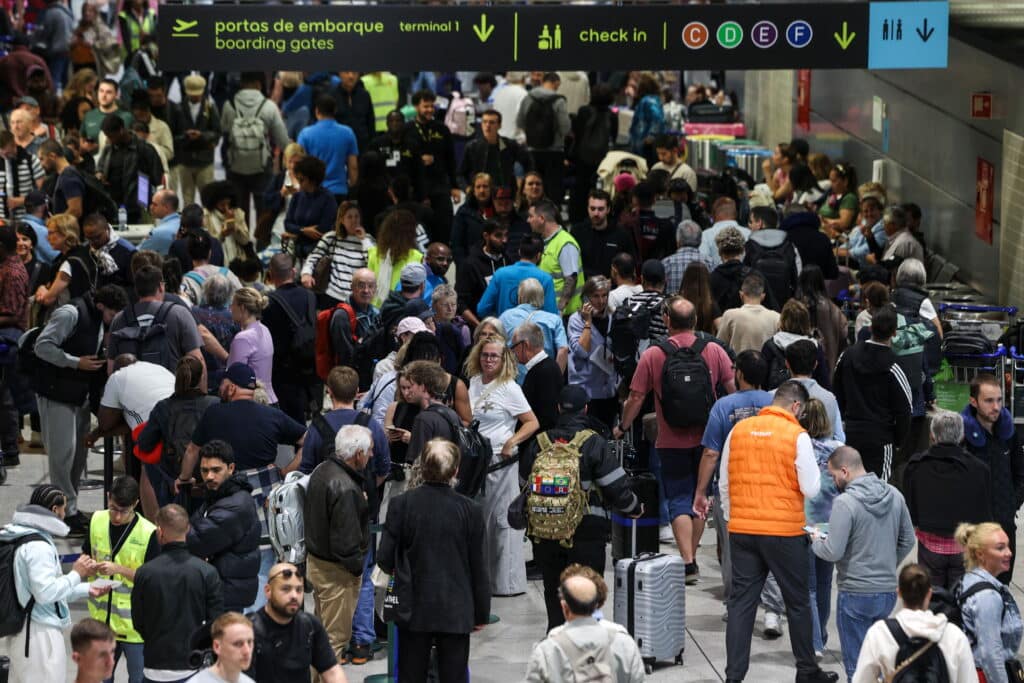
In the space of days since Lusa proclaimed, last Friday, that the EES was now in “full function” at all Portugal’s airports – and getting off to a “smooth start” – the system has been ‘suspended’ on multiple occasions.
One frequent flyer held up at Lisbon has already pointed out the obvious: “Summer will be chaos” if this ‘on/off’ practice continues – and that’s before one factors in the effects of the ‘oil blockade’ in the Middle East, and the wider conflict that appears nowhere near close to being resolved.
Industry experts have already explained that ‘even if the Strait of Hormuz opened today’, consequences will be felt for years due to the sheer quantity of infrastructure/production capability that bombardments have destroyed. Airlines are already predicting shortages of jet fuel: the possibility of flight cancellations already ‘on the table’.
In other words, this is perhaps not the time to start bringing in new systems that compromise airlines’ operations even further than they are already being compromised. But as the saying goes, ‘it is what it is’, and, for the time being, passengers are being told to get on with it.
In Portugal, the argument has been in the past that “there are not enough people processing passports”, “automatic e-gates aren’t working” – but we are constantly being told these issues have been sorted.
There is the perennial complaint that Lisbon airport particularly isn’t equipped for the increasing number of visitors to Portugal.
According to PSP border police data for the period January-March 2026, airport passenger numbers are up by another 12.5% on 2025, meaning no less than 4.3 million people landed in Portugal (and we are still nowhere near the high season) in the first three months of this year.
That argument has been used to continue pushing for a relief airport to be opened at Montijo. But this would not solve the current crisis, as all these passengers need to be processed, and the taking of biometric data is not something that can be done by ‘anyone’: airport police and personnel need training, and expensive infrastructure needs to be put in place.
Thus, there doesn’t appear to be any ‘magic solution’: either EES is permanently suspended, or these added problems to modern travel are set to continue. The problem with ‘suspension’ is that it ostensibly compromises European security (or at least that is what we have all been led to believe by dint of the fact that EES has been deemed ‘necessary’ at all).
Several countries have suspended EES – CNN
According to CNN Portugal over the weekend, Belgium, France and the Netherlands have decided to suspend EES permanently (or at least for the time being). This far, however, the Portuguese government has not made any decision either way, thus operations are being left to PSP police (who operate border controls) and who are using the general rule of ‘if queues start becoming issues, suspend’. This PSP system means that incoming and outgoing passengers have to reach the point of exasperation before EES is waived – so, again, from a flyer’s perspective, it is not ideal.
Airports and airlines appeal for leniency
Olivier Jankovec, director general of Europe’s Airports Council International, has stressed that “it is already evident that greater flexibility is needed with immediate effect”, while Ourania Georgoutsakou, managing director for Airlines for Europe, the leading European industry association, has said: “Our support for the system and its objectives is unwavering. However, strengthening border management must not come at the expense of operational efficiency or the passenger experience.”
The next few weeks may bring some clarity. As both Jankovec and Georgoutsakou have stressed: Europe’s reputation as an accessible and functional destination for tourism and business is on the line – all at a juncture where ‘touristic destinations’ considered safe are dramatically reducing.
___________________
What is EES and why was it mandated by Europe?
The clue to all the confusion is in the description that EES is “is an automated IT system”. ‘Automated’ and ‘IT’ being the two stumbling blocks here.
When the system works, it applies to all non-EU nationals travelling for a short stay, each time they cross the external borders of a European Union country, including Iceland, Liechtenstein, Norway or Switzerland.
The perceived ‘benefits’ of this scheme are that it:
- Makes border checks more modern and efficient
- Makes travel time across borders easier and faster
- Prevents irregular migration
- Increases security in the Schengen Area
But, as this story has explained, we are all a long way from seeing proof of these much-touted benefits.
As to the whole notion that automation and IT will make everything easier and faster, we only have to consider ‘power cuts’, and ‘internet instability’, to appreciate how these can put a spanner in even well-oiled works.
CNN Portugal’s recent article on the problems being experienced, particularly at Lisbon and Faro airports, but also to a lesser extent at Porto’s Sá Carneiro terminal, adds that the European Commission, in launching EES, suggested that self-service ‘kiosks’ would be able to process every passenger in 70 seconds, but that “this has not proved to be the case”.
Anyone who has used a self-service outlet at a supermarket will understand the hidden gremlins at work, and how the whole notion of ‘smooth automation’ can quickly come to a juddering halt. In the case of supermarkets, it is the outlet that might suffer, but in the case of airports, it is the very image of Portugal as an attractive tourist destination. And that is what makes this whole EES ‘shambles’ so frustrating.