We might even call it the country’s foremost intangible export, after the more concrete cultural emblems of pastéis de nata, port wine and Cristiano Ronaldo have been enjoyed and consumed.
According to Amalia (the long-standing ‘home collection’ company, not the ‘Queen of Fado’ synonymous with the ‘condition’), “Saudade is one of the most beautiful words in the entire world and it has no English equivalent. The meaning of this word is deeply connected with the Portuguese culture and soul.”
They continue: “Saudade is an untranslatable Portuguese term that refers to the melancholic longing or yearning. A recurring theme in Portuguese and Brazilian literature (that) refers to a sense of loneliness and incompleteness.”
As far back as 1912, they add, “the Portuguese scholar Aubrey Bell attempted to distill this complex concept in his book In Portugal”, saying: “Saudade is a vague and constant desire for something that does not and probably cannot exist, for something other than the present.”
More recently it seems, and Amalia concedes that, “Saudade can more casually be used to say that you miss someone or something, even if you’ll see that person or thing in the near future. It differs from nostalgia in that one can feel saudade for something that might never have happened, whereas nostalgia is a sentimental yearning for the happiness of a former place or period in time.”
I think we get the picture, and may I be as bold as to suggest that saudade IS translatable, but not relatable in terms of depth and scale, in the way that the Portuguese seem to feel, and even celebrate it?
Saudade, to me at least, is a somewhat inner and melancholic thing. And if that is the case, what, I was wondering recently, is its more positive and light-hearted counterpart? What exactly might it be – in terms of feelings – that the Portuguese miss and long for, when their dear saudade sets in?
At this point, I’ll bring in the Chinese, who in some of their philosophy and worldview suggest that life is an interplay, a result even of complementary and dynamically-connected forces; light and dark, good and bad, male and female. On this basis, if saudade is the yin of Portuguese life, what might be its yang?
What better place might I seek opinion, I thought, when pondering this question last week, than on social media? I decided to petition native and foreign friends alike, who would either think me mad, or spill their insightful beans. Thankfully, they did not disappoint with their thoughtful and gracious views on the idea, when asked.
“Please help, especially Portuguese friends,” I implored. “I think it’s obvious I love and revel in Portuguese culture. It’s not the ‘country’, definitely not the government, but something of a soul-to-soul connection that I am beginning to understand more the longer I live here.”
Keywords I put to them to get the conversation started were: ‘authenticity’, ‘tradition’ and ‘pride’, but “what is the sense of joy, but isn’t joy?” I asked. “It’s fulfilment, but that’s the wrong word,” I continued, seeking instead “the quality that describes the understated Portuguese lust for life and celebration of community? I know it and love it, but I don’t know the word for it! Do you know what I am talking about, and if so, what is the single word for it? Maybe it’s a Portuguese word?”
Does anything come to mind for you as you read this? And why is this so important to me?
A few years into my Portuguese cultural apprenticeship, it strikes me that knowing and thinking of Portugal and the Portuguese, only through a shadowy and dark thing (and I do not use these words in a pejorative way), is something of an injustice.
It’s like thinking only of the ‘stiff upper-lip’ when bringing the British to mind, which whilst it may not be untrue as a generalisation, offers only a single side of a national personality, and denies a fairer, richer picture.
Is it not strange to you, as it is to me, that something seemingly so sad and melancholic as saudade might represent a people who day-to-day and in my lived and delighted experience are so warm, friendly and helpful? And yet, the yang to saudade’s yin is clearly not a forceful, exuberant or ostentatious energy that notable trans-Iberian and trans-Atlantic neighbours exude; Portugal’s is a quieter and arguably deeper happiness, that is shared rather than owned (with the notable exceptions of festas and driving, that I think prove the rule!).
In what turned out to be a delightful and illuminating 46-comment Facebook ‘conversation’, many right-sounding words were commended to me. Among them, in English: ‘home’, ‘peace’, ‘belonging’, ‘completeness’, ‘passion’, ‘contentment’ and ‘soul’; and in Portuguese: ‘alma’, ‘alegria’, ‘viver a vida’ and ‘casa’.
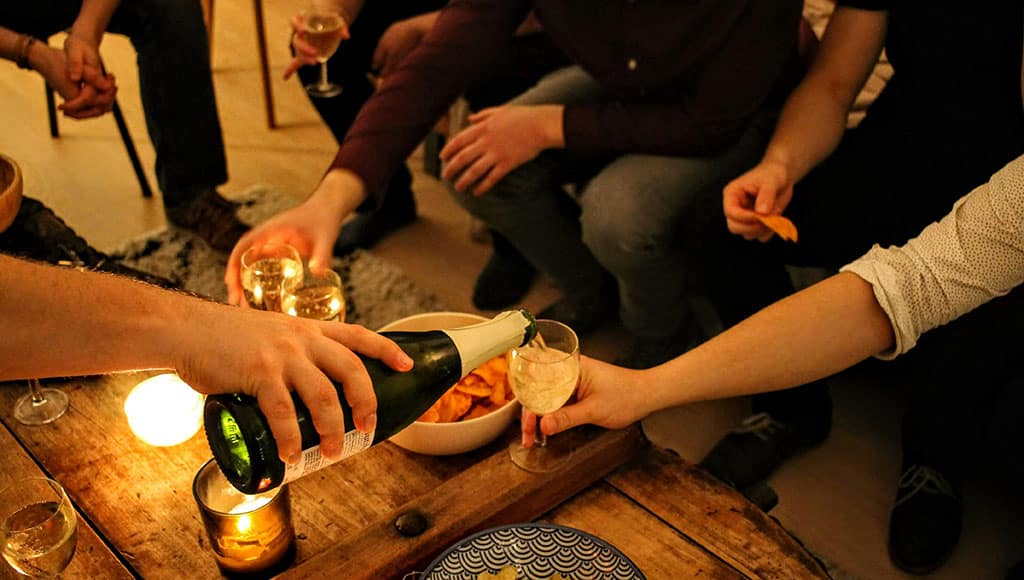
But the word that reached out from the dry digital screen of social media and chimed comfortingly in my chest was ‘convívio’, as articulated by Frank Nibley, among others. “This might be the word you’re looking for,” he said. “Convívio means more than just ‘socializing’ – it’s the joy of being together, sharing meals, music, laughter, stories, and moments, often with food and wine but also with a kind of natural warmth. It’s relaxed, genuine, and deeply rooted in community.”
And whilst clearly not unique to Portugal in concept, there is something peculiarly Portuguese about the preciousness, regularity and ease around the practice of the beloved sense and expression of our convívio – whether you are with friends and family, picnicking by a river beach, or savouring the creations of world-renowned Lisbon-born chef José Avillez, whose food has “Portuguese DNA in every bite, a Portuguese soul in every plate.”
I will no doubt write, elaborate and celebrate more on saudade’s beautiful bedfellow convívio, and leave you with the words of another, who knew exactly what I was trying to identify and eulogize.
“What I’ve come to love most about life in Portugal is something hard to name. It’s not just the beauty, the food, or the history – it’s the way people come together. There’s a quiet, unspoken rhythm of gathering here. No fanfare. Just a table, some bread, a bottle of wine, and time to be with one another. That alone seems to matter more than anything. Life here seems to be built on that mix – the joy of being together, and the depth of feeling when we’re apart. It’s convívio and saudade. I’m learning to practice living this for myself.”
And so am I.