In terms of sports in particular, people from the good ol’ U.S. of A. follow two sports that are very popular in North America, but are not well known or appreciated in much of the rest of the world.
Baseball is considered America’s “National Pastime,” but is not a part of the European sports scene. (Let’s not quibble here. Cascais has a baseball team that plays in a league on the club level, but most people have never heard of it.) Baseball is big time in Japan, but not the rest of Asia; and also played in Cuba, the Dominican Republic ,Venezuela and Panama, but not elsewhere in South or Central America, or at all in Africa. Brits make fun of baseball by calling it another version of rounders, and pointing out that it is nothing like cricket, a game actually disliked in the States.
The other uniquely American sport is “football. “I know, I know – the extremely popular sport played around the world and universally known as football is what Americans call soccer. When referring to their game, they don’t say “American football,” which they seem too lazy to say all the way through or think it’s redundant. The fact that the ball is not kicked that often and sometimes reluctantly doesn’t seem to matter. It turns out that some students at Oxford in the 1880s attempted to distinguish linguistically between the sports of “rugger” (Rugby Union Football) and “assoccer” (Association Football, with new formalized rules). Eventually the term was further shortened to “soccer,” but never really came into general use in England. Then in 1945, the United States Soccer Football Association was formed, but soon dispensed with the term “football”, leaving the sport’s moniker as simply soccer.
There are other countries that sometimes use soccer, because like the United States they play different versions of the general concept of “football.” They include Canada, which has its own form of gridiron football; Ireland, which plays “Gaelic football;” and Australia, which is home to “Australian rules football”, a hybrid of rugby. By the 20th century, rugby football was more commonly called simply rugby, while association football had earned the right to be known almost everywhere as just plain football. When I was growing up, my father facetiously called it “feetball.”
Anyway, did you know that there’s an American (NFL style) football league in Portugal? Ol’ Pat knows because he helped coach the Algarve Sharks, located in Faro as part of an adult, amateur ten-team countrywide league with teams in Lisbon and as far away as Braga. We had a tiny fan base consisting of parents, wives and girlfriends, but not all of them apparently. It was the type of situation where I could name most of the people in the bleachers behind us, because they rode on the same bus that took us to the away games. To be honest, the players didn’t really seem to get it, but thought they looked good in their uniforms. We made the championship game my first season with the club (we lost 28-26 – so close), thanks mainly to two very talented American recruits, but I ended up having philosophical differences (they didn’t want to come to practice) the second season and we parted ways before they were eliminated in the semi-finals.
The point is that American Football, with its helmets and shoulder pads and forward passes, is the reason my lovely wife and I ended up in Portugal. After spending 12 mostly pleasant years retired in Panama, where I even wrote a column for a popular tourist newspaper, I decided we needed a new adventure. When we were much younger (late twenties, early thirties), I was involved in coaching high school football, with some very successful programs. Also, when my lovely wife taught abroad in the Bahamas, I ended up as head coach of the Nassau Marlins (apparently my teams always end up with fish names) and we won the league championship. My record in Nassau for one and a half seasons, after I took over from another coach, was 13-2. So I thought I had a knack for teaching the American sport to players, who grew up playing soccer or rugby.
As it turns out, while it is a very minor sport on this side of the pond, Germany has fifty teams in three divisions and has sent players to the National Football League. American football is a varsity sport at some universities in Great Briton. There are also leagues in Italy, Spain and of course, Portugal, where I ended up. After going back and forth with our little dog Fluffy from Panama and back, my lovely wife and I decided we liked living in the Algarve, and in Portugal, better than in Panama City. Portugal is safer (way!); with a much lower cost of living (and not just wine prices); cleaner with much less litter and quite a bit closer to European cultural centers, which we wanted to visit. The Sharks folded years ago but we’re still here.

Being a football guy, I do miss it sometimes. One Monday morning a year, I get up at 3am to watch the Super Bowl. It’s still Sunday in the States and I really don’t like to videotape games to be watched at a later date. Sports are meant to be watched live, if not in person. That’s why we got excited when we heard the news that the NFL was staging a regular season game in Madrid. To promote the game and expand their already gigantic fan base, the professional league in the States has been staging games at Wembley Stadium in England for a number of years and even a game or two in Germany. At some point, they hope to have a team or two representing and based in European cities. My prediction is the London Panthers. (You heard it here first). But in Spain on the Iberian Peninsula, it felt like they were staging the contest in our backyard. Then, when it was announced that one of the two teams would be the Washington Commanders, our hometown team since we were kids and the club was called “The Redskins,” we couldn’t resist. There was also a time when we followed The Miami Dolphins (guess when?), who were the opponents.
To be honest, we had never really been tourists in Madrid. We flew in a couple times because Iberian Airlines had a direct flight from Panama City and we could be a little more confident about not losing our dog in transit. We rented a car at the airport and drove back to the Algarve. So we decided to spend five days in the Spanish capital, with the game in the middle of our stay. It was a good plan. Having an NFL game as part of the long weekend made the entire experience unusual and special. It started at Lisbon airport, where we were making our connecting flight. We were pleasantly surprised that almost half of the passengers were dressed in Commanders gear – jackets, shirts and hats. We asked, “why Lisbon?”, and the two main answers were that they were expats living in Lisbon or Washingtonians who included Lisbon on their tour itinerary.
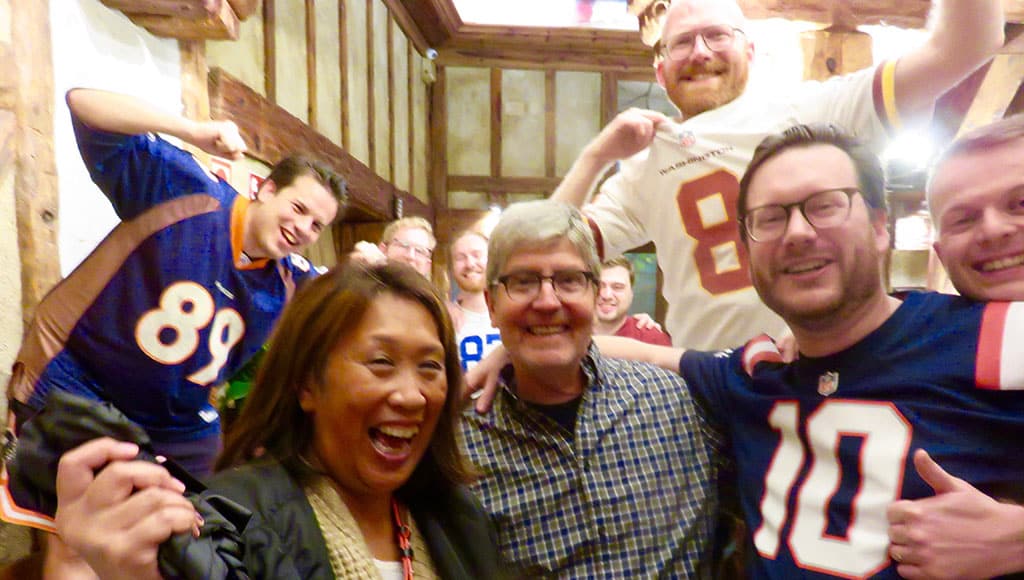
On our first day, we took a Tuk-Tuk tour of the city and sped past numerous impressive scenic buildings and a surprisingly high number of fans showing off their team colors – burgundy and gold for ol’ D.C. and white and aquamarine for Miami. That evening, we went out to dinner and encountered a half-dozen Belgian guys dressed in NFL team jerseys, New England Patriots and Commanders, so we exchanged fist pumps. A while later, as we were digging into our suckling pig, we heard a newly arrived couple mention to the lads that they were from “the Algarve in Portugal.” Say what? It turned out that Susan Agricola and Tom Verhauz, a couple originally from San Francisco but currently residing in Vilamoura, were in Madrid for the game and rooting for Washington. Their favorite team is, of course, the 49ers, but they like the Commanders, and Tom likes to play fantasy football that includes players from around the league. There were five tables in the room and nearly half of them were occupied by regular readers of The Resident.
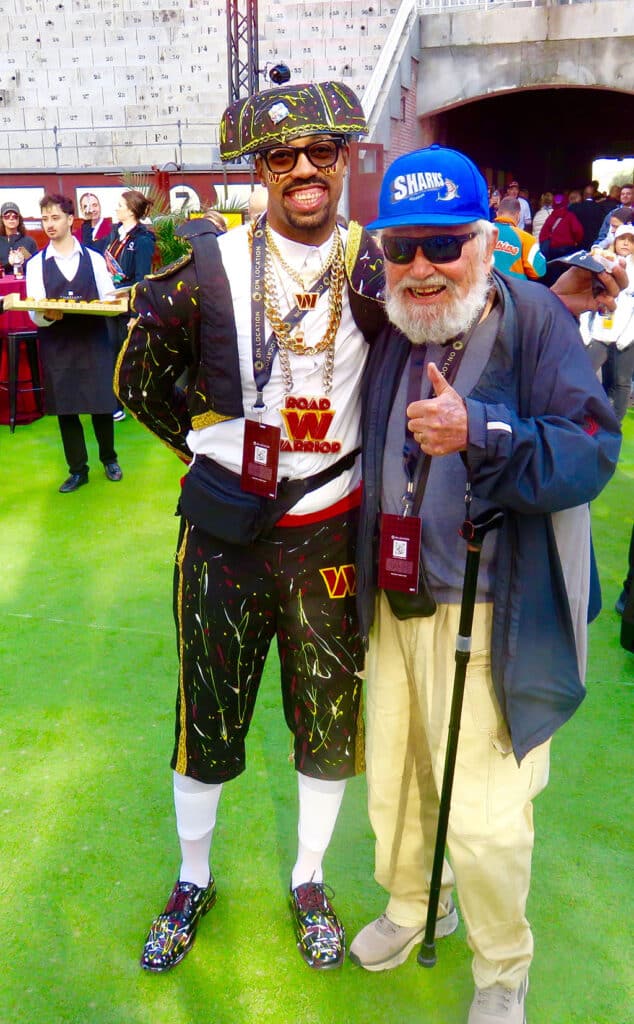
Our second day was spent wandering around the Plaza Mayor near our hotel and resting up for the big day. Game day started off with a huge pregame party at the Plaza de las Ventas, a large old historic bullring, with plenty of free drinks and food and packed with fans from both cities. The two teams are not traditional rivals and everyone seemed to be in a good mood, which made it fun. We sat and talked with several people and enjoyed reminiscing about the old Redskin days. It gave us a chance to remember when we were kids and both of us figured that we attended our first game at an old converted baseball park called Griffith Stadium way back in 1954.
Then on to Santiago Bernabéu Stadium, the fabulous home pitch for Real Madrid CF. Located in the center of the city, this very modern, spaceship-looking sports complex has a roof and three different levels of natural grass fields that they somehow alternate using modern technology and engineering so that the playing surface was perfect at game time. The nearly sold-out crowd of 78,000 seemed to be evenly split between Commander or Dolphin supporters and curious Spanish sports fans.
The fact that the Commanders lost the game in overtime, and that the game itself was a rather lackluster affair that ended tied 13-13, didn’t really spoil the overall experience. The crowd cheered, cheerleaders pranced around and shook pompons, replays were shown on the Jumbotron, and there was a delightful spontaneous lightshow when most of the fans turned on the flashights on their phones. I sat next to a guy who attended a rival high school and most in the crowd seemed to know what was going on most of the time.
The last two days, my lovely wife and I were back being tourists. We had booked a nice walking food tour with a gal who was more like an old friend than a guide. We learned more than we thought possible about jamón and extra virgin olive oil and sipped a number of tasty wines, but we don’t remember the names of the vineyards. And of course, finally, we paid a visit to the Museo Nacional del Prado. We’ve done something like this before at the Louvre, for example. At the beginning, it was exciting to be in the presence of so many magnificent art works, but by the end, we were suffering from masterpiece overload. I discovered I’m not a big fan of Goya, for example.
In retrospect, the experience made me realize just how influential the game of American football had been in my life. I believe sports are important in many people’s lives. I was eleven years old when my father took me out to be on our parish school team that played in a city-wide Catholic Youth Organization league. I made the varsity as a tenth grader in high school and had the fun of being a running back, who got to score touchdowns. I didn’t play college ball, but attended every home game of the University of Maryland Terrapins (That’s right, our mascot is a turtle.) For the first 10 years of my teaching career, I was best known as a football coach in Maryland and the Bahamas. After that I was a sports writer for local newspapers specializing in football. Ultimately, it was football that got me to where I am today – writing a column for the leading English-language newspaper in Portugal.
Read Pat The Expat’s last month’s article: Pat, the expat, is old