By CHRIS GRAEME chris.graeme@theresidentgroup.com
A senior banker has warned that Portugal’s only way out of economic crisis and stagnation is through market diversification and increasing exports.
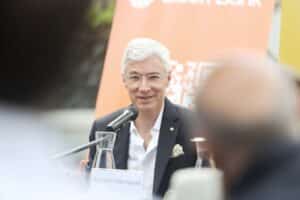
Current President of BIC Portugal bank and former finance minister under Cavaco Silva, Luís Mira Amaral, has laid out his vision of the future in his new book, E depois da crise? (And after the crisis?).
Amaral argues that, in the short term, Portugal can escape the crisis if it fulfils its austerity pledges for the Stability & Growth Pact.
The economist also says that the European Union needs to move towards a federal United States of Europe with greater tax and budgetary union.
He believes a rapid recovery of the world’s economy is “out of the question” and admits that Europe could even enter a new and prolonged recession.
As for Portugal, Luís Amaral predicts “many years of blood, sweat and tears” and adds that the Prime Minister’s euphoric statements about Portugal’s modest economic growth in the last few quarters “aren’t sustainable”.
“That slight recovery was induced by an increase in consumer spending and exports. With the Government’s austerity measures, there will be a fall again,” he said, warning that 2011 and 2012 will both be difficult years.
Diversifying
In his book, the economist states that Portugal will take many years of reduced Government spending and structural reforms to get out of the crisis.
“The only hope we’ve got is growth on the back of exports,” he says.
“With internal financial account imbalances, I don’t see how it’s possible to spend our way out of this crisis via consumer and public spending without making our external debt and the debt of the State and our families even worse.”
Luís Mira Amaral also cautioned about pinning hopes on Portugal’s one time most important economic partner Spain, whose economy was also suffering sluggish economic growth and recession.
“The Government’s mania for ‘Spain, Spain, Spain’ was over peddled. To think that Spain can now be our salvation is clearly wrong. Spain’s economic model was that of a giant with feet of clay. It wasn’t sustainable because it was all on the back of property speculation,” he said.
“At a certain point, the Government has done one thing right – it’s begun to diversify its attentions and the investments of Portuguese business in countries like Algeria, Angola, Libya, Venezuela and Brazil.”
The economist concludes in his book that Portugal needs to stay in the Euro for financial stability and discipline but that, ultimately, the country could only grow by exploring non-EU emerging markets.
“Keynesian policies aimed at increasing internal demand won’t work in Portugal; it’s too small. Instead it has to look outward.”
He also predicts that Germany will increase in economic strength within the Eurozone as it takes tighter control over economic policy at the European Central Bank and in Brussels.
The ECB will become more like the Bundesbank with the Germans holding the ‘Golden Share,” he said.