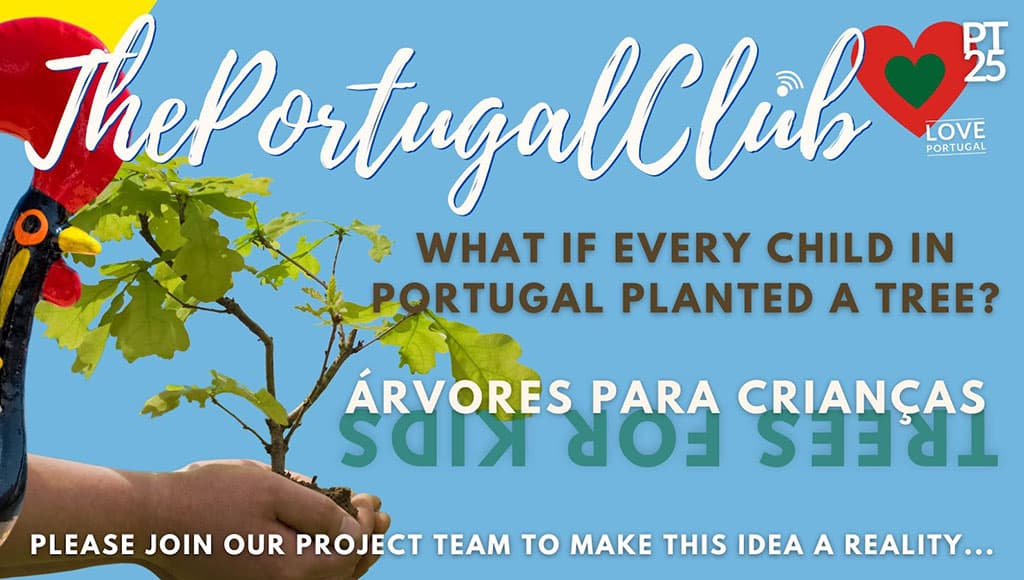
I’m going out on a limb today, sharing a wonderful idea with you, along with a generous smattering of tree-related puns, and a delightfully positive vision of the future.
The concept I am putting before you found me through my fortnightly Positive Echo podcast, which I co-host with Gary Coulton, who I’ve written about before here, he of the “maverick mind” and chief proponent of the Positive Echo movement, into which today’s cultural serving suggestion firmly fits.
Furthermore, it ticks many boxes, socially and ethically, and ties up a number of loose ends that I’ve been aware of in my time here, including the natural reforestation of Portugal, the idea of expat ‘giving back’, global environmental concern, and a gift to the country’s future, notably for and through its children.
Bringing all of these themes neatly and movingly together is Neighborhood Forest, a not-for-profit organisation that provides free tree saplings to children across North America, primarily on Earth Day (April 22 annually, with origins dating back to the 1970s), with the aim of “fostering environmental stewardship and a love for nature”; and it was to its co-founder Vikas Narula that I spoke, and was seriously inspired by, one recent and perfectly ordinary Wednesday afternoon, via the magic of a trans-Atlantic teleconference.
In our conversation, Vikas spoke to Gary and I of a childhood connection to trees and a midlife health crisis that were both partly responsible for his subsequent aim to “beautify neighborhoods, reduce carbon footprints, and instill a sense of responsibility in kids by giving them their own trees to plant and nurture.”
Starting with 400 trees back in 2010 in Minneapolis, the free trees idea has grown significantly, reaching over 110,000 children this year alone, across every US state, most Canadian provinces, and with pilot programs in Mexico, Ghana, and Haiti. I’d like to add Portugal to that list, given the astonishing simplicity and massive goodwill this ‘simple act of planting a tree’ has to offer, when so many environmental initiatives can seem, to me, too gloomy, complicated or expensive to capture widespread public attention or foster sustained action.
Imagine for a moment, if you will, what would happen if every child in this country was given a sapling, importantly a native, perhaps culturally significant species – like oak, olive or chestnut – that would grow with them, and create a slow, yet dramatic, and literal change of scenery as well as instill environmental consciousness. Each tree would be a mirror, a landmark, and totem of hope for its little owner, or steward, ultimately becoming a legacy that might offer shade to that child’s own grandchildren some hot day long into our collective future.
Funded 60-70% by corporate partnerships, plus individual donations, “Trees for Kids” now engages nearly a million volunteers and “promotes a positive, community-driven approach to environmental care”, I learned to my surprise and delight. And, very thoughtfully, for the kids who don’t have easy access to gardens, the Neighborhood Forest folk also offer indoor plants to budding but yard-less green guardians, so no one need miss out on this life-changing, life-enhancing possibility.
With such brilliant roots, it’s hard to see how a plantation of our own version of the idea would fail to branch out all over this already favourably verdant land, even if our planting scheme has become dominated more recently by monocultural cash crops; in itself a strong reason to encourage child-centred, local horticulture and awareness.
An infrastructure of fundraising and logistics would certainly be necessary to have this happen, and it’s here that I see the huge reservoir of talent and goodwill, so often mentioned and suggested by the mainly-retired expat community, coming into its own to complement Portugal’s existing and vibrant volunteer culture and local, philanthropic associations.
“We want to give every child in North America their very own tree to plant, eventually the world,” Vikas told us. “And in the process, plant this seed in the hearts of the children of loving nature, loving trees and caring for the planet.” And as someone who’s planted a few trees in his time, formally and informally (see the ‘guerilla gardening’ moment that I am proud to confess publicly, here and now), I am really excited by the inoffensive and natural power this initiative has to unite and nourish people beyond the confines of age, origin and political persuasion.
Vikas, who was educated at the Maharishi International University and exposed to transcendental meditation, which profoundly shaped his worldview and purpose-driven work, very nearly gave up on this dream, when the results he was hoping for were failing to fruit. In fact, in 2019, he very nearly shut the project down due to slow growth.
Encouraged, thankfully, by wife Priya, who suggested he keep going “for the love of it, not outcomes”, Vikas persisted and Neighbourhood Forest prevailed. Thereafter, “we went viral among librarians after a Michigan library joined our program, and overnight, we grew more than in our first 11 years, hitting 20,000 trees in that year.”
“Now, we’re supported by corporate partners like UPS and over 5,000 individuals donating about $15 each,” Vikas shared, who after a sudden and debilitating, bedridden month many years ago, decided to quit 15 years of joyless corporate life and realise his dream. He listened to that wake-up call, and fortunately to his wife, when more was apparently happening beneath the ground than evidently above. I’m so pleased he did, as I suspect many others are – and will continue to be – who have seen a wispy sapling eventually grow bigger than themselves or their child.
I’ve heard it said that the best time to plant a tree was 30 years ago, and that the second best time is now. So who’s in, and who wants to encourage the youth in Portugal today to plant trees that their own children, and children’s children might climb in and picnic under, just like Vikas Narula did, long before his acorn of an idea became an impressive oak of a thing inspiring others, like me, in a land far away?
More here – www.neighborhoodforest.org