The government’s PR machine was at full throttle on Sunday. Shaking off the disaster of the summer wildfires, the message was all about housing. In fact, “the largest investment ever in housing!”
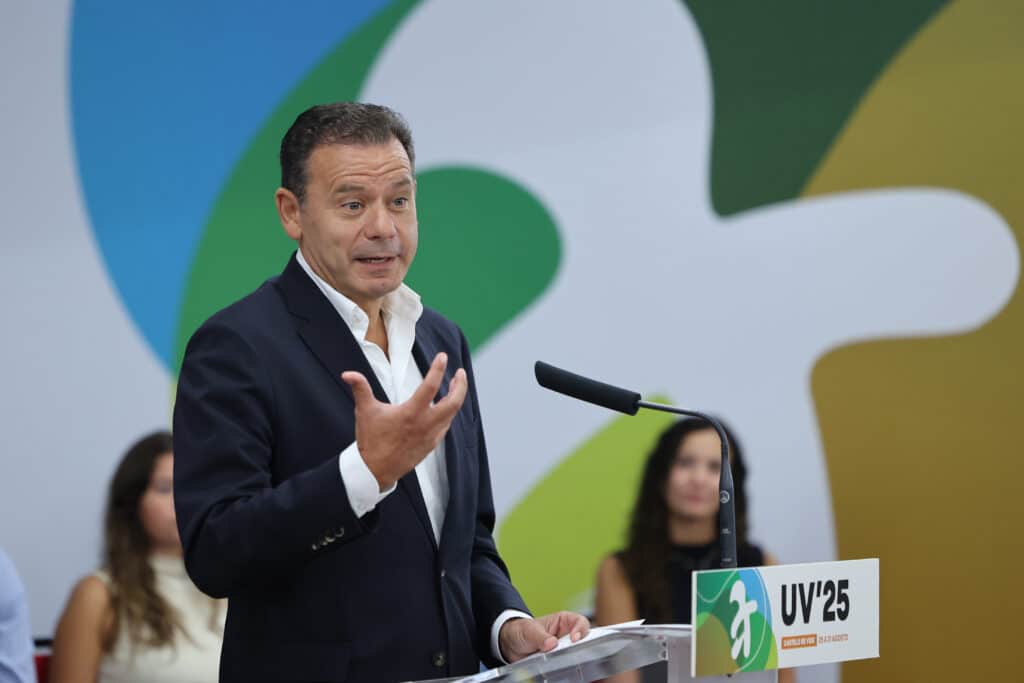
Luís Montenegro, Portugal’s prime minister and leader of the PSD, addressed young political supporters at the end of the party’s summer university to unveil a new raft of measures, announce a €1.3 billion credit line (for the construction of affordable houses and apartments) and the municipal construction of 133,000 ‘public housing units’.
There was so much ‘information’: public entities with “assets that are not being used” (i.e. vacant properties) were going to be asked “to explain themselves”, and if they have no plans for those assets, “we will not stand by and watch (them) being degraded, without use and without justification (…) We will give (them) to ESTAMO (the company that manages the State’s real estate), which can do whatever it wants with (them), sell (them), rent (them)…”
On he went. “We will encourage private investment, remove bureaucracy, simplify procedures, create an attractive tax regime, and move forward with innovative measures so that supply can be increased and prices moderated…”
The government will also move forward with the creation of what it has called a single digital file for each property, a digitally accessible document that will bring together all the certified documents for that property. “A kind of ID card for the property”, extolled the PM, the idea being that, in a simpler future, property owners will not have to run ‘this way and that’ to collect all the relevant papers they need.
And this is where anyone who hadn’t been bowled over by the excitement of the moment might have stopped and said, ‘marvellous, but how is any of this going to get me a roof over my head that I can afford?’
This is the nub of the issue – and why reports conceded on Monday that “the new package of measures for housing is still vague”.
Not just vague, but vaguely familiar.
Enter former Socialist (PS) housing minister Mariana Gonçalves (who naturally was not at the PSD Summer University) to explain that most of the ‘new package’ has already been approved ‘in law’ but not enacted (due to the fact that Portugal keeps changing its governments).
“It seems that we have been stagnant for a year and a half, only to now resume instruments that were already on the table,” Gonçalves told SIC Notícias on Monday. “These are not just instruments that were part of the PS’s discourse. They were provided for in law, with financial commitments.”
In other words, the PM’s grand announcement is simply the “carrying out of a financial objective defined in the past”, she stressed.
Ditto the decision to wrestle ‘unused assets’ out of the hands of indolent state entities. This was another PS policy which never picked up any kind of traction.
With other parties equally ‘underwhelmed’ by the content of the prime minister’s speech, SIC stresses that a number of the government’s great ideas have failed, in the final analysis, to be as great as it made them out to be: the rental support programme for the under-35s, for instance, “has turned out to be very slow”, says the news channel. “There are young people waiting more than six months” for the help they need. Same goes for the ‘extraordinary rental support’ announced with some fanfare.
And then there is the question of the prime minister’s ‘truth’ (again!). After the ghastliness of his family company Spinumviva (which basically caused the fall of Mr Montenegro’s first government), we now have the blocking from public access of details of his 55 properties (46 of them inherited).
The PM has called the story ‘nonsense’, thus it has been all over the front pages of a certain tabloid, citing documentation to prove that it isn’t nonsense at all. To be fair, very few people will be interested in a plot of land down a lane in the wilds of Resende (or Bragança).
The issue is more one of ‘transparency’ – a quality people living in a democracy hope to find in their leaders. Mr Montenegro has all the right words for grand announcements, but is there any substance behind those words? These are the questions now being posed by opposition parties.
Mariana Leitão, the new leader of Iniciativa Liberal (IL), was already wondering on Sunday about ‘the money’: “A quick calculation shows that €1.3 billion will come from the European Investment Bank, and the rest through the Banco de Fomento. But are we talking about debt incurred by municipalities, or are we talking about central government debt? Who will be responsible for this money, and how much are we talking about specifically,” she asked.
Another query from Ms Leitão: “‘Who are these houses for and what are they for? Are they for rent? Are they for sale at controlled prices? Are they for the middle class? Or as social support for people who, in fact, cannot afford decent housing?”
This is also accepting the fact that companies will appear that want to construct affordable housing. ECO online carried an interview very recently with a real estate lawyer and partner in a reputable law firm who stressed that “there is no model that has been created so far that can solve the problem of lack of affordable housing”, because construction costs are simply too high.
“If the development of high-end luxury projects has a market, how can you convince developers away from this path and get them to build affordable housing,” the expert quizzed.
Certainly, the way IL sees it, the government should stop with its grand announcements and concentrate on “dynamising the market” by creating the right conditions: lowering taxes, reducing bureaucracy and accelerating licensing.
CHEGA, meantime, the country’s second political force – whose support (or otherwise) holds the government in a certain degree of check – has been lukewarm about the ‘largest investment ever in housing’, suggesting AD (the PSD/CDS-PP minority coalition) could go a lot further.
“We need to help people so they can deduct more of their housing expenses from their income tax. What they currently have to deduct is peanuts, when families’ housing expenses are brutal,” party leader André Ventura points out.
PCP communists have stuck to their habitual hymn sheet. Leader Paulo Raimundo said of the PM’s announcement: “We were treated to an intervention of some magnitude, marked by what this government has been marked by” – that is, promises, illusions (and) outside the reality of the difficulties of the population.”
Thus, it was basically another ‘Groundhog Day’ on Sunday – but at least no-one mentioned the government’s ‘failure to properly manage the wildfires’.