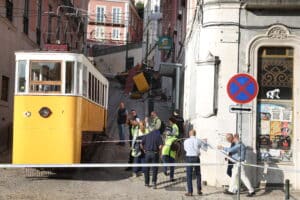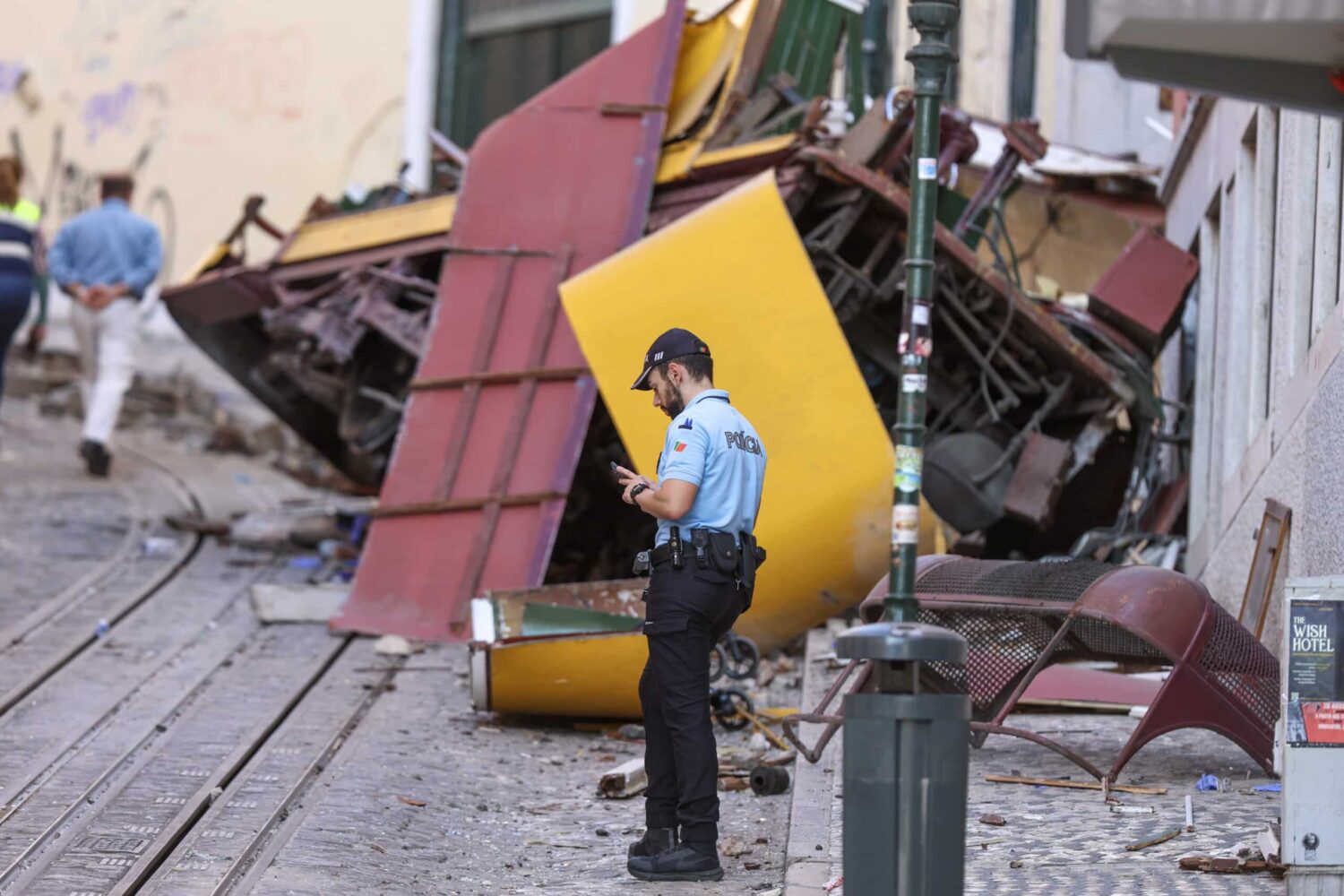
Yesterday it was the possibility that Lisbon’s Glória funicular – which crashed so devastatingly last week, killing 16 people – was open to sabotage; today it is “the choice of a cable with a nucleus made of plastic” (more correctly: polymer fibre) that is being flagged as (potentially) being “at the origin of the accident”.
Expresso goes into some details today, having consulted “experts from IST”, the Superior Technical Institute, as well as specialist engineers.
What it boils down to is that the original cable, “made entirely of steel”, was replaced six years ago with a new one with a fibre core. Despite the change in material, the same fastening system to the lift was maintained “and it is precisely this factor that may have caused the accident”, explain reports.
Over time, the new cable will have lost strength in the area where it is attached to the pulley, due to factors such as heat, vibration and deformation of the material, experts explained.
Carris, the public transportation company that contracted Glória’s maintenance out, should have tested the new fastening system after replacing the cable – something that, by all accounts, was not done, says Expresso.
The paper cites initial findings by GPIAAF (the office for the prevention and investigation of aircraft and railway accidents), which pointed to the cable which joined the two cabins of the funicular ‘giving way at its attachment point within the upper compartment of cabin 1’.
The description ‘giving way’ (and not snapping or breaking) “is important for specialists”, explains Expresso. “It signifies ‘plastic deformation’.
“GPIAAF’s final evaluation will only come after 45 days, and will concentrate (…) among other aspects, in the investigation of “the type of cable and its fixation to the pulleys, quality controls in reception and execution” and also on the ‘disconnection mechanism between the cabin and the pulley, with an analysis of the condition of the cable attachment to the pulleys, and its execution’”, says the paper.
Two things are certain: “Everything that could have gone wrong with the Glória funicular went wrong. The cable came loose, the brakes didn’t work and the carriage did not withstand the impact, and was left totally destroyed at (a speed of) 60 km/ hour”. Also, the topic of this terrible disaster will be ‘obligatory’ as parties enter the debating period ahead of municipal elections in roughly one month’s time.
There are also some really worrying moot points: aside from the various questions Expresso posed Carris, to find them unanswered in time for publication, is a written report by the maintenance company (the principal shareholder of which has still not faced the press) that claims it carried out a nighttime inspection on September 2 of “the critical point” where the cable 18 hours later ‘gave way’, ‘verified’ the workings of the pulleys, cleaned fixation points, and lubricated the cable.
It is “information that raises doubts between the difference between what was declared and what was effectively done by the company”, stresses Expresso, as to do this work, the pulleys would have had to be ‘dismantled’, something that would have taken more time than the times noted in the report.
Then there is the situation of the brakes, and their ‘lack of effect’. It suggests, said two of the IST lecturers who have studied this accident, that there were “serious conception errors” within the system, that are “inconceivable in this day and age”.
Source material: Expresso/ SIC Notícias