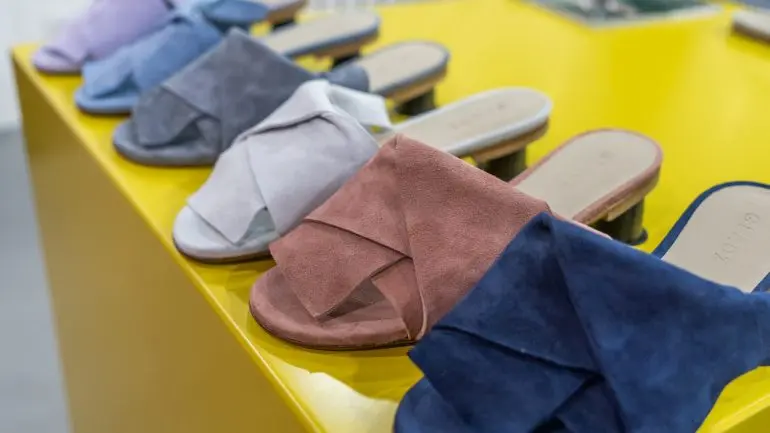
MICAM, the footwear fair in Milan – considered by the sector to be the most important – started yesterday and runs until Tuesday, with Portugal represented by 42 companies that have done ‘their homework’ and ‘prepared for difficult times’.
MICAM, which is celebrating its 100th edition, has more than 1,000 brands and expects around 42,000 visitors.
There will be 42 Portuguese companies at the event, organised by APICCAPS – the Portuguese Association of Footwear, Components, Leather Goods and Related Products Manufacturers.
“This is the most important and prestigious international trade fair, where we have the strongest Portuguese representation. This fair allows us to have contact with customers from all over the world, as well as Europe, the USA, Canada, Japan and Korea,” Paulo Gonçalves, spokesman and communications director for APICCAPS – the Portuguese Association of Footwear, Components, Leather Goods and Related Products Manufacturers, told Lusa.
Despite the good performance the footwear sector has recorded this year – gaining ground on traditional competitors, (Italy and Spain), there are still some doubts about the outcome of the second half of the year.
The period is marked by the tariff agreement between the United States and Europe – the collateral consequences of which for the footwear sector cannot yet be ascertained.
Equally, some of the sector’s most important markets are showing a very modest economic performance. Germany for example is “on the brink of a technical recession” (Portugal exports €400 million in shoes every year to Germany), while the situation in France is also far from ideal.
Even so, Portuguese footwear is ‘relatively optimistic’ given the investment that has been made in the industry, says Gonçalves. More than €100 million in investment is underway in projects linked to areas such as automation and more sustainable solutions. “We have prepared ourselves for difficult times”, he said. “We aim to be a leading international reference for sustainable solutions, and we have made significant investments. These are difficult and demanding times, but we’ve done our homework.”
In this context, products arising from the BioShoes4All project will be presented for the first time. The project involves 70 partners, including research organisations and companies, and has the support of the PRR (European funded Plan for Recovery and Resilience Plan).
BioShoes4All focuses on sustainability, using products that enable rapid production but also boost recycling, including rice husks, cereals, olive stones, chestnuts, mussel shells, vine prunings and algae, to reinforce new materials, insoles, reinforcements and shoe soles.
According to data provided by APICCAPS, Portuguese footwear exports increased by 3.7% in value to €843 million in the first half of 2025.
Between January and June, 36 million pairs were exported, up 5.4%.
In 2024, footwear cluster exports totalled €2.147 billion.
Last year, Portugal produced 80 million pairs of shoes, of which 68 million pairs were exported, worth €1.724 billion.
During this period, Portuguese footwear was sold in more than 170 countries; Belize being the most recent market.
With regard to new markets, APICCAPS has ‘fine-tuned its strategy’ and identified 145 cities around the world with the capacity to receive Portuguese footwear, which is not cheap, due to its specialisation in leather.
Two thirds of these cities are in Europe and the United States.
The Strategic Plan for the Footwear Cluster foresees an investment of €600 million by 2030.
Source: LUSA