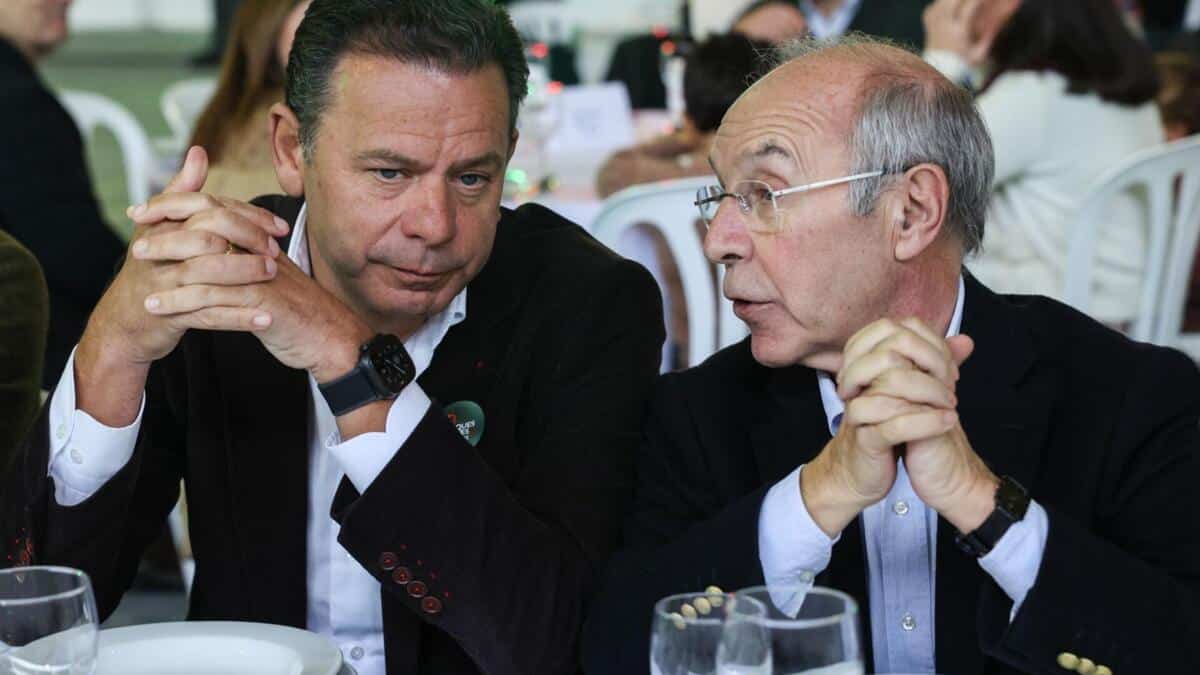
Portugal’s prime minister Luís Montenegro hit the presidential campaign trail today in support of his PSD party candidate, former party leader and long-term political commentator Luís Marques Mendes.
His message was very much along the same (failed) vein of PS Socialist counterpart José Luís Carneiro: “don’t spread your votes around; vote tactically”.
“We cannot fall into the trap of dispersing votes and being tied to not having good choices in the second round,” Montenegro told a lunch of party faithful in Batalha. “We must concentrate our vote on Luís Marques Mendes right now.”
It was an easy message to impart: the prime minister was addressing ‘hundreds of supporters’, writes Lusa. Thus they may already have decided to vote for Marques Mendes.
Montenegro’s concern is that people voting for ‘moderate socialists, liberals, social democrats and Christian democrats’ will divide the vote so much that Marques Mendes will fail to reach the second round.
The 68-year-old represents “a safe haven”, the PM told his audience, whereas the dispersal of votes – voting for example for Iniciativa Liberal’s João Cotrim de Figueiredo, or PS Socialists’ António José Seguro – could mean that neither candidate (nor Marques Mendes) gets into the second round (which is looking ‘inevitable’ as no poll shows any of the ‘favourite’ candidates likely to scoop more than approximately 20% of the votes, when 50% is needed to ‘win’).
José Luís Carneiro has already tried to persuade left-wing contenders to throw in the towel in favour of Seguro, suggesting Seguro is the only candidate of the left with a fighting chance. No-one took him up on the idea.
Now Luís Montenegro is trying the same, with the same veiled warning that if people do not vote tactically (and vote for his party’s preferred candidate) then the second round will be (as most polls have predicted, between the two ‘anti-systemic candidates’: CHEGA leader André Ventura and former Admiral of the Fleet Henrique Gouveia e Melo).
Mr Montenegro did not actually name Ventura or Gouveia e Melo. He simply spoke of ‘populists’ “whether they come from civil society and sometimes even from youth movements, or whether they are populists who come from a more disguised or militarised space”.
“We want the moderate space of social democracy, Christian democracy, moderate socialism and liberals to be in the second round (…) to win the second round,” he stressed.
Thus “this is not the time to distribute the vote based on sympathies” or “momentary impulses (…) If we fail to elect Luís Marques Mendes in two weeks’ time, we will not be able to correct that later” he added.
This was the first official day of the campaign, and the PSD president was keen to stress that by electing Marques Mendes people would be electing a man with a similar background to outgoing President Marcelo – a man whose two five-year mandates have not shown any evidence that his political leaning have “created any problems for the country”.
The prime minister stressed Marques Mendes’ impartiality and independence, saying that he has the best qualities to be “an arbiter of the political game, of the interdependence of public powers, of the relationship between the public sector, the private sector and the social sector”.
“Before my role as president of the PSD and my current role as prime minister, I am, in fact, a friend of Luís Marques Mendes, a friend who has known him and his family for many years,” he added.
However, this friendship is not “an indication of an easy relationship between the prime minister and the president”.
“That is not the criterion that Luís Marques Mendes will have. The only criterion he has in the exercise of public functions – and I know this from my own experience – is the criterion of the interest of Portugal, the criterion of the collective interest,” Montenegro concluded (which, to be fair, is the criterion that current candidates would say they too espouse).
The presidential elections are scheduled for Sunday, January 18, with the almost inevitable second round (between the two figures who poll the most votes) due on February 8.
Source: Lusa