A week after the world’s press featured a lavish military parade in Beijing involving China’s president Xi Jinping, and Russian and North Korean counterparts, Vladimir Putin and Kim Jong-un, Portugal’s prime minister Luís Montenegro has flown to the Chinese capital for an official visit, including an audience with President Xi tomorrow.
Reports make much of the fact that President Xi “rarely receives foreign prime ministers”.
The meeting is all the more notable for the fact that last week’s military parade was viewed in the west as a show of force very much ‘against the west’. Europe’s head of diplomacy Kaja Kallas described the event as a “direct challenge to the international rules-based order”.
Mr Montenegro is travelling with a delegation including the ministers for foreign affairs and the economy, and the president of AICEP, Madalena Oliveira e Silva.
Asides from his audience with President Xi, the Portuguese PSD leader will be meeting with president of the Popular Chinese Assembly, Zhao Leji, and later have a working meeting with the Chinese prime minister Li Qiang, where a number of “juridical instruments” are due to be signed.
How involved in trade this visit is will no doubt become clear in the future.
Afterwards, the Portuguese delegation is going on to Macau and finally to Japan.
In all, the trip will take four days – and marks the first time a Portuguese politician has flown to China since before the pandemic. Indeed, it has been almost 10 years since former prime minister António Costa visited China.
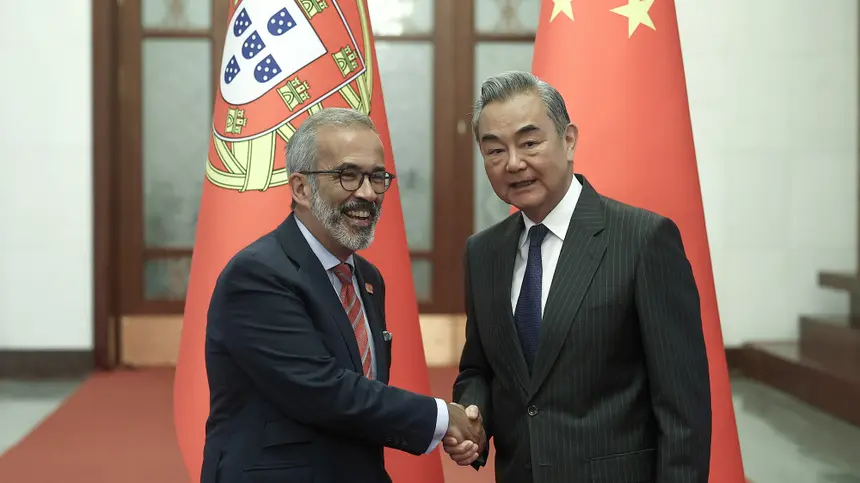
Today, however, another potential reason for the trip became clear as minister for foreign affairs, Paulo Rangel, met with Wang Yi, his counterpart in Beijing, and highlighted “the unique role that China can play in persuading Russia to reach a negotiation commitment with Ukraine”.
China’s position in this war has always been an issue, in that it is clear that Chinese equipment is being used in the legions of ‘kamikaze’ drones attacking Ukraine from Russia – and the country’s ‘friendship’ with Russia is frequently referred to by Mr Putin himself.
But it is also clear that China would be happier to see the war come to an end, for its own reasons. Thus, Mr Rangel’s statements today could be significant.
He described the relationship between Portugal and China (which already has so many economic interests in Portugal) as “quite calm”.
“It was a meeting that went very well, in which there was a great convergence of views on the issues that we need to bring to the international agenda, and in which there is a good relationship, a very relaxed relationship between Portugal and the People’s Republic of China,” Rangel said
In his brief opening remarks at the meeting – open to the media – in the Great Hall of the People, Wang Yi defended the importance of the “multilateral system, centered on the United Nations and international law.”
According to the simultaneous translation of his speech, Wang Yi argued that the current international situation “makes dialogue and cooperation more urgent” and highlighted Chinese President Xi Jinping’s Global Governance initiative, “working together for human progress.”
“I hope and believe that the Prime Minister’s visit will promote progress in bilateral relations and address challenges,” said the Chinese minister.
When asked how the defence of multilateralism advocated by both ministers fits in with the meeting in Beijing between Chinese leaders Xi Jinping, Russian Vladimir Putin, and North Korean Kim Jong-un, at a military parade marking the 80th anniversary of the end of World War II in the Pacific, Rangel made a point of separating the two issues.
“We have to keep things very separate: China has always defended, in principle, multilateralism and the United Nations Charter, the position of international institutions, and even their reform,” he stressed.
The government’s effective second-in-command state that Portugal “is counting heavily on China to play a role of great influence in getting the Russian Federation to accept a ceasefire and a negotiation process aimed at peace” in Ukraine, stressing this is “a unique role, which few other world powers will have.”
Rangel also made a point of ‘separating the timing of the Prime Minister’s visit’ – which has been scheduled for a long time – from the military parade in Beijing last week, which drew such strong criticism from sources in the west.
“A trip to Japan was scheduled for the first half of the year and one to China for the second half of the year. Due to the (early legislative) elections (called in May), we had to squeeze things in; we have local elections, we have presidential elections,” he explained. In the meantime, Japan has also suffered its own form of political crisis, with prime minister Shigeru Ishiba resigning over the weekend. “We don’t know if this will still have any impact on this visit, but it probably will,” Rangel conceded.
The Portuguese delegation’s four-day schedule will also see stops made in Tokyo and Osaka.
Source: LUSA