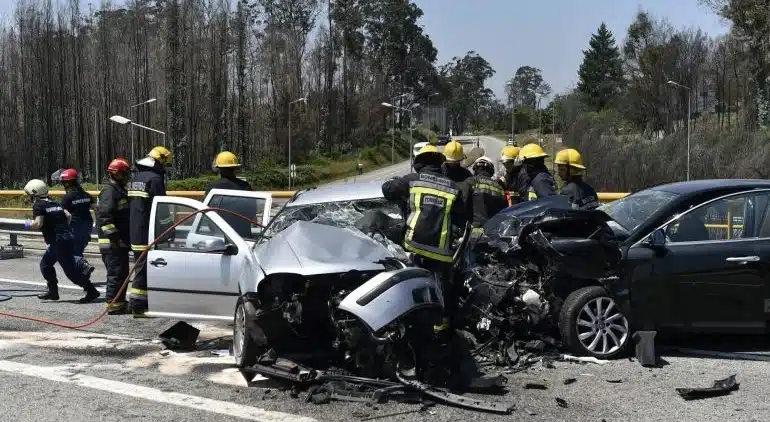
European Transport Safety Council describes deaths on Portugal’s roads as “steady trend”
Portugal ranks among the worst European countries when it comes to getting to grips with deaths on the roads.
While most countries have made progress over the last decade, Portugal has maintained a “steady trend” with figures remaining “virtually unchanged”, in the words of state news agency Lusa.
“The ETSC’s annual Road Safety Performance Index (RSPI) report, released today, indicates that Portugal recorded a 0.6% reduction in the number of road deaths between 2014 and 2024, from 638 to 634 deaths.
“This performance highlights an opportunity for Portugal to improve its position relative to the European average, which achieved a 17.2% decrease over the same period”.
The ETSC is an independent, non-profit organisation dedicated to improving road safety and advancing transport in Europe, of which Prevenção Rodoviária Portuguesa (PRP) is a member.
The organisation indicates that last year 634 people died on Portuguese roads, a slight decrease from the 642 victims in 2023, representing a reduction of only 1.2%.
“These figures need to achieve an annual reduction of 6.1% to meet the European target of halving road deaths by 2030,” the index indicates.
The Portuguese road death rate stands at 60 deaths per million inhabitants, higher than the European Union average of 45 deaths per million inhabitants.
According to the report, this difference highlights the gap between Portugal and the best-performing countries in terms of road safety, such as Norway (16 deaths per million) and Sweden (20 per million).
The ETSC reports that last year there were 20,017 deaths on EU roads, a collective decrease of 2% compared to 2023, “which requires further progress toward the 6.1% annual reduction needed to achieve the EU target of a 50% reduction by 2030”.
“Only Lithuania has halved the number of road deaths in the last decade. Sixteen other countries achieved reductions above the EU average of 17%, including Belgium and Norway. However, seven countries recorded increases, such as Israel and the Netherlands”.
At the same time, Portugal maintained a steady trend, according to the same document that Prevenção Rodoviária Portuguesa (Portuguese Road Safety) released.
In addition to stagnation in the number of deaths, the index shows that Portugal faces “a worrying increase in serious injuries”, which rose by 24.4% between 2014 and 2024, a trend that also runs counter to “European efforts to reduce accidents”.
Given these results, PRP warns of the need for Portugal to step up investment in road safety, and speed up the implementation of preventive measures, stressing that “the country must end the stagnation of the last ten years and align itself with European standards and fulfil its commitments under EU transport policies”.
The report “serves as a clear warning: Portugal can strengthen its road safety measures and align with its European partners in protecting citizens on the roads by embracing a paradigm shift in its approach,” says PRP’s vice-president quoted in the statement.
In 2023, the National Road Safety Authority (ANSR) submitted its Safety Strategy – Vision Zero 2030 to the PS government of the time, aiming to reduce the number of deaths and serious injuries on the roads by 50% by 2030. The subsequent AD government received the document, and approval is now said to be pending. ND
Source: LUSA