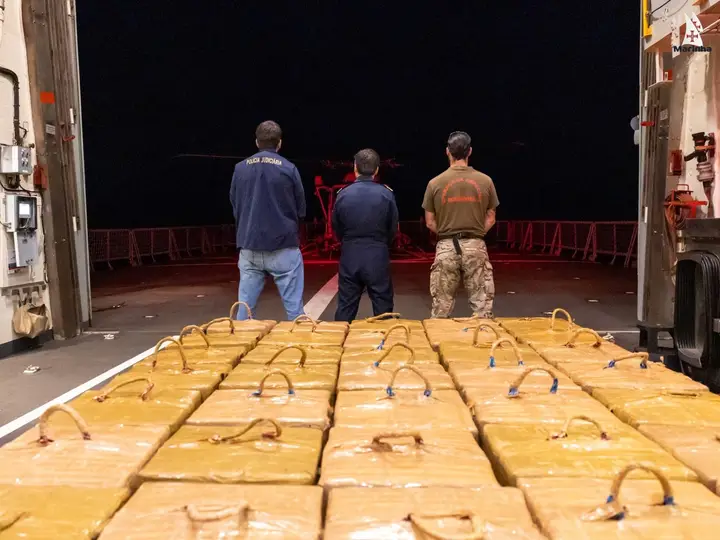
Two fishing boats transporting almost eight tons of cocaine have been intercepted by the combined forces of PJ criminal police, the Portuguese navy and the airforce in an operation that took place 1,000 nautical miles from Lisbon, between the archipelagos of Madeira and Azores.
The haul, in the hands of 10 ‘foreign citizens’ (namely Brazilians), is described as the largest ever apprehension of cocaine by Portuguese authorities.
Coordinated by the PJ’s Narcotics Trafficking Combat Unit, Operation Renascer originated from information sent by Lisbon’s Maritime Analysis and Operations Centre – Narcotics (MAOC-N), which reported a possible drug shipment by sea, already underway and destined for Europe.
According to a joint statement released today from the various forces involved he operation “deployed a vast array of resources from the Navy, belonging to the Naval Component of the Force System, the National Maritime Authority, the Air Force, and elements of the Judicial Police, to intercept the vessels and prevent them from transferring all the bales of cocaine to high-speed vessels” mid-Atlantic.
The investigation also involved collaboration with the Brazilian Federal Police, the US Drug Enforcement Administration (DEA), the US Joint Interagency Task Force West (JIATF West), and the UK National Crime Agency (NCA).
Five of those arrested have already been heard by a judge in Funchal, Madeira, and remanded in custody.
The joint statement refers to the fact that the cocaine will have been loaded onto the very typical looking fishing boats when they were already off the coast of Brazil. Had the drug been successfully transferred to speedboats on the high seas as intended, the boats could have pulled into any port (or returned to Brazil), showing no signs of drug trafficking ever having happened.
In a press conference today held at the PJ headquarters in Lisbon, Commander Ricardo Sá Granja, of the Portuguese Navy, revealed that the operation required covering more than 3,935 nautical miles (approximately 7,280 kilometers) and 339 hours of direct military involvement. It played out over separate phases: in the early hours of November 17, four and a half tons of cocaine were seized off one vessel, while on the afternoon of November 20 (last Thursday), authorities struck the second vessel.
“The Navy intercepted these vessels, in an operation that involved more than 210 military personnel and also had the support of the National Maritime Authority, through the Regional Command of the Maritime Police of Madeira,” Sá Granja explained, adding that the Navy has already collaborated this year in the seizure of more than 17 tons of cocaine on the high seas, notably intercepting two semi-submersibles (commonly called narco-subs) in March and October of this year.
Also present at the press conference, António Castilho, from the Brazilian Federal Police, said: “Brazil does not produce a single gram of cocaine (…), but Brazilian territory is used as a transit point for drugs, mainly destined for Africa, Europe and Asia.”
Sources: Lusa/ SIC/ PJ Facebook