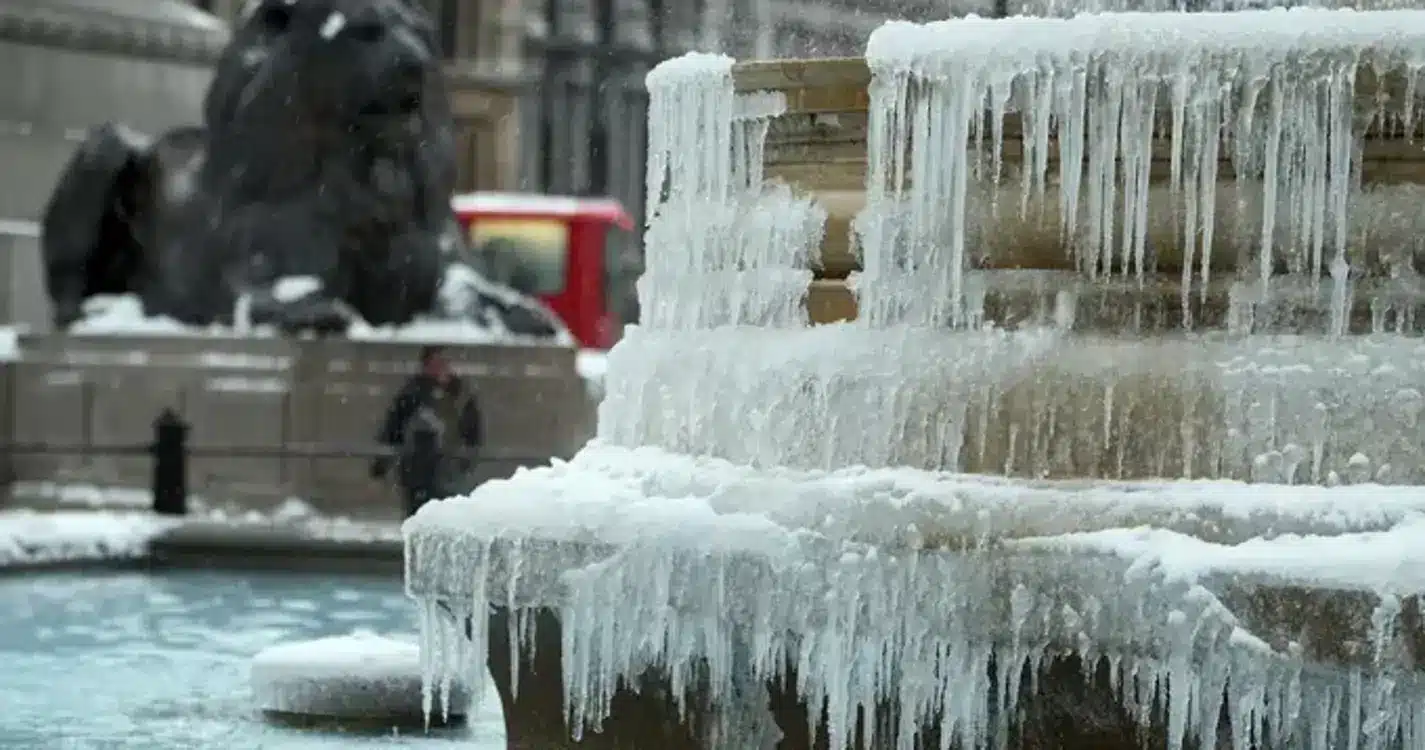
New study points to northern Europe getting ‘significantly colder’
The only ‘good news’ is that Portugal doesn’t appear to be among countries identified in a study, released today, on changes to the Atlantic Ocean current known as AMOC (Atlantic Meridional Overturning Circulation). But the bottom line is still dismal.
Presented in Nice today – where policymakers, environmentalists and scientists are meeting for the third World Oceans Conference – the study predicts that winter temperatures in some European cities could drop by 15ºC and extremes of cold could reach -34ºC in Copenhagen, -29ºC in Berlin and -18ºC in Paris.
“In the UK and Ireland, extremes of cold could reach -19°C in London, almost -30°C in Edinburgh and -22°C in Dublin, with the Arctic ice sheet covering parts of the British Isles”, the document adds.
This is all down to the ‘weakening of AMOC’ (the current that regulates Europe’s temperatures by carrying warm waters northwards and transporting cold, deep waters southwards. The Gulf Stream, for example, is a key component of AMOC’s northward flow). The system that for decades provided heat and nutrients to colder regions is being weakened by global warming – which, in spite of all the conferences, policies and warnings issued, shows little sign of being effectively tackled.
With a weaker AMOC and a temperature rise scenario of two degrees above pre-industrial times, far from being visited by warmer weather, Europe is set to freeze – with an expansion of the north Atlantic sea ice pack.
There will also be an increase in winter storms, predicts the study, and greater daily temperature fluctuations.
Scientists and researchers have been warning of this kind of doomsday scenario for some time. What appears to have changed is that this study by the Royal Netherlands Meteorological Institute and Utrecht University quantifies, for the first time, what European temperatures would be like under different scenarios of the Atlantic current and climate change.
“Every fraction of a degree of global warming brings us closer to the collapse of AMOC. Our new study shows that this would take Europe to the other extreme – a future of intense cold,” says author René van Westen, stressing that the study is “another strong warning to EU policymakers that, to avoid a climate catastrophe, they must follow the advice of the scientists on the European Climate Change Scientific Advisory Board and cut emissions by 90-95% by 2040.”
Source material: LUSA