By CHRIS GRAEME chris.graeme@theresidentgroup.com
The new leader of the opposition PSD party has called upon the Government to abandon its insistence on big ticket public works projects which Portugal cannot afford.
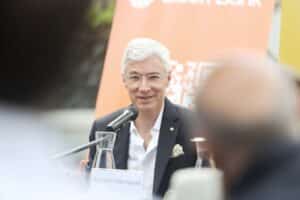
Dr Pedro Passos Coelho was addressing Portuguese and foreign business movers and shakers at a luncheon promoted jointly by the American Club of Lisbon and American Chamber of Commerce in Portugal in Lisbon last week.
He had last addressed the American Club in February 2009 when he had numerous ideas on reforming public policy. Then, in a bold move sparked by the European Sovereign Debt Crisis, he initiated direct talks with Prime Minister José Sócrates on unveiling a concerted and cooperative approach to necessary austerity measures aimed at bringing the Portuguese public deficit down to three per cent by 2013.
Pedro Passos Coelho has been calling on a reduced state role in society to only those functions that are absolutely necessary.
He believes in greater freedom when it comes to the selection of schools, medical services and a review process for individuals nominated for posts in Government agencies and companies.
He also insisted that Portugal needed to reduce the weight of its public sector and increase its competitiveness.
Pedro Passos Coelho began by stating that part of Portugal’s problems today was that it had not significantly adapted in the face of changes over the past 15 years.
In particular, in the past 10 years since the EU had introduced a single currency, the main inherent economic problems in Portugal had remained and got worse.
Cheap and easy financing had led to external and consumer debts while reforms were not undertaken to make the economy sufficiently flexible and robust against external shocks.
“Everything that was in the front line in terms of social and economic vulnerabilities 10 years ago has become more urgent and intense since,” he said, mentioning high external borrowing, a loss of competitiveness and productivity on the European stage on the part of Portuguese companies, the heavy weight of public expenditure, an increasingly higher level of taxation and mounting irresponsibility from leaders – party, social and company.
“For many years we seemed to be protected from these issues by the fact that we were part of the European Union club. But the recent Greek crisis showed clearly that not all member states had quite the same status neither in the OECD or the EU,” he said.
But the question was how to get out of the current economic situation without risking revolution and social upheaval.
Foreign investment
The country needed to reduce foreign energy dependency, rapidly reduce imports, particularly on oil, be more efficient in the use of energy sources, increase exports and make the internal market more competitive.
“We need to be more efficient in our internal market, export more and attract more transactional investments,” he said.
Only by this raft of measures would Portugal be able to solve its internal and external debt problems and create greater competitiveness and increase productivity within the country.
Pedro Passos Coelho admitted that it had been “difficult to reach a consensus agreement with the Government over structural reforms.”
“We had a lot of problems finding points of understanding with the Government over what was a structural problem when the Government’s understanding is that what is structural in terms of reforms has been done,” he said.
The PSD leader believes that the measures that are being taken “to stabilise the country’s public finances” needed to be followed up by “a strategy with aims and direction.”
This not only included reducing energy dependence, but also employment and justice reforms and the creation of a “simpler and more attractive tax incentive scheme to attract foreign capital investment”.
But Pedro Passos Coelho warned that measures had to be “sensible” and that the Government couldn’t go down a road that led to “social unrest and upheaval”.
“If we don’t explain to society the real situation and do something now then a large part of the public sector systems, such as health and education, will start breaking down and it will be the most vulnerable in society that will face the most difficulties,” he warned, calling on both union and industrial leaders to support the necessary austerity measures which may have to be increased.
1″>news