By CHRIS GRAEME chris.graeme@theresidentgroup.com
If Portugal doesn’t start exporting goods and reducing imports and reliance on imported energy, her external debt will reach 230 billion euros by 2013.
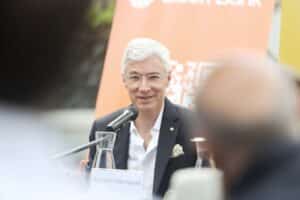
This was the stark warning from economist Dr Henrique Medina Carreira at a lunch organised by the British-Portuguese, South Africa and German chambers of commerce in Lisbon on Monday.
This imbalance resulted from a lack of coordination between public demand and private demand, as both the Portuguese State and private sector spent more and borrowed more than it was earning from transactional goods receipts.
In other words, Portugal was spending too much on the back of loans raised on the international financial markets to fuel internal demand.
And with the disappearance of the Escudo and the capacity to devalue the currency, Portugal’s productivity grew little as she was unable to sell traditional goods abroad in an increasingly competitive market.
Between 1974 and 1986, the economy grew 2.5 per cent per annum, between 1986 and 1995 it grew 3.6 per cent and between 1995-1999 1.9 per cent. On average over the 35 years, the economy grew by 2.5 % per annum.
This is in stark contrast to the 1960s, the end of the Salazar years, when the economy was growing at an accumulated rate of 106 per cent for the decade.
From 1986 until Portugal joined the Euro the limitations on political powers as a consequence of joining were not that great.
The main consequence was losing complete border and customs autonomy.
That period 1986-1999 was relatively favourable, the average growth rate of 3.6 per cent predominated while the price of crude fell from 1984 onwards which was “very significant” and there was a growth in the economy which favoured the country.
With increased foreign investment from 1986 and Portugal’s joining the EC there was also an increase in exports.
But the enlargement of the 27 EU Member States following the collapse of the Soviet Union, with the entry of new states in central Europe, began to bring disadvantages to Portugal.
“These industrialised countries had highly qualified work forces, low labour cost regimes and an organisation that was superior to Portugal’s with consequences on investment attractiveness.
“Many of the companies that had been operating in Portugal then headed for this central European area,” said Medina Carreira.
“This new phase of Capitalism basically meant the absolute unfettered and free circulation of capital, production and goods, which is why capital investment has been flying to countries where the returns are greater,” he added.
“This means that if we don’t have the right conditions in terms of attracting investment, we’re excluded internationally and this is one of the most serious problems we’re facing and is something we haven’t been able to resolve,” he said.
Portugal’s entry into the Euro was the single most decisive factor on what has been happening in the country over the past 25 years.
“We lost the Escudo which meant we couldn’t emit currency or devalue it in times of crisis. It also meant an end to independent, autonomous interest rates with the Exchange Rate Mechanism and the Euro.
“The Exchange Rate Policy was therefore the heaviest consequence for Portugal because Portugal could no longer, like many countries still do, devalue the currency to boost exports and competitiveness. We also lost budgetary and deficit autonomy with the EU’s Stability and Growth Pact agreement,” he said.
The Private Sector, which should, together with the State, have been regulating things, spent more because the interest rates were low leading to internal demand going through the roof with grave consequences on Portugal’s External Debt.
In 1996, the external debt stood at eight billion euros, now it stands at 190 billion euros and will rise to 230 billion euros by 2013.
In conclusion, he said Portugal simply isn’t producing anything: computers, cars, oil, natural gas and now even food products are all imported.
Internal demand cannot alone satisfy economic growth and generate wealth. Only external demand can save Portugal from a slow and inevitable decline, Medina Carreira said.
1″>news