The retrial of six defendants in the case of the collapse of a municipal road between two quarries, killing five people, has been scheduled for April 7.
This means that more than seven years since the tragedy prosecutors are still pushing for ‘justice’.
As the final arguments of the original trial heard, “justice will only be done if all six defendants are convicted” – but this did not happen, due to what appeal court judges in Évora have agreed was “an irreconcilable contradiction in the reasoning behind the decision and a clear error in the assessment of the evidence”.
The six facing trial were ‘acquitted’ almost two years ago. Judge Karolen Ramos da Silva Dias did not accept the public prosecutors case that the former mayor of Borba, António Anselmo, his then vice-mayor, Joaquim Espanhol, employees of the Directorate-General for Energy and Geology (DGEG) Bernardino Piteira and José Pereira, the company that operated the quarry and its technical manager were all guilty of homicide by omission, and violation of safety rules, because “they all knew’ about the “serious danger” of the EM255, but abjectly failed to safeguard the public interest.
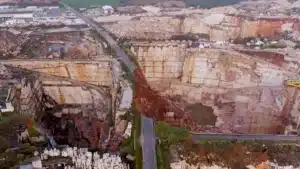
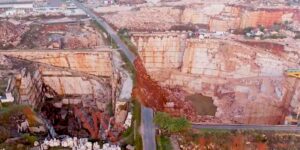
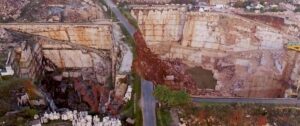
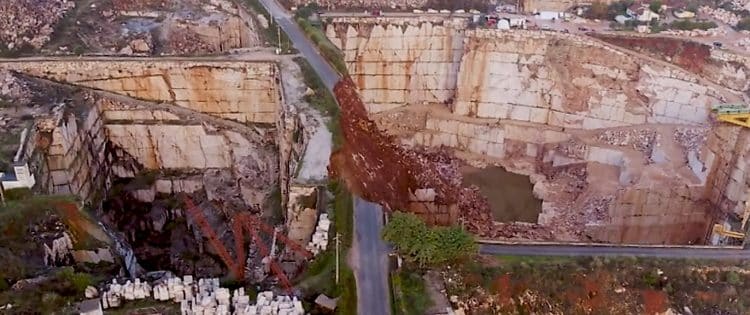
It was on November 19, 2018 that a 100-metre stretch of the EM 255 collapsed between Borba and Vila Viçosa due to a large volume of rocks, marble blocks and earth sliding into two quarries – one active, the other not.
The accident caused the death of two workers from a marble extraction company – in the quarry that was ‘active’ – and three other men, occupants of two vehicles that were following the section of collapsed road and fell into the water plane of the quarry that was not active.
The families of the deceased have already been ‘compensated’ by the state to the tune of around €1.6 million. The state has since filed an administrative action in the Beja administrative and tax court to recover this money (should culpability be proven).
This new retrial has several sessions ‘booked in’ until June 16, and will be questioning witnesses who testified in the first trial, including local government officials, marble industry business owners and experts, among others.
Source material: LUSA