As yet another political hot potato looks like being bundled unceremoniously under the carpet, the Resident asks ‘just how surreal can things get in Portugal’?
Scandals have become Portugal’s stock-in-trade. They are now so commonplace that at the weekend the country’s prime minister could be heard exhorting the nation to “make more babies” as he sat alongside one of the key figures in the Banco Espírito Santo financial debacle.
That José Maria Ricciardi could have been chosen to address a forum of business people in Vilamoura – tainted as he is as a former administrator of the disgraced bank’s investment arm – is extraordinary. But the fact that someone actually placed him at the same table as the country’s prime minister beggars belief. This is certainly the opinion of PCP leader Jerónimo de Sousa (read panel).
Passos Coelho, fresh from his own political scandal – concerning alleged “illegal” payments when he was an MP in the late 90s – did his best to cope with the situation, while Ricciardi, wrote Expresso, “remained silent”.
Even so, the PM and his wife beat a hasty retreat, leaving the function before fado singer Gisela João was brought on to complete the evening’s entertainment.
The message the unlikely place-setting sent may have been what an increasingly ill-at-ease President Cavaco Silva was referring to in his Day of the Republic speech on Sunday, when he warned that the Portuguese people were among the most “dissatisfied” with their political regime in Europe.
Cavaco’s comments were delivered as the country’s latest scandal came in for widespread ridicule.
After a decade of news stories alleging high-level corruption, coalition MPs have concluded that no bribes can be proved to have changed hands in the (in)famous billion-euro purchase deals of German submarines and defence equipment.
MPs “block investigation into €40 million worth of bribes”
Amid opposition howls of “whitewash”, “farce” and “unseemly haste”, MPs heading the parliamentary inquiry into alleged illegalities have delivered a preliminary report that completely absolves everyone of any wrong-doing.
Despite the fact that a German court has already found businessmen involved in the deals guilty of corruption – and in the face of endless allegations involving over €40 million worth of high-placed bungs, including at least €5 million to key members of the Espírito Santo family – the report compiled by the majority parties sitting in on weeks of “grilling” has ruled that all allegations were lacking in proof and larded in innuendo.
Delivering the 446-page report, PSD MP Mónica Ferro presented 37 conclusions which will have left nearly everyone involved sighing with relief. The only damning point she raised was the fact that it is “especially frustrating” that there has been a “low level in execution” of the various contra-deals agreed in the multi-million euro defence contracts.
Presenting the story under the headline “MPs block the discovery of bribes”, the nation’s gutsy tabloid Correio da Manhã devoted a whole section of its double-page spread on Saturday to the “trail of commissions paid to offshore companies” the moment the government’s contract to purchase two submarines came into effect on September 20, 2004.
According to CM, €21 million was paid straight away by the winning German Submarine Consortium to Escom UK (the company then owned by the Espírito Santo financial empire). Most of this was transferred to an unknown bank account in the Cayman Islands the next day.
A second payment of €1.2 million was paid to Escom UK in July which again the next day was transferred to an unknown account, with the reference “Escom Espírito Santo Com”.
A further €5 million was then transferred from Escom UK to Switzerland, claims the paper. This money is reported to have gone to five members of the Espírito Santo banking clan, of which the former head honcho –Ricardo Espírito Santo Salgado – is currently on €3 million bail and facing all manner of fraud and embezzlement charges.
CM’s trail then gets a little fuzzy, mentioning transfers from Escom UK to unidentified accounts in the Bahamas and Dubai.
National daily Público was more reserved in its reporting but played with the word “portas” (meaning ‘doors’ in Portuguese).
Paulo Portas, Defence Minister at the time, has always been under opposition suspicion over the deals, and Público quoted Socialist MP José Magalhães as saying: “We have always been stopped from going through doors, literally.”
Público suggests Magalhães stressed the word ‘literally’, “almost forcing the change of the little ‘p’ in his sentence to the capital ‘P’ of the proper name”.
But, all are agreed, this latest government report is almost certain to be carried when MPs get to vote on it this Wednesday (October 8).
Will it bring an end to the matter? Draw a line under the scandal that has festered throughout Portugal since the submarines were purchased? If opposition MPs get their way, it most certainly will not.
Likening the report to “a French cheese full of very large holes”, José Magalhães told Jornal de Notícias that the next step is to upload online all the evidence presented to the parliamentary inquiry, “to appeal to citizens to analyse it”. A special form will be supplied, so that “readers can leave their contributions”, he added.
Meantime, he told CM, now that it is known that commissions were paid to the Espírito Santo family, “the case will be extended to the commission of inquiry into Banco Espírito Santo, which should start soon”.
As José Maria Ricciardi was welcomed back into the fold of big business in Vilamoura last week, he remarked to journalists that he was “entirely available” to answer any questions to the upcoming inquiry – but, remarked CM, “he refused to comment on the case of commissions in the negotiation of the purchase of the submarines”.
And so the scandal merry-go-round continues, with the clock ticking towards next year’s general elections, and bankers strategically placed alongside ruling politicians.
Politics that “favours speculation, back-room deals, illicit enrichment and systematic extortion”
The significance of last weekend’s business dinner was not lost on Communist leader Jerónimo de Sousa, who pronounced himself “scandalised”.
Forever to be relied upon for plain-speaking, the secretary general of the PCP declared it was simply another “example of the politics of nepotism and promiscuity that remain exempt from punishment in Portugal”.
To see Ricciardi “side-by-side with Passos Coelho, being treated as if he was an unsullied banker” was simply a “complete scandal”, he told a meeting of party faithful in Loures – the result of a political system “that favours speculation, back-room deals, illicit enrichment and the systematic extortion of the country’s, and people’s, resources”. It is as if the country was “in the hands of a species of Sorcerer’s apprentices who cannot control their actions or the consequences of their decisions”, the political pugilist railed.
Four months on since the withdrawal of the troika, and “nothing has changed”. Everything has been launched into “accelerated degradation, disorganisation and destabilisation”, he concluded.
As if on cue, stress fractures have once again opened up in the PSD/CDS-PP coalition. Very much like the fractures being witnessed in the UK between the Conservatives and the Lib Dems, Passos Coelho and Paulo Portas have been publicly contradicting each other just a little too often.
The new issue centres on the reduction of income tax for families. Paulo Portas claims the government is committed to reducing the IRS tax burden, while Passos Coelho has curtly said he can’t see the government has room for manoeuvre.
Rumours of rupture between the two leaders are commonplace. This is just the latest – and comes when both are trying to ward off separate personal scandals.
Passos Coelho’s centres on income received and not declared to the tax authorities, and Portas, as ever, is still heavily implicated in the submarine controversy due to the fact that he was Minister of Defence in the years under scrutiny.
By Natasha Donn news@algarveresident.com
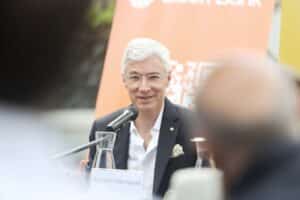
Photo: Prime Minister Pedro Passos Coelho during the 3rd Algarve Business Forum, under the title ‘The paths for Portugal’s growth’, held in Vilamoura on October 4