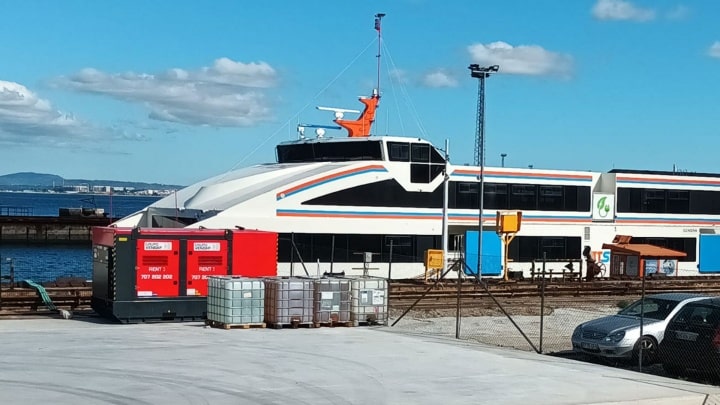
Services between Seixal and Cais de Sodré “continue dogged by controversies”
Agonising months of ups and downs with Lisbon’s electric ferry fleet have found a new explanation, if not any useful solution: they were not constructed for the work they are currently struggling to perform.
“They should be sailing on lakes”, writes tabloid Correio da Manhã today.
Tidal rivers like the Tejo are thus proving exceptionally challenging – as ferry passengers have found out to their intense frustration.
Back in 2021, the €52.4 million purchase of 10 electric ferries quickly ran into trouble when it became clear that the state-owned Transtejo ferry company had only bought one ferry complete with a battery, and nine others without.
At the time, it was likened to buying cars without engines, or bicycles without pedals.
Fast-forward rapidly to the point where the ferries started operating, and the woes sadly persisted.
Right now, there are six of the 10 ferries purchased from a Spanish company already in Portugal, but only three of them ‘are working’.
Cegonha Branca – the first vessel that arrived already damaged, has suffered since ‘serious damage’ due to coming into contact with a jetty on a day of ‘bad weather’.
Another two ferries “are unable to navigate for technical reasons”, says CM.
Battery charging is one of the greatest problems. It became clear last year that the problem with buying boats without batteries was that when batteries arrived they were not ‘compatible’: timetables have had to be rearranged, and there is still a major issue surrounding how long it is taking to charge these boats, straining relations between Transtejo management and the municipality of Seixal, whose residents are the people suffering the most.
As Seixal mayor Paulo Silva has told reporters, the population “deserves respect and dignity in public means of mobility”.
Indeed, mayor Silva has come to the conclusion that “the whole electric boat project wasn’t properly considered by the authorities”
One option used by Transtejo has been to use “other boats to mitigate the lack of electric ferries”. Other being diesel-powered – while Seixal residents have essentially decided to “abandon the use of ferries”, according to mayor Silva, and “overloaded the Fertagus rail service” (which of course, has not been running through the strike by railway unions…).
Another moot point of this ‘adventure with green power’ is that the boats have been charging their batteries via diesel-powered generators.
Source material: Correio da Manhã