Tourism ‘leaders’ are expecting anaemic growth through 2026 – albeit certain regions, including Porto and Madeira, should do considerably better.
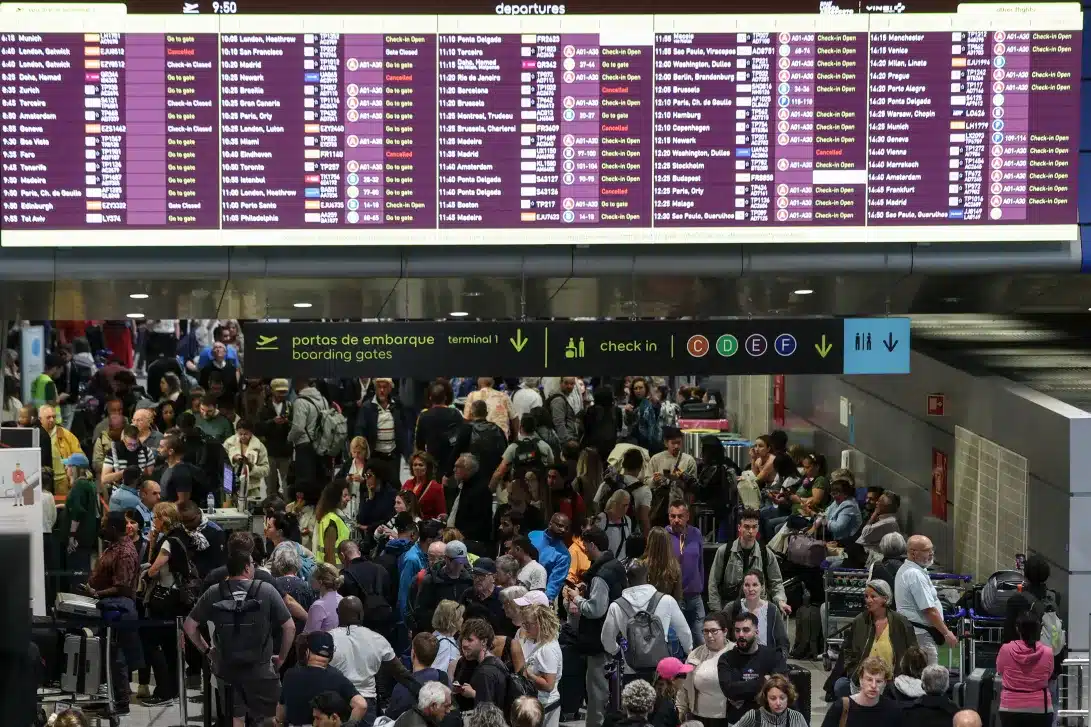
The chief concern, explains Expresso, are the limitations posed by Lisbon airport – operating well beyond capacity, and poorly.
Bernardo Trindade, president of the Portuguese hoteliers association (AHP), forecasts a year in which the same clients will be returning for a greater number of hotels. This will lead to “less occupation per hotel, and doubts about improved prices”, he believes.
“After 2025 saw occupancy grow a little more than 2% on the year before, the tourism sector faces a challenging 2026 – which could be an alert for the national economy”, warns Expresso.
“In 2024, according to Statistics Portugal, tourism accounted for 16.6% of GDP, equalling the maximum achieved the year before. The sector represents around 6% of the employed population in Portugal. In the first half of 2025, exports in terms of services increased by 4.8%, of which 2.5 percentage points (in other words, more than half) came from tourism.
“With the economy still largely anchored in this sector, the government projects a 2.3% growth in GDP in the State Budget for 2026.”
But then one has to factor in the opening of 2,400 new hotels/ pensões/ tourist residences. Will this be a case of ‘the more the merrier’ or ‘overkill’?
Cristina Siza Veira clearly believes in the latter: “Because of the restrictions of the airport, and with the new units of accommodation entering the market, we are clearly entering a plateau in Lisbon where we won’t see growth, an increase in hotel occupancy or prices, for some time…”
Reading between the lines of Expresso’s – and other articles recently – it is almost as if there is a pressure building to force the government to ‘contingency arrangements’ from an airport point of view while the country awaits the construction of the ‘new airport’ at Alcochete (which doesn’t appear to be moving at all, and will definitely take another decade to come into being). ANA airports authority, after all, has always favoured the environmentally catastrophic Montijo option over Alcochete due to the purely financial ‘advantages’. It could be now that business/ tourism – even potentially the government – do too.
Expresso continues in this vein, saying that the enthusiasm shown by Americans in Portugal, “particularly for hotels in Lisbon, and Porto (thanks to the direct air links that have been extended to the Algarve)” represent “a beacon of hope for the sector when it comes to the desired growth in revenue – but the new European system of border control that has been implemented throughout the country’s airports, obliging the presentation of biometric data by passengers from non-EU countries, has generated situations of chaos, with queues of several hours waiting to enter the country, with particular impact on the already saturated Lisbon airport.”
Thus, for hoteliers, “the greatest problem (to achieving growth) could come from airport infrastructures”, says the paper which has also managed to find “an official source for the Pestana hotel group” to say that “the experience of people using Portugal’s airports: Lisbon all through the year and in the Algarve at high season, is very bad – and this could have an impact on demand in the future”.
Raul Martins, owner of the Altis hotel chain, cuts straight to the chase: “a provisional airport at Montijo, just for flights from Europe” could “complement the offer of Lisbon’s Humberto Delgado terminal” and create the possibility for tourism to receive yet more visitors, and increase prices, he tells Expresso.
Suddenly, the absolute misery inflicted on passengers through recent months falls into a chilling perspective: this could all have been a form of chess game played by those who never accepted the rejection of Montijo (on the basis that it would inflict further misery on local communities and compromise an important birding wetland).
Seeking to use the government’s language of promoting economic growth, the incrementally building pressure appears to be focused on getting what ANA airports authority has always wanted.
Raul Martins goes on to insist that without Montijo, the sector will “enter a spiral of low occupancy without being able to increase prices”.
Expresso also talks to Pedro Costa Ferreira, president of the Portuguese association of travel and tourism (APAVT), who also describes Lisbon airport as “the elephant in the room” offering “insupportable conditions” for all those who frequent it.
Coming as it does at the start of the year, we can only expect this pressure to find a short-term solution to Lisbon airport’s obsolescence to continue to build.
The government is also juggling with the ‘soap opera reprivatisation’ of flag carrier TAP, and the drawing up of its Tourism Strategy 2035.
Source: Expresso