By Michael Bruxo news@algarveresident.com
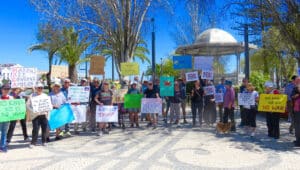
Thousands of Portuguese citizens made their way to Lisbon and Porto to join protests organised by the CGTP workers’ union over the government’s latest State Budget for 2014.
The budget focuses on cuts to the public sector and pensions in order to complete the country’s adjustment plan and meet the Troika’s demands.
The PSD/CDS-PP centre-right coalition government believes the new budget will help the country fulfil its agreement with the Troika and reduce its public deficit to 4% of GDP next year.
However, the economic hardship these decisions place on the shoulders of the population – particularly pensioners and civil servants – has led to uproar.
“Let’s fight so that the measures in this budget are declared unconstitutional,” CGTP leader Arménio Carlos encouraged banner-waving protesters as they stood in the pouring rain in Lisbon, chanting: “Government – out! Government – out!”
“We came here because we want to overthrow this government which on the orders of the Troika is forcing the country backwards, without listening to the Portuguese people,” said an elderly protestor on the 25 de Abril Bridge.
A 71-year-old retired nurse waiting for a lift from one of the passing buses commented: “I would even take a plane to protest if I had to! What is important is that we get out there and say ‘enough’!”
She added: “I came to protest over the lack of respect for seniors, the government’s empty promises, and to fight for dignity and the future of my grandchildren”.
Much of the Lisbon protests took place on the bridge – one of the main access routes into the capital – with cars, buses, motorbikes and other vehicles honking noisily as passengers waved flags.
The CGTP had pushed for permission for a pedestrian protest along the bridge, but the government stood its ground and refused, citing “safety reasons”.
Even so, buses from across the country filled with outraged citizens made their way across the bridge in a cavalcade of angry protest.
Some demonstrators, like 81-year-old Silvério Carlos, agreed the whole event would have been more effective on foot – because protestors could have been more vocal.
However, demonstrators also took to the streets, keeping to the Alcântara section of the city.
Some even tried to halt activity in the port, but their attempts rapidly ran out of steam.
The idea had been to show support for dock workers who had also gone on strike, forcing many ships to dock elsewhere.
Further protests went ahead in Porto where thousands gathered on the Infante bridge chanting anti-government slogans and bringing traffic to a standstill.
The number of protestors in both Lisbon and Porto was high. Organisers claim approximately 50,000 people took part, while police put the numbers at only 20,000.
Reactions though were mixed. Some praised the demonstrations, while others said they were no solution to the country’s problems.
Among critics was president of the business association CIP (Confederação Empresarial de Portugal) António Saraiva, who acknowledged people’s constitutional right to protest and/or go on strike but questioned whether this was the right path.
“We must take a look at our country and the state we have unfortunately reached, and find new ways to overcome these issues,” he said.
Opposition parties were, not surprisingly, right behind protestors.
Socialist leader António José Seguro described the day’s events as “a clear sign that the Portuguese people will not stand by and watch” while the government “destroys employment, the economy and the country”.
Speaking at a national commission of the PS party in Vila Nova de Gaia, he explained he could not be present at the protests due to commitments as party leader but promised he would take part in other demonstrations further down the line.
And one is already scheduled.
The CGTP has called on people to gather in front of Parliament on November 1 – the day the government is expected to vote on the proposed 2014 State Budget. The aim is not just to protest against the new austerity measures, but to oppose the axing of All Saints Day as a public holiday (normally celebrated on November 1).
Public sector trade-union representative FESAP has also scheduled a civil servants’ strike for November 8, which will be joining protests planned by fellow unions.
“We want to express our complete disagreement with this situation and we will tell (public) workers that they must express their indignation in a general strike,” the trade union said.
Meantime there was still room for humour among all the resentment.
An action entitled ‘Obrigado Troika’ (Thank You, Troika), billed as a serious pro-Troika campaign, took place on Monday and revealed itself tobe a tongue-in-cheek satire mounted by the ‘Que Se Lixe a Troika’ (Screw the Troika) movement.
Protestors were dressed in traditional old-fashioned clothes, some wearing animal masks, others sporting long Pinocchio-type noses, and they suggested all manner of unreasonable ‘extra measures’ to fulfil the Troika’s demands.
The movement’s ‘real’ demonstration, publicised as ‘Não Há Becos Sem Saída’ (There are no dead ends), is scheduled for this coming Saturday, October 26.