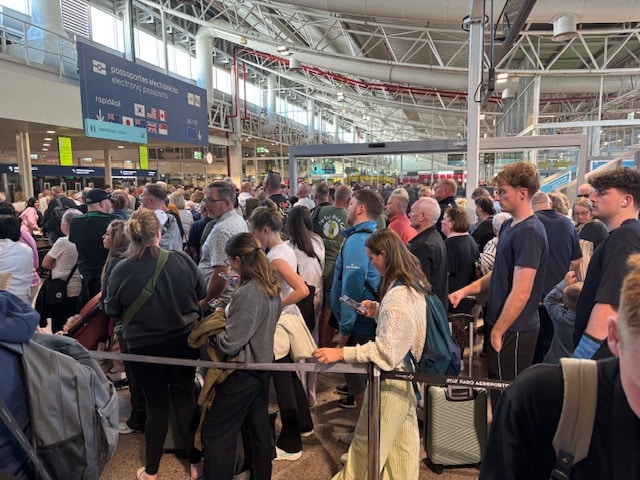
Non-Schengen passengers faced queues exceeding 90 minutes at Lisbon Airport on Tuesday, as Portuguese police acknowledged that the rollout of the European Union’s new border control system has caused major delays for both arrivals and departures.
“Today is without a shadow of a doubt a critical day,” said João Ribeiro, Deputy National Director of the PSP and head of the National Unit for Foreigners and Borders (UNEF), speaking to Lusa news agency. He confirmed that throughout the morning, travellers from outside the European Union endured long waits to clear border controls.
The disruption follows the implementation of the EU’s new Entry/Exit System (EES), which went live across Portugal and the wider Schengen Area on Sunday. The system electronically records the entry and exit of third-country nationals, logging their date, time and border post, and replaces the traditional passport stamping system used for decades.
While the Internal Security System (SSI) hailed the system’s launch as a success on Monday, conditions deteriorated sharply on Tuesday as tens of thousands of non-EU passengers passed through Lisbon Airport – the country’s busiest international gateway.
According to Ribeiro, Tuesdays are typically the heaviest traffic days for flights to and from Schengen destinations, and the new digital checks have lengthened processing times considerably.
“Looking at the period I’ve been in this role, for over a year, today is the most challenging day to date,” he said. “The volume of departing and arriving passengers is requiring an enormous effort and mobilisation of resources.”
The EES, part of the EU’s broader smart borders initiative, aims to improve security and monitor overstays among non-Schengen visitors. However, Tuesday’s chaos at Lisbon Airport highlights the teething problems facing authorities as the system scales up across Europe.