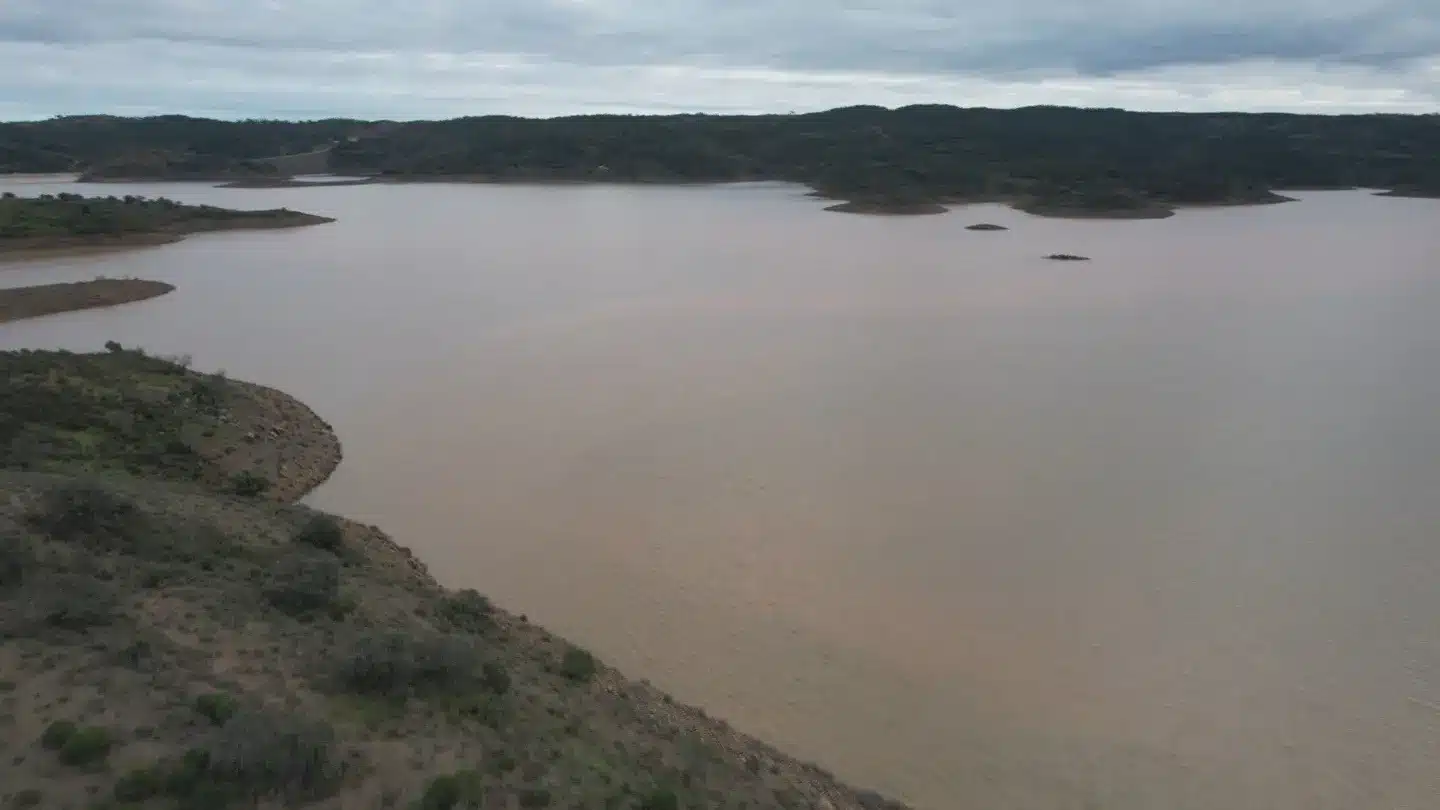
The Algarve’s dams are at an average of 72% of their capacity and have enough water to guarantee urban consumption for three to four years, president of Portuguese Environment Agency APA has said today.
José Pimenta Machado gave an update on the region’s water reserves stressing that, although the Algarve recorded “the best situation in the last 10 years” in terms of stored surface water in November, we need to remember that the drought is not over : “exemplary” efforts made to improve water efficiency must continue.
“We have to know how to manage water well to prepare for the coming years, which will certainly be years of drought and reduced rainfall. (…) Some sectors say the drought is over, but it is not over at all. It is a temporary situation; we have been lucky, but we have to prepare for the years to come,” he told Lusa.
At the moment, reserves in the region’s six dams are, on average, at 72% of their capacity, which represents 322 cubic hectometres – with the Odelouca dam standing out, “which is fundamental for the Barlavento (western) area and is at 77%”.
The main dam in the Sotavento (eastern area), Odeleite, is at 76%, which means that the two largest dams in the Algarve are at “almost 80%” of their capacity “in the middle of the wet season” when more rain is certainly expected throughout the winter.
Pimenta Machado also highlighted the volume of water recorded at the Funcho dam, located in the western region and one of the most affected by the drought, which reached 80% already this year, and has been discharging water.
As for the other dams, the Arade is at 59%, Beliche is at 68% and Bravura, north of Lagos, straggles behind at 46%.
“Storm Cláudia allowed us to recover 5%. On average, we went from 67% in the series of six reservoirs to 72%,” said the APA president.
Thus, as of November, the Algarve region is in the “best situation ever in the last 10 years” regarding water stored in dams.
Only 22 months before (January 2024) “we were in the worst situation ever” when the region was looking at “water for four to five months, no more” recalls Pimento Machado. It was this moment that prompted the government to apply measures restricting urban consumption, agriculture and tourism in the region.
And it was this moment that also highlighted the appalling state of aquifers which have been steadily depleted by the arrival of agricultural multinationals – sometimes even when they are not licensed.
A source for the ministry of the environment has told the Resident of an unlicensed plantation near Lagos that is consuming water for thousands of avocados trees “and there is nothing we can do about it! Everything is going through the courts. Until there is a decision, the water will keep sustaining those trees!”
Thus the need to “continue to use water conscientiously” and continue work being carried out to improve the Algarve’s water efficiency.
This work is an “example for the country and even at the European Union level” suggests Pimento Machado. It must continue. “We need more rain, continuously, for groundwater bodies (aquifers) to recover. They have, in fact, been greatly depleted during the drought,” he admits.
Pimenta Machado pointed to the Querença-Silves aquifer, the Algarve’s main underground reserve, as an example, which has “very low values” and a level of “less than 20%” of its capacity.
Source: LUSA