Authorities admit “no known way of stopping it…”
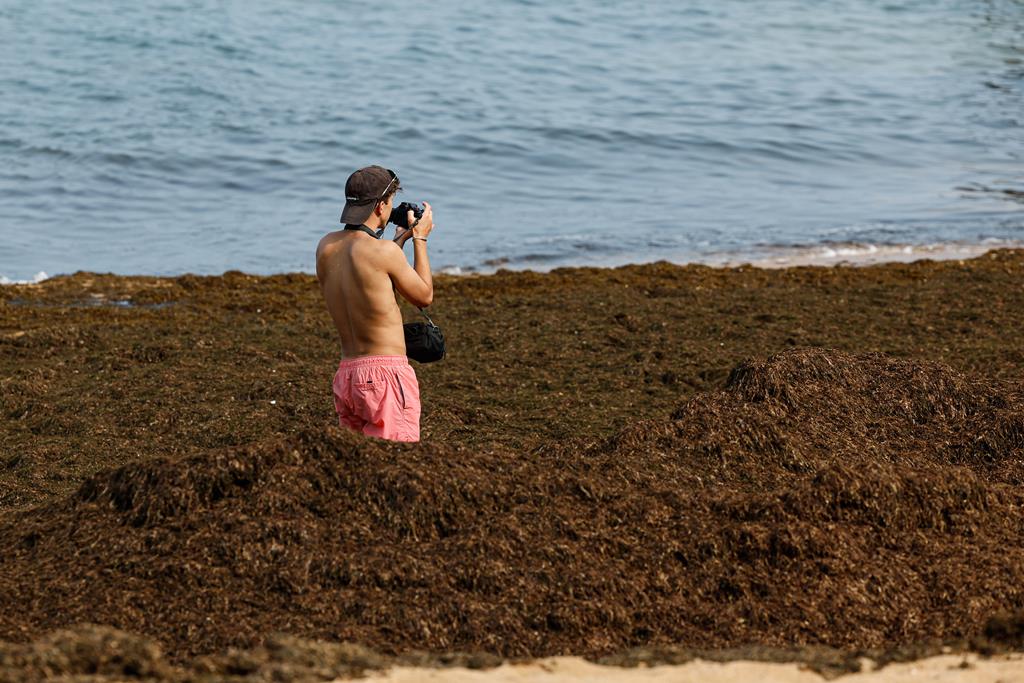
Bathers will just have to get used to the thick brown algae that has been blighting beaches in the Algarve* and Cascais. Authorities admit there is no known way of controlling it.
A study carried out by Cascais municipality admits the invasive fuzz (which stinks when dry) does have applications in the pharmaceutical industry – and there are projects for its use as a compound and fertiliser in agriculture or even in bioconstruction.
Thus, the way forwards is to investigate these to see how this increasing problem can be potentially turned to ‘good use’ – or even make money
According to a statement put out by the ministries of environment and energy, and agriculture and sea, this ‘exotic species’ of macroalgae (‘Rugulopteryx okamurae’, of Asian origin) has been spreading at an alarming rate since it was first detected in Portugal, on the island of São Miguel in the Azores, in 2019.
It has since travelled to the mainland, landing especially on the Algarve’s southern beaches and in Cascais, where two tons of the stuff was removed from just two beaches, in the space of four months.
The problem with this ‘solution’ is that it doesn’t stop the algae from returning.
Charting its arrival on the Iberian peninsula, authorities recall that the algae was first noticed in Spain, in the strait of Gibraltar, in 2015. Its arrival in the Azores four years later may have been because some of it stuck to the hulls of ships. Alternatively, the algae could have been carried in ballast water.
Whatever the details, there is now a national strategy in place for ‘the Management of the Invasive Macroalgae’.
The ministries’ statement refers to the impact the stuff has had on fishing in neighbouring Andalusia, “reducing catches of several species and damaging fishing gear” (…) local authorities spent €1.2 million on cleaning up over a nine-month period (the duration of a study carried out about five years ago)”.
While there is no evidence of risks to humans, Rugulopteryx okamurae stifles biodiversity by preventing other species from developing and by colonising rocky substrate on the sea bed. Even worse, it just keeps on growing: “no natural regression of the algae has been observed”, says the Cascais study.
Thus the government’s action plan, with measures for ‘monitoring, operational response, biomass enhancement, scientific research and institutional coordination, with the aim of mitigating ecological, social and economic impacts’.
Interventions envisaged include the removal of the algae in critical areas, the study of its use for industrial and/ or agricultural purposes, the mobilisation of regional rapid response teams and the creation of a national database with georeferenced records of the species’ evolution.
*This far the algae doesn’t appear to be building up on west coast beaches of the Algarve, as these have a much more active tide.
Source material: LUSA