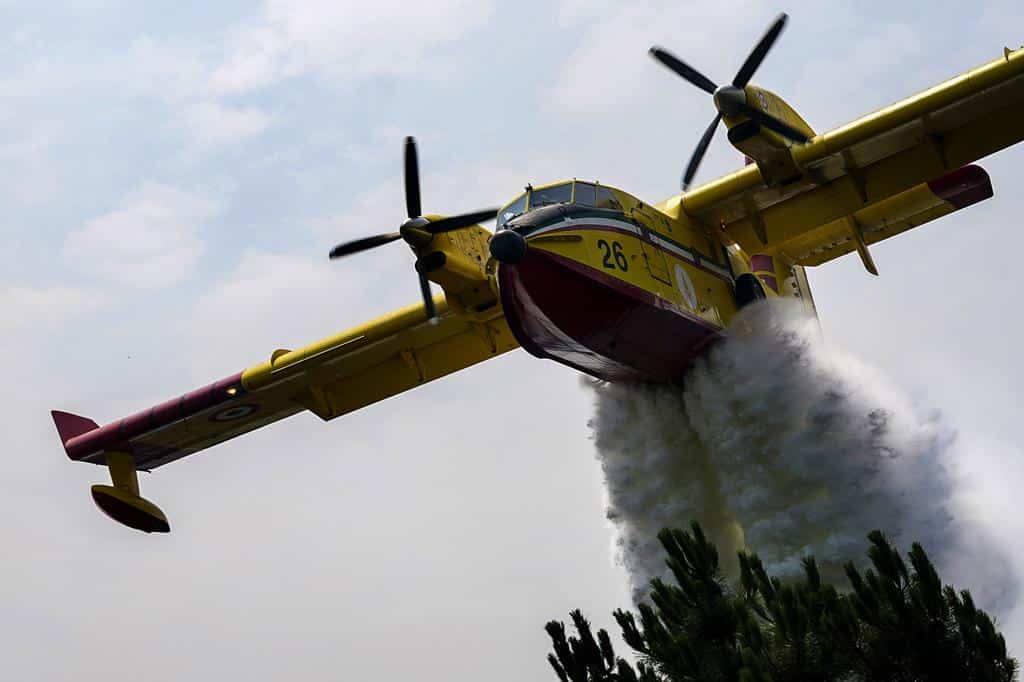
None of the country’s heavy-duty water bombing Canadair planes are operational.
Bit by bit through the summer, the aircraft have started developing faults.
In July it was a ‘ditching in the Douro’, this week it was a smoking engine over Castelo Branco. A safe emergency landing later and now we have the confirmation: “None of the firefighting Canadair planes in this country is operational”.
At a point where three serious fires are still blazing; when temperatures are higher than normal and likely to stay that way until at least Saturday, this is truly grim news – and may well see political point-making resulting.
What it does mean is that the country is ‘more vulnerable’ as these Canadair are the ‘big cheeses’ in fire combat. There are scenarios where they are too unwieldy for certain situations, but generally they are seen as ‘the cavalry’ when things are getting much too scary.
Bizarrely, on August 11 in 2022, exactly the same situation was facing the country – only on that occasion the country only possessed two Canadair.
One ‘saving grace’ is that the Air Force has already agreed to step in to make up for shortages. Their P-3C CUP+ aircraft will now be more needed than it was yesterday, albeit an experienced flyer, aeronautical engineer and former volunteer firefighter has confided in us that he seriously doubts that a large 4-engine military Lockheed P-3, designed for submarine detection, can operate safely in the low-level water bombing situations for which Canadair are intended.
The ‘good news’ since writing this report is that two replacement Canadair have arrived on loan from Morocco until the end of the week, and Avincis, the company hiring out the Canadair planes to Portugal, has already replaced one of the inoperational aircraft.
Source: RTP