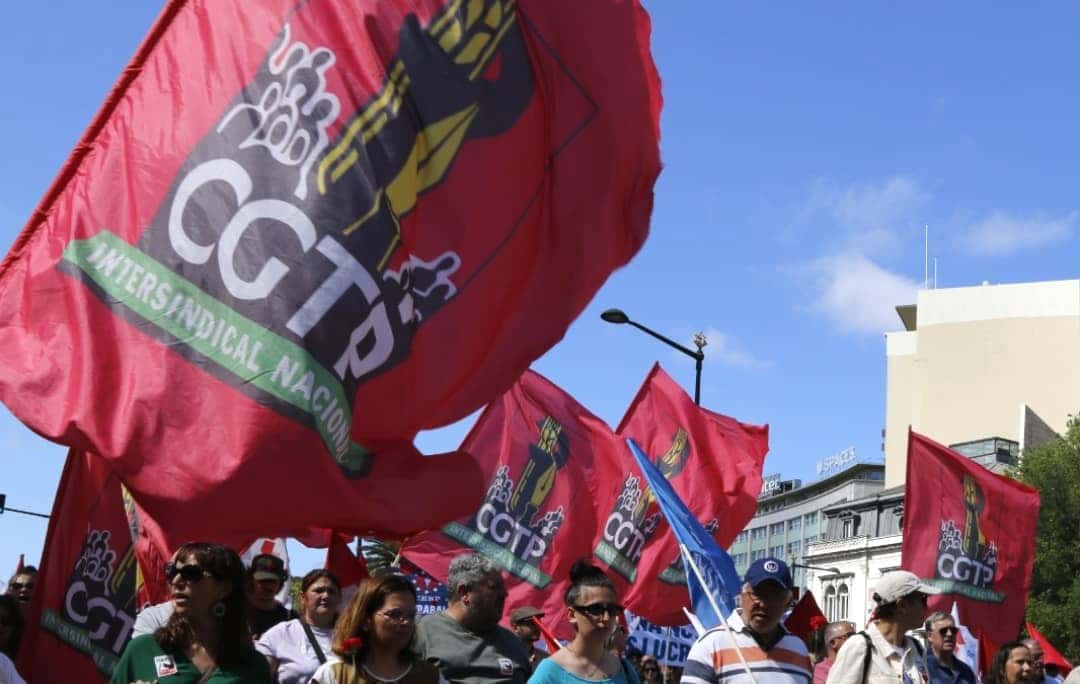
The Communist-backed CGTP union confederation has called for demonstrations in Lisbon and Porto on 20 September against the draft revision of labour legislation, calling on workers to mobilise against what it calls “an assault on rights” and an “affront to the Constitution”.
“In view of the seriousness of the contents and the government’s timetable, with meetings already scheduled for next month, the CGTP-IN considers it essential to move forward with clarifying the workers and holding a day of struggle in September, marking the rejection of the labour package and the mobilisation and action to defeat it,” CGTP general secretary Tiago Oliveira has announced.
Speaking at a press conference in Porto, the CGTP leader called for everyone to converge “in the fight to reject the labour package”.
He also defended the “demand for the repeal of the burdensome rules of labour legislation that already unbalance labour relations, unprotecting those who work”.
“The fundamental question is what starting point the government has given workers for the discussion of this labour package. And the presentation of this labour package puts workers, right from the start, in a completely unfavourable position in terms of improving their living conditions,” he said.
Considering the document to be a “deeply ideological package, which only responds to the interests of companies and large economic groups and puts workers in a fragile position from the outset”, Oliveira said that the confederation would not it.
For the CGTP, the government’s preliminary draft for revising labour legislation “attacks a wide series of rights”, containing, in particular, proposals that “aim to perpetuate and worsen low wages, promote the deregulation of working hours, multiply the reasons and extend the deadlines for precarious contracts, facilitate dismissals and limit the defence and reintegration of workers”.
In addition, the measures set out in the preliminary draft “attack maternity and paternity rights, facilitate forfeiture and promote the destruction of collective bargaining” and “attack trade union freedom and the right to strike, imposing limitations that profoundly harm these fundamental rights”.
“No less serious”, according to Tiago Oliveira, is the fact that none of the proposals put forward by the government “go towards solving problems that already exist today in labour legislation”, namely “rules that attack workers and their rights and that need to be repealed”.
In this context, the national day of struggle called for September 20 aims to “make workers’ voices heard” and “raise the level of struggle, in the workplace and on the streets”, for the demand of “more wages and more rights” and “against the rise in the cost of living, in defence of public services and the social functions of the state”.
The draft reform of labour legislation approved by the government, which still has to be negotiated with social partners, provides for the revision of “more than a hundred” articles of the Labour Code.
The changes envisaged in “Work XXI” – and which the government presented on 24 July as an “in-depth” review of labour legislation – range from the area of parenting (with changes to parental leave, breastfeeding and gestational bereavement) to flexible working, training in companies and the trial period of employment contracts, as well as extending sectors that minimum services will cover in the event of a strike.
According to minister of labour, solidarity and social security Maria do Rosário Palma Ramalho the aim is to make labour regimes “which are very rigid” more flexible, to increase the “competitiveness of the economy and promote the productivity of companies”.
Source: LUSA