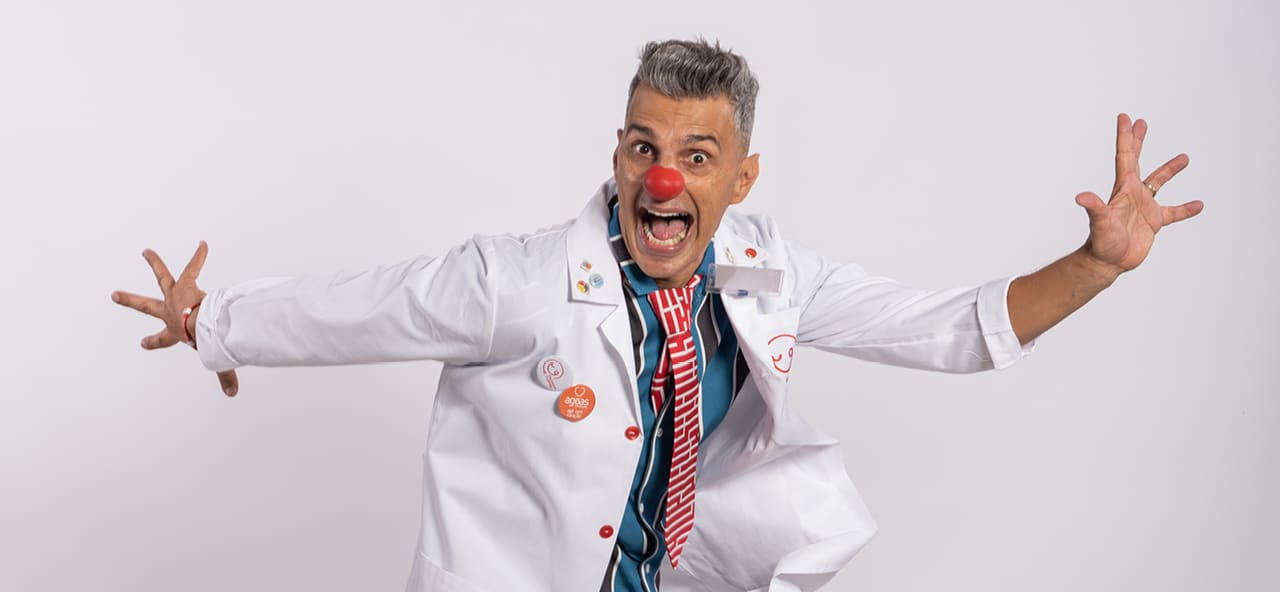
Lisbon’s Faculty of Medicine (FMUL) has teamed up with Operation Red Nose to create a new course this year, on “the art of the clown doctor”.
The 20 available places are already filled.
“The Art of the Clown Doctor in the Context of Medical Student Training” is a new curricular unit within the Integrated Master’s Degree in Medicine, explains Lusa.
“The objective is for this subject to become part of the optional units offered to FMUL medical students every year”.
For the time being, the first edition of this course is being taught by Dr Tiago Proença dos Santos together with Operation Red Nose’s artistic director Fernando Escrich – and the underlying motivations are no joke: the course aims to “contribute to the development of a subjective perspective on physicians’ interactions in a hospital setting, integrating the practice of medicine with an approach centered on the uniqueness and subjectivity of the person and their circumstances, beyond the disease.
“The aim is to provide a set of strategies and tools from the Clown Doctor of Operation Red Nose that can be useful to medical professionals in the different stages and challenges of their practice,” say those behind the initiative.
Operation Red Nose president Luiza Teixeira de Freitas, explains that “the growth of (project) has always been based on a rigorous partnership with health professionals and a solid scientific foundation and validation” of the work it carries out.
“It was the combination of these two factors that allowed us to create a course that aims to introduce the language and methodologies of Clown Doctors to medical students – the future partners with whom we will work in hospitals, in favor of the humanisation of health care,” she tells Lusa
Sharpening one’s eye to understand the condition and needs of others – beyond their clinical situations – strengthening listening to establish trust, and sharing Clown doctor strategies and tools – opening the possibility of their integration into clinical practice – are the main objectives of this refreshing course
Tiago Proença dos Santos – himself a pediatric neurologist – emphasises the importance of cultivating “a more human approach to listening and a more conscious presence in medical training (…) Students are invited to cross the bridge between science and art, inspired by the practice of Clown Doctors to develop empathy, improvisation and mindfulness.”
“Every gesture, look, and silence becomes a tool of care, and from the encounter between the doctor and the clown emerges a new way of listening—to oneself, to others, and to the present moment. It is in this space of authenticity that even bad news can be shared gently, paving the way for truer and more hopeful relationships,” says the neurologist.
Hopes are that the course creates a new (and possibly delightful) kind of doctor, with “greater self awareness, and more humanised interaction with peers, patients and caregivers”.
In an environment nationally where doctors appear to be consistently ‘angry’ and unhappy with their lot, this kind of training may also help change all that, and bring much needed spin-offs when it comes to citizens’ healthcare.
Source material: LUSA