In three to five years, many traditional job pathways shaped by the industrial age will be unrecognisable or gone altogether.
This reality raises a critical question for families and educators alike: are our schools preparing children for the future … or for the past?
Traditional education models were designed to serve an industrial economy. They emphasised standardisation, compliance, memorisation, and efficiency — skills well suited to factory lines and predictable office roles. Students learned to follow instructions, complete uniform tasks, and produce correct answers under time constraints.
While this model worked for a previous era, it is increasingly misaligned with a world defined by complexity, uncertainty, and rapid technological change.
In contrast, educational approaches such as Montessori and the Primary Years Programme of the International Baccalaureate (IB PYP) were designed with a different end in mind: developing adaptable, thoughtful, and self-directed human beings.
What AI can do—and what it can’t
Artificial intelligence excels at processing data, recognising patterns, and executing predefined tasks. What it cannot do — at least not in any human sense — is exercise ethical judgment, build meaningful relationships, navigate social complexity, or take responsibility for a community.
These distinctly human capacities are precisely what Montessori and IB-PYP environments are designed to cultivate.
Rather than training children to recall information that machines can now retrieve instantly, these approaches focus on how children think, learn, and interact with others. The goal is not simply academic achievement, but the development of capabilities that remain relevant
no matter how technology evolves.
Independence and confidence as foundations
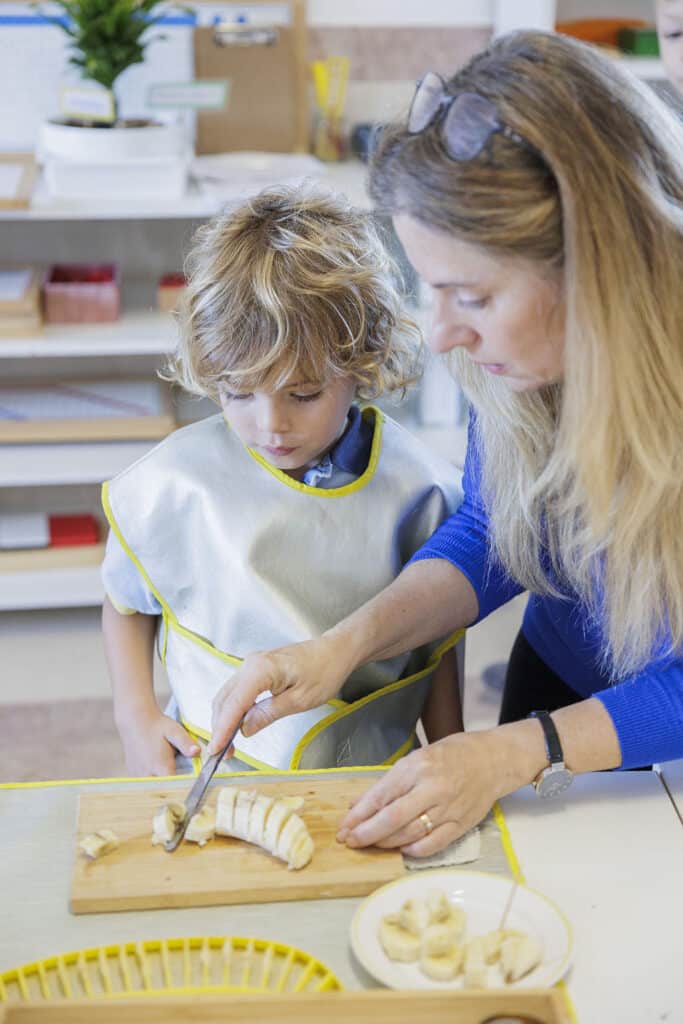
From as early as age three, Montessori students are encouraged to take responsibility for their learning. They choose work, manage time, and persist through challenges with guidance rather than constant instruction. This nurtures confidence rooted in competence — not external validation.
In a future where career paths will shift repeatedly, the ability to self-direct learning is invaluable. Workers will need to reskill, adapt, and problem-solve independently. Students who grow up trusting their ability to figure things out are far better equipped for that reality than those accustomed to being told exactly what to do.
Adaptability over rigid achievement
The IB PYP emphasises inquiry, conceptual understanding, and interdisciplinary thinking. Students are encouraged to ask meaningful questions, explore multiple perspectives, and apply knowledge in new contexts. This flexibility of thought is essential in a world where information changes rapidly and certainty is rare.
Rather than rewarding a single “right” answer, students learn to tolerate ambiguity, reflect on feedback, and refine their thinking. These habits build resilience — the capacity to respond productively to change rather than resist it.
Communication and conflict resolution
As automation replaces transactional work, human collaboration becomes more valuable, not less. The ability to communicate clearly, listen actively, and resolve conflict respectfully will define effective leadership and teamwork in the age of AI.
Montessori and IB-PYP classrooms explicitly teach these skills. When disagreements arise, they are treated as opportunities for growth rather than disruptions to be managed. Children are guided to understand different perspectives, reflect on their actions, and consider their impact on the community.
These experiences develop emotional intelligence, empathy, and accountability — traits that cannot be automated and are increasingly sought after in every professional field.
Learning in community, not competition
Mixed-age classrooms, a hallmark of Montessori education, mirror real-world environments more closely than age-segregated systems. Younger students learn by observing older peers, while older students develop leadership and responsibility.
This structure fosters collaboration rather than competition. Students learn that success is not a zero-sum game, but something strengthened through mutual respect and shared purpose — an essential mindset in interconnected, global workplaces.
Preparing children to stay relevant
The future will not reward those who can memorise the most information. It will reward those who can think critically, adapt quickly, communicate effectively, and act ethically in complex situations.
Montessori and IB-PYP education does not attempt to predict specific future jobs. Instead, it prepares children to remain relevant no matter what those jobs become.
By nurturing independence, resilience, adaptability, confidence, and strong interpersonal skills, these approaches equip students not just to survive the age of AI—but to lead within it.
In a world where machines are becoming smarter, the most valuable investment we can make is in our children’s humanity.
Tel: 289 037 265 or 935 450 009
Sponsored Content