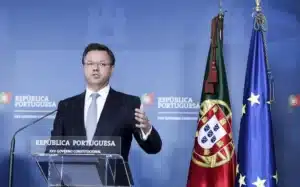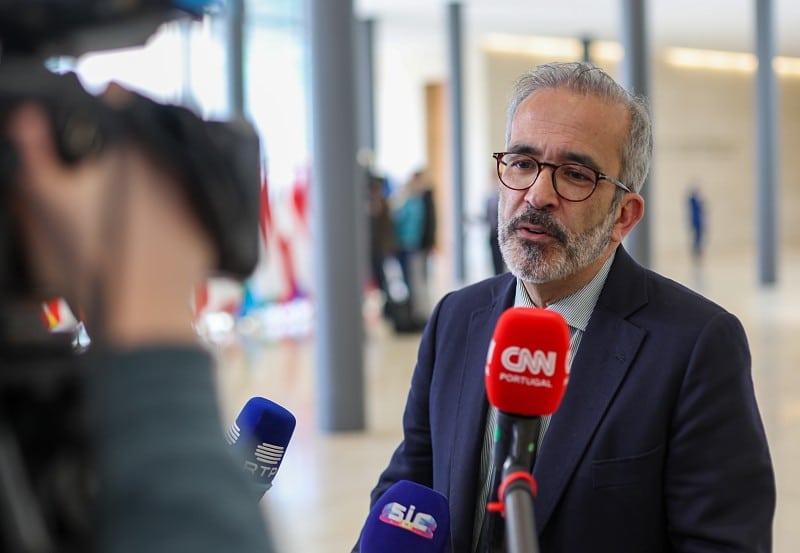
Portugal’s foreign minister, Paulo Rangel, has met his Lebanese counterpart, Youssef Raggi, in Beirut today to express solidarity with Lebanon as it emerges from weeks of Israeli bombardments, and announce financial aid for the education of displaced children.
A spokesperson for the Portuguese foreign ministry told Lusa that Rangel’s visit was planned several days ago, presumably to coincide with the start of the ceasefire agreed by Israel.
During the meeting with Youssef Raggi, Paulo Rangel announced a €150,000 financial aid package, through UNESCO (United Nations Educational, Scientific and Cultural Organisation), to support the education of tens of thousands of children affected by the current conflict, which has displaced over one million people in Lebanon.
Reaffirming “complete solidarity” with the country, and expressing condolences for the hundreds of civilian victims, Rangel stressed his government’s hopes for “full respect” for the current ceasefire, which is intrinsically linked to wider Iran/ U.S. peace talks, believed to be resuming within the next few days in Islamabad, Pakistan.
Yesterday, US President Donald Trump announced that his Lebanese counterpart, Joseph Aoun, and Israeli prime minister Benjamin Netanyahu, have agreed to a 10-day ceasefire, which came into effect at 10pm (Lisbon time) last night, and that the agreement is binding on the pro-Iranian Shia group Hezbollah (which is the only faction in Lebanon that has been attacking Israel).
The current escalation between Israel and Hezbollah on Lebanese territory began on March 2 – two days after the start of Israeli and US strikes against Iran.
Following Hezbollah rocket fire into northern Israel, Israel responded with air strikes across Lebanese territory, killing hundreds of people, particularly women and children, and destroying dozens of homes and communities.
Regarding the conflict, the Portuguese government has repeatedly condemned the attacks by both Hezbollah and Israel, calling for a total cessation of hostilities, considering this beneficial for the people of Lebanon, and for the ceasefire process in the war involving Iran.
Rangel last visited Beirut in February 2025, becoming the first foreign minister to meet with the then-new prime minister, Nawaf Salam, and the new foreign minister at the time.
Since then, he has maintained regular contact with his Lebanese counterpart, with their last meeting taking place in Barcelona in November last year.
According to the International Organisation for Migration (IOM), the current conflict has displaced over one million people, with more than 141,000 currently staying in over 700 collective centres across Lebanon.
The IOM has described the human cost of these last weeks as “devastating” – citing over 2,000 deaths, attacks on healthcare facilities and workers, the destruction of roads, bridges, homes and other critical infrastructure.
Emerging from his meeting with Youssef Raggi late this morning, Paulo Rangel told SIC Notícias: “The Lebanese government is, without a doubt, a government that wants to bring peace to Lebanon and has pursued a very courageous policy (…), playing a key role in completely outlawing Hezbollah, the terrorist movement, in an effort at the time to prevent incursions and attacks from Israel.
Source: LUSA/ SIC Notícias