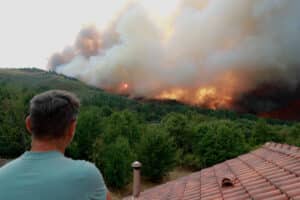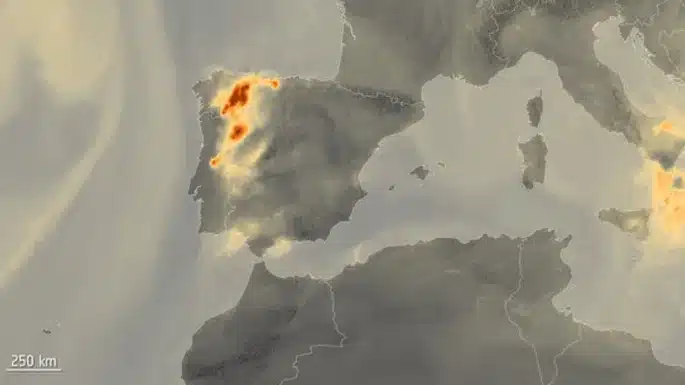
There will be little surprise at ‘the news’ that the raging wildfires that ravaged Portugal and Spain this summer are “likely to worsen air quality across the European continent”.
“The high emissions caused by these fires have the potential to affect not only Spanish cities, but also the rest of Western Europe and the entire continent,” Lorenzo Labrado, chief scientist of the World Meteorological Organisation (WMO), told a press conference today, explaining that forest fires are a permanent source of the most polluting and harmful particles in the atmosphere, those with a diametre of less than 2.5 microns (known as 2.5 PM).
Labrador was presenting the annual edition of the WMO’s air quality bulletin, which compiles data from 2024.
The report points to an increase in pollution by 2.5 PM particles, above all in South America, due to forest fires that have scorched parts of the Amazon, as well as fires in Canada, Siberia and Central Africa.
Intriguingly, this type of pollution has fallen (again) in eastern China, where cities like Beijing were once among the most polluted in the world, but where systematic mitigation measures have had positive results, according to the report, which analyses variations in the presence of aerosols (small suspended particles), some types of which contribute to global warming, while others produce cooling.
One bit of good news is that aerosols produced by sulphur emissions have decreased over the years thanks to the measures taken to reduce their presence in fuels – which has improved air quality and reduced premature deaths and childhood asthma.
However, this reduction has also contributed to an increase this year of 0.04ºC in global temperatures, Labrador pointed out, since these aerosols reflect part of the sun’s radiation.
The UN agency also highlights the increase in “smog” episodes in winter in many regions of the world, including the overpopulated north of India. It warned that “they are not just a seasonal meteorological phenomenon,” but a symptom of the increase in pollutant emissions resulting from human activity.
This prediction comes a day after the release of a study concluding that climate change caused by human activity has increased the risk (by 40 times) of heatwaves like the one that fuelled August’s relentless forest fires in Portugal and Spain.
Source: Lusa