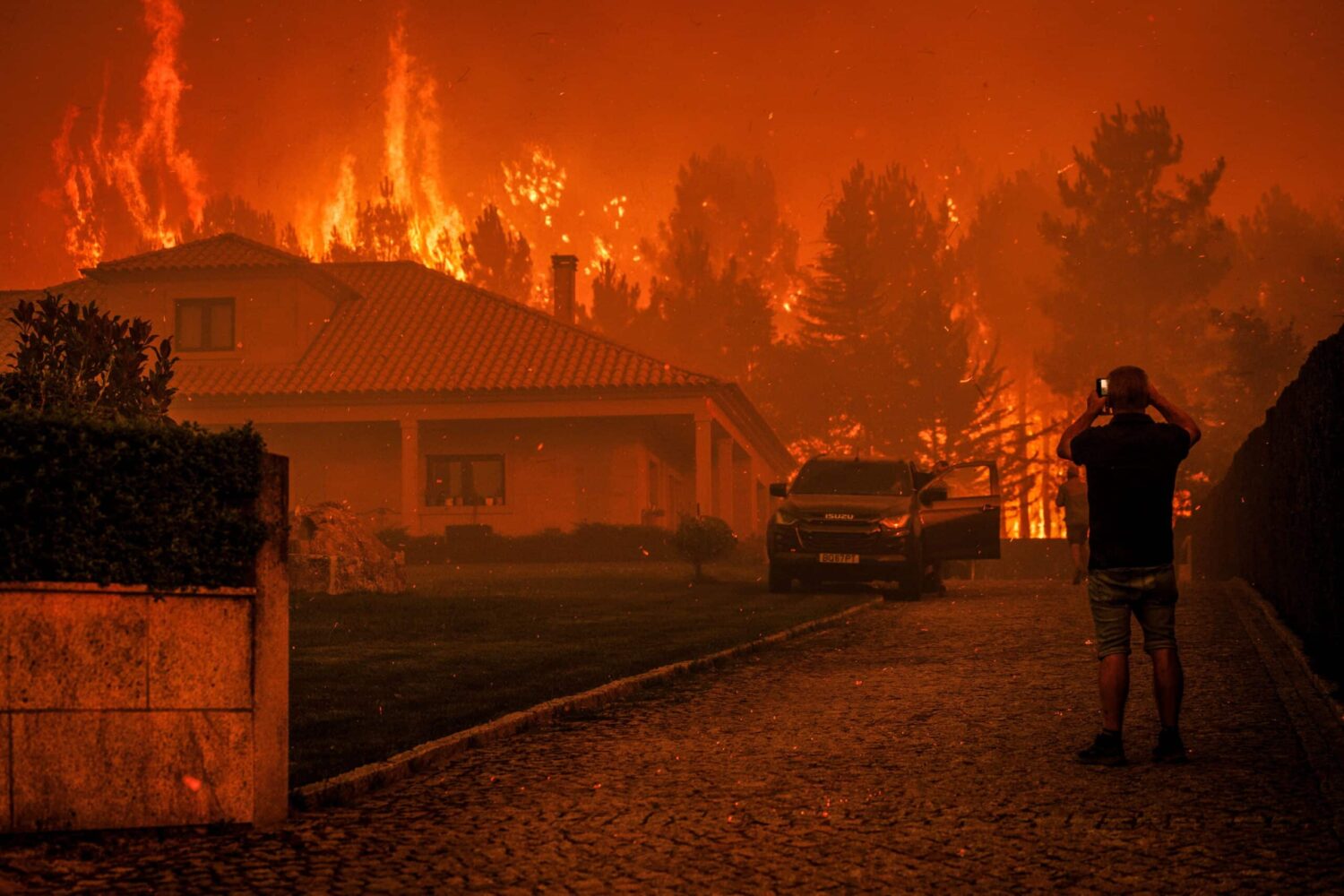
Today is the day that authorities coordinating fire combat are said to be ‘most concerned’ about a perfect storm of weather conditions that could send wildfires into even further dangerous territory.
As things stand, the country has already reached the stage of ‘national calamity’ (the words of the minister for internal administration who made a rare public appearance yesterday).
In spite of political leaders actually ‘partying’ in the south, the reality for communities in the north could not be more bleak, tense, or terrifying.
SIC’s Jornal da Noite last night actually referred to two countries in one: the north and centre under devastating conflagrations, the south where politicians were fist-pumping the air and shouting: “PSD!” as if nothing else mattered.
Anger at this disconnect is palpable. There has been criticism, for days, that communities are not receiving the firefighting combat support that they need. Yesterday, in Oliveira do Hospital, that criticism was given dramatic airtime by SIC: mayor Francisco Rolo was so beside himself with frustration at the lack of response to his call for more air support at a critical time that he ended up swearing furiously and turning his back on the cameras.
What had happened was what Rolo had predicted much earlier in the day ‘could happen’ unless the municipality received much more firefighting support: the fire raging through the mountainous region of the municipality managed to make the leap to the urban area.
“Exactly what happened in 2017!” He shook his head in disbelief (2017 being the year in which wildfires ended up causing the deaths of over 100 people). One minute there were airplanes dousing walls of flame with water, the next they had gone, he said, leaving Oliveira do Hospital to descend into chaos.
“We are in the middle of chaos”, Rolo screamed. “We have houses in danger, animals in danger, people in panic, children shut in houses and no one does anything!”
Hundreds of firefighters worked again through the night on at least nine ‘significant blazes’ (some of which have shown positive signs of evolution).
At 8 o’clock this morning, civil protection command referred to 37 active fires across the country, six of which were still considered significant, mobilising 3,500 firefighters.
The Trancoso/ Sátão fires have reached a point where they are “almost interacting”, Jody Rato, the ‘second regional commander of the centre’, told Lusa – and have now spread to 10 municipalities: Sátão, Sernancelhe, Moimenta da Beira, Penedono, São João da Pesqueira (district of Viseu); Aguiar da Beira, Trancoso, Fornos de Algodres, Meda and Celorico da Beira (district of Guarda).
“There are currently three very large active fronts. One of them is over 20 kilometers wide. The area of greatest concern is in the north, at the head, because that’s where it’s most intense—that is, in Penedono and São João da Pesqueira,” Rato added.
“We currently have four air assets and will eventually reinforce during the day. We don’t know, because there are other active fires and resources are finite, and we understand that mobilisation must be managed,” he said.
The so-called ‘Trancoso fire’ (now so much larger) began last Saturday afternoon. Aside from the extensive landscape (trees/ beehives/ agriculture) that has been burnt, a number of homes, warehouses and businesses have been affected.
A final damages count is a long way off.
At the same time, the wildfire that began in Arganil (Coimbra district) is still active, along with so much else.
Popular opinion, fanned very possibly by much of the media, is not impressed. Today’s Correio da Manhã (a paper that reflects the thoughts of the popular psyche) has lambasted the government’s treatment of this terrible August, suggesting the AD coalition has “abandoned prevention, has no forestry planning policies, and zero strategy for one of the greatest national problems”.
Deputy editorial director Eduardo Dâmaso also refers to the “tentacular presence of spurious interests in the hiring of aerial resources”. Just as SIC’s political analyst José Gomes Ferreira has said, time and again, there are people who make money out of Portugal’s chaotic wildfire management, and they have been making money out of it for decades.
Thus, for now, we are at this Bank Holiday moment mid-August, on a kind of ‘groundhog day’ that has marked days in August for longer than most people can remember.
The latest reports from ‘the front’ are that the Arganil fire is now bearing down on villages and the ‘environmental jewel’ of Mata da Margaraça.
Mayor Luís Paulo Costa is yet another mayor desperately concerned over how this Friday will develop.
“Right now, Mata da Margaraça is under threat. It hasn’t burned yet, but the fire is nearby, on the same slope. Work is underway to try to contain the fire, but it’s difficult,” he told Lusa this morning, adding that the fire “became completely out of control in the early hours of the morning, between 3:00 and 4:00 am”, when winds became very intense and the direction of the fire became correspondingly volatile.
Further back, one of the fronts that threatened the town of Sorgaçosa yesterday is moving, according to Luís Paulo Costa, towards the Agroal area, near the parish headquarters of Pomares.
There is another fire front raging to the southwest, towards Porto Castanheiro, near the area where the Arganil section of the Rally of Portugal is being held, said the mayor.
Fire updates will come as the day progresses.
“Who has to decide, requires tranquility and peace” – minister
As for the low profile of the government, minister Maria Lúcia Amaral has stressed that “those who are responsible for making decisions need tranquility and peace”.
“There are hours of such gravity, such gravity, when what is at stake is so serious, and so deep, and so complex, that the country has to understand that those who are responsible for making decisions need tranquility and peace to be able, in the name of everyone, to do their best”, she told Rádio Renascença.
During yesterday’s press conference, Ms Amaral – the country’s former Ombudsman – said she did understand the criticism that has been coming from various mayors, but stressed that resources available this year are greater than ever. “In an effort as large as this one, (a lack of coordination) can occur, because everything is extraordinarily complex”, she added – having started her statements to the country praising firefighters, and the solidarity of communities that have been battling to save each other in the face of a “real calamity”. ND
source material: SIC/ Correio da Manhã/ Lusa/ Observador