Investigation opens into judge suspected of issuing a ruling using ChatGPT – and mosquito transmitting dengue, zika and chikungunya discovered in Condeixa-a-Nova
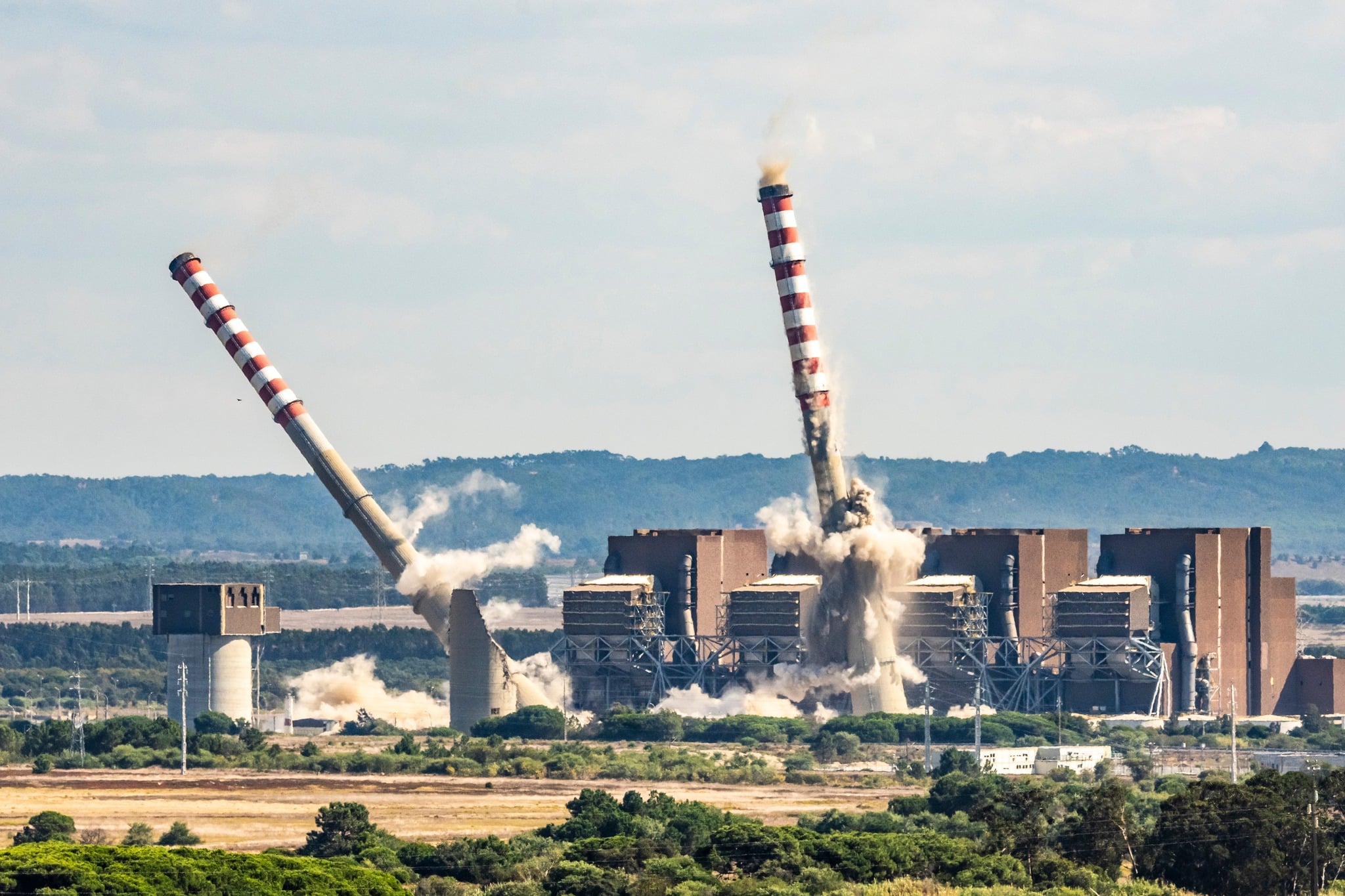
Some days there is just too much news to keep up with. Thus, for Friday shorts, we have chosen the radical change to the Alentejan landscape of Sines, where the twin chimneys that have stood marking the power plant for the last 40 years were brought down in a spectacular controlled explosion to make way for a much more sustainable future.
All it needed were 17 seconds for the two 225-metre chimneys to crash to the ground yesterday, throwing up clouds of dust, and leaving an estimated 15 tons of rubble to be dealt with, most of it sustainably, pledges EDP.
Sines coal fired power station was closed four years ago, but before that it generated enough electricity for a quarter of Portugal’s consumption.
Ground clearing and dismantlement of the plant will continue for the next two to three years, before EDP converts the space for the production of ‘clean energies’.
With parties of the left reacting in dismay over the use of Lajes airbase for the delivery of fighter jets to Israel, calls are already going out for the dismissal of defence minister, Nuno Melo – under whose watch this monumental slip up appears to have been sanctioned.
Perhaps in a bid to take the heat off Melo – already in hot water for describing the Humanitarian Flotilla recently thwarted by Israel as an ‘irresponsible pamphleting initiative heading towards a territory occupied by a terrorist organisation responsible for an attack that killed more than 1,200 people in Israel” (when the government he is part of has only just ‘recognised the state of Palestine’ and lamented the lot of the citizens trapped in Gaza) – minister for the presidency António Leitão Amaro this afternoon has blamed the whole PR disaster on…’an administrative failure’.
What we are dealing with here is “a communication under a prior notification mechanism, with a very short deadline, and an administrative assessment by the services, in relation to which a failure has been recorded”.
If that doesn’t explain everything perfectly, he added: “Indeed, there was a failure at the service level — this is acknowledged — which did not give rise to a decision to oppose. It is in this regard that there was a failure to alert the political level to the possibility of different treatment, which did not occur, of a situation that was reported as the passage and use of American military equipment”.
Hopefully, that will quieten everyone down for the weekend. It will be a busy one for politicians, as they are all racing around the country trying to support local colleagues standing in municipal elections in nine days’ time.
Someone whose weekend may be uncomfortable, if not busy, is the lead judge of a ruling called out earlier this year for using “strange expressions, careless Portuguese and citations of articles that don’t exist in the law”.
Yes, this was the awful moment we were led to believe that the country’s judiciary could be content to leave the law in the hands of robots. It has taken months for deliberation, but the Superior Council of Magistrature has finally come up with a statement: “The Superior Council of Magistrates confirms that the Plenary received the preliminary investigation report on the case indicated and decided to initiate disciplinary proceedings.” This will be particularly galling for lead judge Alfredo Costa who flatly denied “the hypothesis raised by defence judges” that he may have used Artificial Intelligence for the ruling signed off by himself and two colleagues last year, saying it was “completely unfounded”…
And while all that sinks in as the sun disappears into the horizon for another day, DGS (the country’s general health inspectorate) alerts to the discovery of Aedes albopictus in different parishes and boroughs of mainland Portugal, stressing the importance of ‘reinforcing measures of control and prevention to reduce the abundance of this kind of mosquito’.
The nasty thing about Aedes albopictus is that it carries diseases like dengue (treatable), chikungunya (ditto) and Zika (which can be terrible for pregnant women as it affects the development of their babies’ brains to the point they can be born with large parts of them missing).
At the moment this unpleasant mosquito has been identified in Condeixa-a-Nova, where locals are being advised on what kind of action to take. This essentially boils down to ensuring no recipients are allowed to sit holding water (“pots, buckets and containers should all be turned upside down”); water troughs should be kept clean, ditto drains etc., and people should use ‘long clothing, especially at dawn and dusk’ and repellants with DEET (N,N-diethyl-meta-toluamide), picaridin or IR3535.
And to round off a day with a lot of nonsense in it, the subject of the ‘Great Iberian Blackout’ has reared its head again today, in the form of yet another report to say much the same as all the others. “The Iberian blackout on April 28 was caused by a series of sudden shutdowns of renewable energy production and the subsequent loss of synchronisation with the European continental grid, according to the panel of experts investigating the incident”, writes SIC. This finding raises additional questions about the behaviour of the grid under conditions of high renewable production, which will be the subject of an in-depth study in the coming months, says Lusa.
Authorities in Portugal meantime seem happy to stress, ‘this all started in Spain’ – meaning none of it was Portugal’s fault.

Minister Maria de Graça Carvalho is cited as “welcoming” the detail (given already multiple times) that the blackout originated in Spain.
Sources: LUSA/ SIC