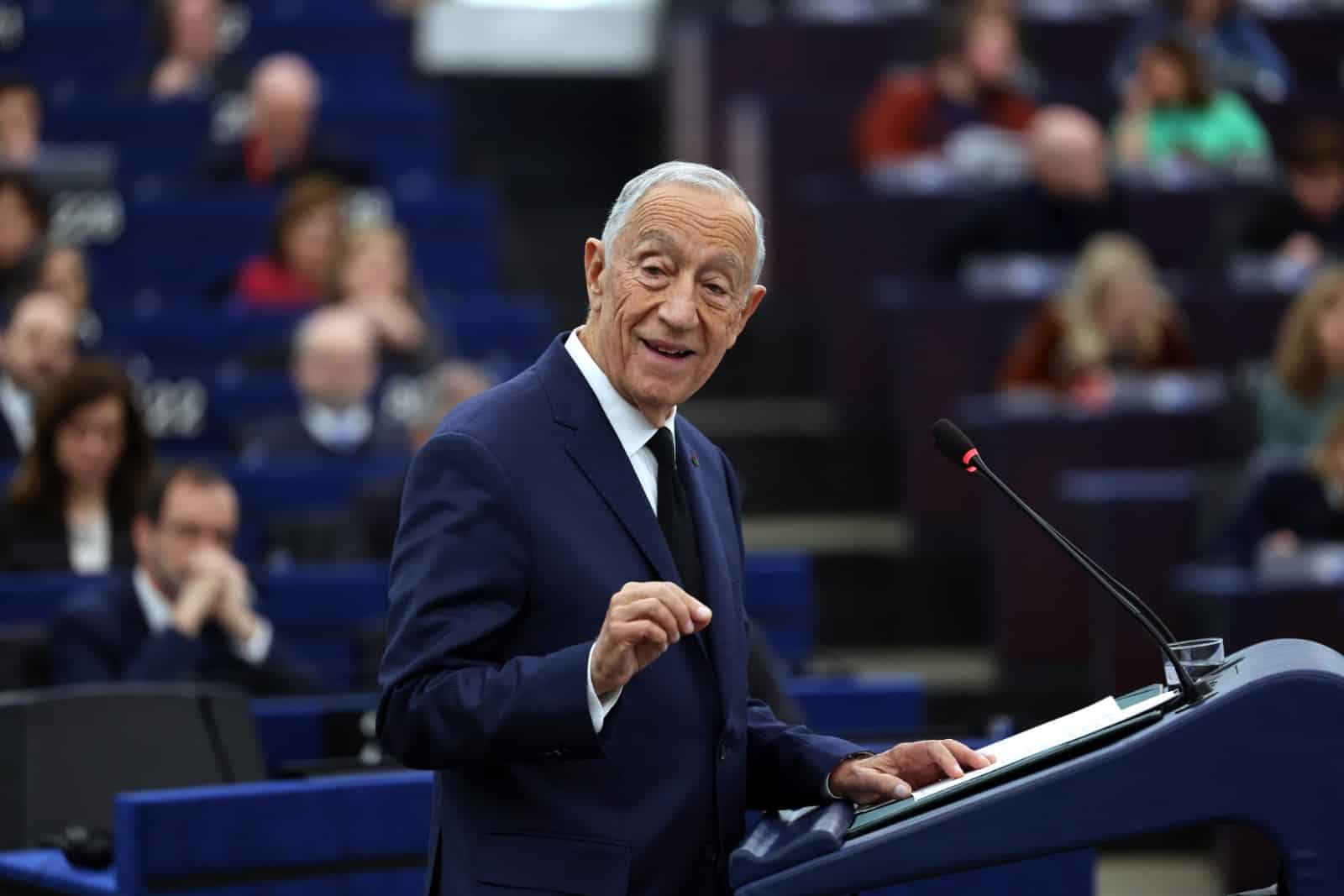
Even with his days at the head of the nation drawing to an end, Marcelo Rebelo de Sousa is focused on his mission. Today, in the European parliament, he has warned that anyone who tries to “recreate by force the division of the world into hemispheres as in the past” will fail.
There was no ambiguity to whom Portugal’s president was referring – but Lusa has spelt it out anyway: “Marcelo Rebelo de Sousa was referring to statements by the President of the United States, Donald Trump, who, after the capture of the Venezuelan head of state, Nicolás Maduro, in early January, stated that “American dominance in the Western Hemisphere will never again be questioned.”
Said Marcelo, in a speech during the commemorative session marking 40 years since Portugal and Spain joined the then European Economic Community: “No one today can forcibly recreate the division of the world into hemispheres as in the past and dream of controlling their own hemisphere, or solving universal problems on their own. Those who try this in the 21st century will fail, as others failed in the 20th century.”
Again alluding to President Trump (who is expected to speak at the World Economic Forum in Davos today), Portugal’s president warned that “bilateralism, which is truly unilateralism – a way of weakening multilateralism and international institutions – (should) not be invoked without those who wish to exercise this hegemony, this control, having the conditions to do so as they dream or claim (…) And there is no way to do it ignoring Europe, its power in values, social justice and the world economy because Europe still is, and always will be, the cradle of democracy, the beacon of freedoms, the mainstay of the rule of law, the reference point for the welfare state.”
Addressing MEPs and the King of Spain, who also spoke at this session, Marcelo stressed that the Portuguese “are always European, always transatlantic, always universal (…) Let us move forward, then, let us reinvent ourselves in whatever way is necessary, for the allies and partners we desire will come, as they always have, when they understand that there are no single masters of the globe, that there are no eternal powers, and that our alliances and partnerships are worth more than the froth, however spectacular, however seductive, of each day.”
Applause punctuated the speech as it stood as ‘yet another’ that has resulted from the extraordinary events of the last few weeks and days.
In Davos yesterday, Canada’s Prime Minister Mark Carney led the way for ‘middle nations’ to break away from tyranny underway, and find a better path.
Marcelo pointed out that “it is fashionable today to forget, minimise, and diminish Europe and its role in the world (…) Let us not waste a second hesitating, doubting, or self-flagellating. We have more freedom, democracy, and the rule of law. Many of us are at the forefront of human development and social equality standards”. Europe is (still) a “dream destination for so many, from all continents.”
“But we know that all this is not enough. We sometimes lose time and we have to do more, and better,” he argued. We need “more youth, more technology, more common security, more growth, more capacity for change in political systems” and “more future”.
“Let’s deal with this. With priority and urgency. Let’s count, first and foremost, on ourselves, we ourselves, who must believe in a free, equal and democratic Europe.”
Marcelo called for a reconstruction of Europe “without fear, without inhibitions, without complexes.”
“Anything that can be said about the European communities, now the EU, as critical, fallible, wrong, insufficient – which has been the case for a long time – is nothing compared to what we owe them,” he added.
Addressing Portugal’s alliances, Marcelo stressed that the country, in addition to the European Union, has been an ally of the United Kingdom “for almost 650 years” and he would prefer that the country “be even more aligned with the EU than it already is.”
“We have the United States, whose independence Portugal was the first European state – except for France, therefore the first neutral state – to recognise, and we would prefer that we were always one hundred percent allies and not with gaps, intermittencies or mood swings,” he concluded.
Marcelo will finally stand down as Portugal’s president on March 9 – at which point everything looks like seeing the presidency pass to António José Seguro.
The outgoing head of state has said that he is “ready for the next chapter” in his life which, according to Lusa late last year, will involve lecturing at a university in California.
Source material: LUSA