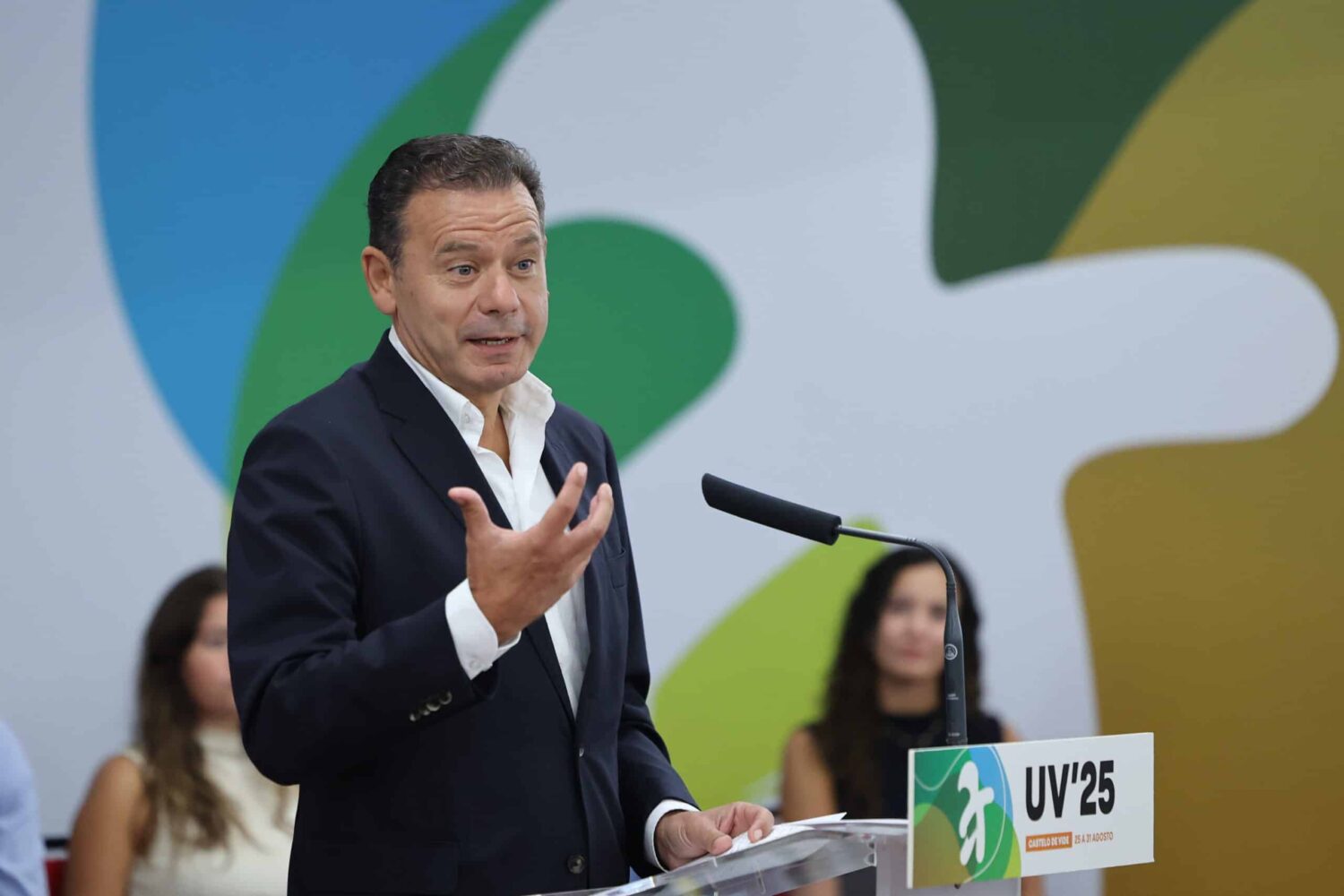
Opposition parties are still calling for more by way of explanations, but the prime minister closed the week’s PSD Summer University in Castelo de Vide today with major announcements on how his government seeks to combat Portugal’s housing crisis.
Luís Montenegro told his audience that next Thursday, a credit line of over €1.3 billion will be signed with the European Investment Bank, specifically to fund investment in affordable housing.
At the same time, the government plans to “go further” in the use of state assets – giving all public entities a deadline to explain why these assets are not being used.
“We’ve been deceiving each other here, and that will end”, he said. “We will not stand by and watch public assets being degraded without use or justification. Where there is no justification, they must be made available for use, whether in the public or private sphere.”
The Prime Minister explained that, when there is no justification for lack of use, the property will be transferred to the company that manages the State’s real estate, Estamo.
“In simple terms: we’ll tell a government department: “You have an abandoned house there. What do you want to do with it? Why is it abandoned? If there’s no plan for it and it’s going to remain abandoned, we’ll give it to Estamo, and they can build it, rent it, sell it, and monetize it,'” he said.
A third measure will be the creation of a single digital file that will bring together, for now, “all documents certifying the property”, with the aim of, in future, adding to this file, “the property matrix at the tax office and the property description at land registry offices”, so that citizens “do not have to go around collecting papers” (as happens now).
Among the measures to be presented next week, the Prime Minister highlighted a fourth: the government will “once and for all” define the role of each body in the housing sector, giving the IHRU (Institute of Housing and Urban Rehabilitation) “the functions of coordination, regulation and planning of public responsibilities in the housing sector in Portugal.”
“We want Banco Português de Fomento to be the partner in financing all operations that will make more homes available to individuals and families to rent and more homes to buy, at affordable prices,” he said.
The “responsibility for the implementation, ownership and management of public assets” will fall to local authorities, which will be provided with “feasible conditions from a technical and financial point of view to promote good management of the state’s housing stock.”
“Excuse me for using this expression, I’ll use it so the Portuguese understand. Every monkey has its own branch, each has its own responsibility, each fulfills its task and fulfills its mission.”
Meantime, the government wants to continue negotiating to establish “a guarantee line within the scope of the Banco Português de Fomento” for the 133,000 public housing units included in local housing strategies.
Mr Montenegro admitted that the challenge in the housing sector “is huge, but it must be overcome and conquered (…) And it will be, I want to assure you here, it will be. It will take a few years, but it will be (…) Those who ask us for results in months, or even in a year or two, after having failed for more than a decade, they will have to be patient, because we will insist, we will decide and we will, patiently, with the Portuguese men and women, obtain the result”, he assured.
Various opposition voices have since ‘piped up’ to ask for further details. It is being hoped also that vacant state assets will refer to the dozens of empty properties owned by municipalities themselves. The next week will, hopefully, provide all the answers.
Source: LUSA