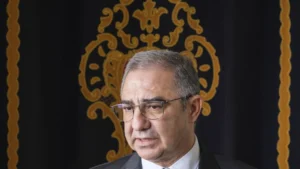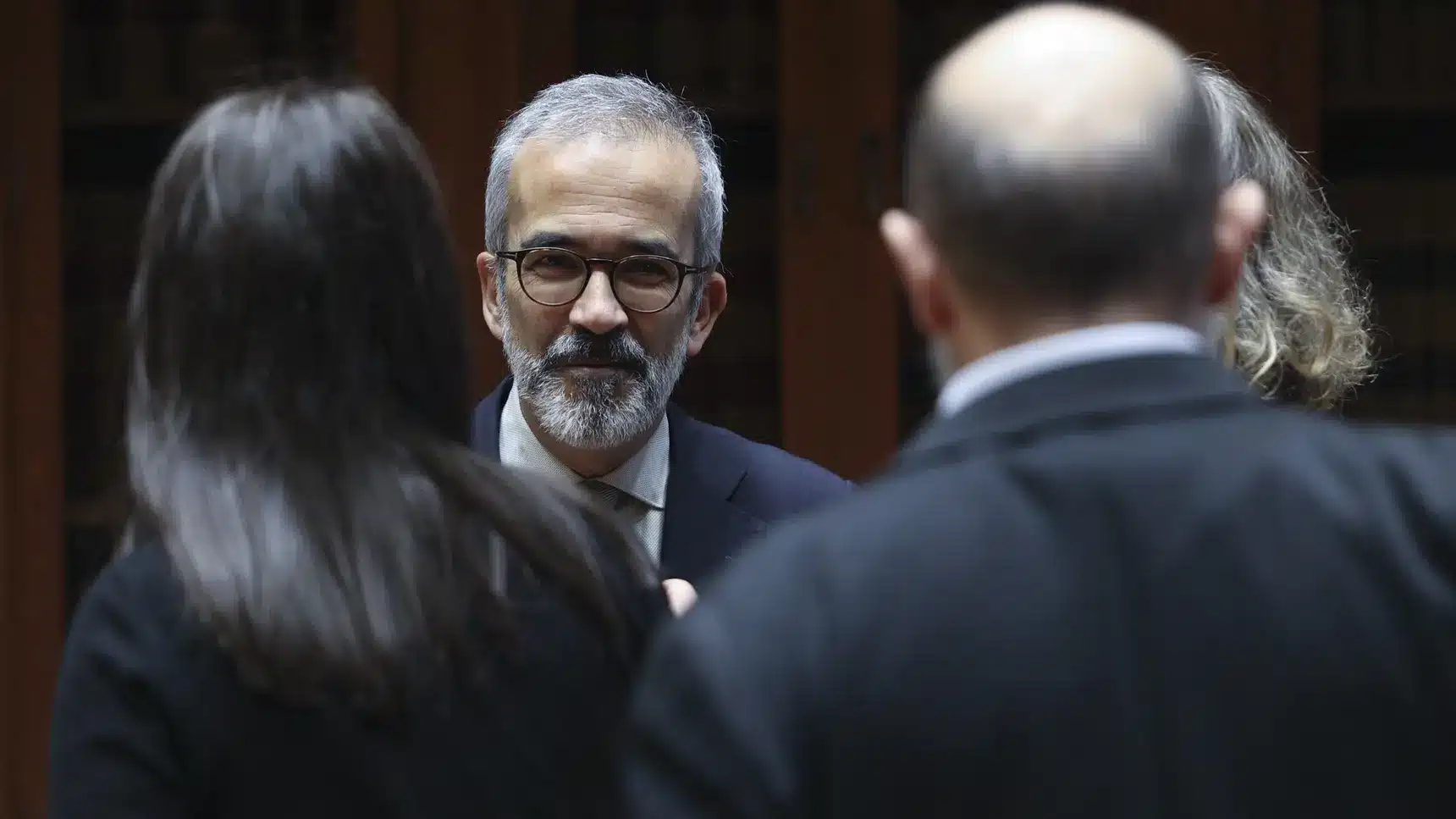
With the world still digesting U.S. President Donald Trump’s announcement that America will be running Venezuela pro-tem, Portugal’s foreign minister Paulo Rangel has said: “I wouldn’t interpret the words in that literal way.”
In a statement to the press at Palácio das Necessidades in Lisbon, Rangel defended a “solution that brings democracy and stability” to Venezuela – admitting, after being questioned by journalists, that it would “perhaps be preferable” for former opposition candidate Edmundo González Urrutia to assume the presidency, “in the long term”. (Edmundo González is the opposition candidate who claimed victory in the July 2024 presidential elections).
“We have this de facto situation and we have to work to create a solution that brings democracy, stability, and governability to Venezuela,” Rangel explained, albeit acknowledging that such a solution “probably cannot be immediate” since the situation on the ground at this moment “is not clear.”
“It is necessary to begin the transition process to democracy,” he stressed.
Rangel argued that there is “an elected candidate, demonstrably the winner (in 2024), according to independent, impartial international agencies that had access to the minutes, and he will be a legitimate president” if the outcome of this transition process is in that direction.
“For Portugal, and almost certainly for the European Union, the solution to restore democratic legitimacy as soon as possible is not to reinstate (Nicolás) Maduro in power, but rather to put the candidate who won the elections in the presidency,” he went on.
Asked to comment on the intervention of the United States, which attacked targets in Venezuela and detained Venezuelan leader Nicolás Maduro as well as his wife, Rangel returned to the basis that the Portuguese government ‘defends respect for international law’.
“Many consider this intervention, carried out in these terms regardless of the intentions – which are benign – to be inconsistent with international law, but given the illegitimacy of Nicolás Maduro and a narco-state elite, some believe there may be some degree of legitimacy involved,” he said.
As for President Trump’s statement that the US will, for now, govern the country, Rangel was not convinced: “I wouldn’t interpret the words in that literal way,” he said.
“There will have to be a process of pacifying the situation on the ground, which may involve talks with agents of the current regime and the involvement of the opposition,” and in which the US “will have a pivotal role in this dialogue.”
Rangel argued that countries like Portugal – but also Spain or Italy, which have significant communities in Venezuela – have “important influence” in “creating the conditions so that, as soon as possible, a democratic solution, endorsed by the Venezuelans, can become the governing solution.”
The future of the country was the main focus of a meeting yesterday afternoon between the President of the Republic, Marcelo Rebelo de Sousa, and the Prime Minister, Luís Montenegro.
Rangel expressed concern for current political prisoners in Venezuela – including five Portuguese-Venezuelans.
Regarding Venezuela’s Portuguese community – one of the largest in the diaspora – the foreign minister reiterated that people’s safety is the government’s “primary concern,” and that there are no indications, at this point, that anyone has been injured or suffered property damage.
Rangel added that the Portuguese community is “very influential and highly visible” in Venezuela – and, in spite of its “great resilience”, has “suffered greatly” under “the dictatorship of Hugo Chávez and later Nicolás Maduro.”
Source: LUSA