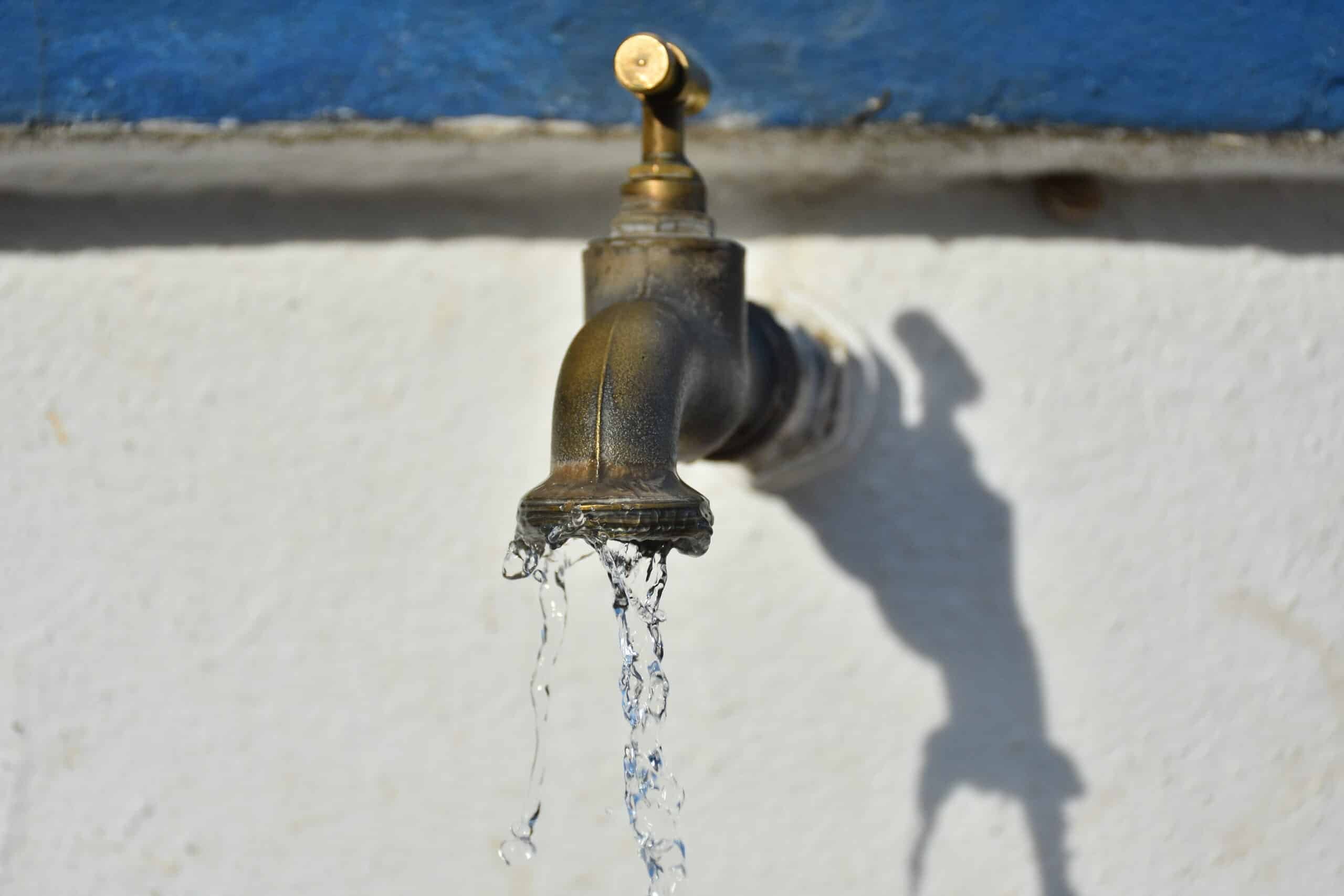
… that’s 180 million cubic metres per year: enough to supply country for three months
In spite of all the pledges and interventions, mainland Portugal is still losing a terrifying amount of water. To give an easy-to-understand picture, the country is losing the equivalent of 12 Olympic swimming pools every hour.
This inconvenient truth was spelled out by Eduardo Marques, president of the Association of Portuguese Companies for the Environment (AEPSA)
Speaking to Lusa, he explained this is “the water that I’m collecting, treating, pumping into the reservoir and sending to people’s homes (…) we need to recover it.”
In Marques’ mindset the first thing that needs to happen is that water tariffs need to go up.
He explains that, overall, water is cheap. Cheaper than electricity, cheaper than a Netflix subscription, cheaper than gas. This may have led into the consequence of a sector so inefficient that losses run at around 27%.
Marques also highlighted the efficiency of ‘private concessions’, which serve 20% of the population. These have a significantly lower average loss rate (around 13%).
According to Marques’ calculations, if the whole country had the same efficiency as the private sector, it would save 90 million cubic metres of water, equivalent to a reservoir with a base the size of a football field and nine kilometres high (see below).
One of the reasons for losses is the poor condition of infrastructure. And here we get to all those recent government/ council pledges to ‘get to grips with leaks’: the country is rehabilitating only an eighth of what needs fixing, says Marques, stressing that the rehabilitation of assets must be done “at the right times”, but because this type of investment “rarely wins votes” (as it involves pipes hidden underground), “contractors often extend this type of investment over time.”
With reduced rainfall being the forecast for Portugal’s short and medium-term future, Marques explains there is no other option: the country has to become more efficient.
And this efficiency, he told Lusa, “relies on desalination plants and additional dams”, when reducing water losses could reduce the need for either.
Very much as environmental groups have explained (again and again) ‘reducing losses’ can save more water than the capacity of any desalination plant. And whereas desalination plants cost millions of euros (the one earmarked for Albufeira, in the Algarve has ballooned in terms of costing, from an initial €40 million to upwards of €108 million), are heavy on energy and damage the environment, reducing water losses have no negative consequences whatsoever.
“Many people believe that reducing water losses requires replacing pipes”, Marques added – but efficient management also cuts losses in the short term.
Here too was a source sceptical of the government’s Água que Une (Water that Unites) programme. Marques told Lusa that more focus on good management would be a lot better than on rehabilitating pipes.
As for reusing wastewater, he too was of the opinion that this is not always feasible
What is essential, he said, is to promote fair tariffs, increase competition in the sector and have efficient systems, both in urban public supply and in agriculture.
As the government attempts to push through public consultation on the desalination plant planned for the Algarve, this latest opinion suggests that environmentalists, fishermen and local residents so opposed to it have a point. The Association of Portuguese Companies for the Environment (AEPSA) cannot be described as a group with a particular axe to grind, other than the sustainability of the country.
ERSAR back in control of Portugal’s water
Marques’ interview comes at a point where ERSAR (the regulatory authority for water) has been put ‘back in charge’ of setting water tariffs.
Much to the indignation of PS Socialists – and fear of certain municipalities – the AD government has put ERSAR ‘back in control’ of setting water tariffs.
Marques explains that for years, tariffs have been subsidised, ditto the authorities supplying water, most of which are running with significant losses.
“From next year (after the local elections), ERSAR will once again set tariffs for public systems, but it will also be able to make proposals and recommendations for private ones. The process is now at the stage of prior consultation with the market”, explains Lusa, suggesting a great deal in Portugal’s water supply sector is set to change.
Bottom line: Marques believes “it is necessary to increase the price of water by around 50%, because ‘tariffs can’t be political, they have to have technical and social support”.
Defending a social tariff for those who can’t afford a normal tariff, Marques stresses that right now, having quality water and sanitation on demand, water for drinking, bathing, for all needs, costs roughly 30 cents per person, per day: a third of the cost of a small black coffee.
The Strategic Plan for Water Supply and Wastewater and Rainwater Management 2030 (PENSAARP2030) already recommends and foresees average tariff increases of 50%, he adds.
Thus, we wait and see what comes when ERSAR sets the country’s new tariffs next year.
Source material: LUSA