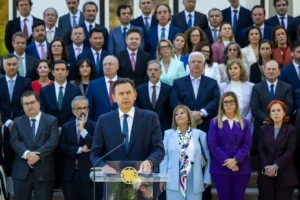
Very quietly, as the country turns on itself over the appalling tragedy in Lisbon last Wednesday, Portugal’s prime minister Luís Montenegro led a delegation on a four-day official visit to China, Macau and Japan.
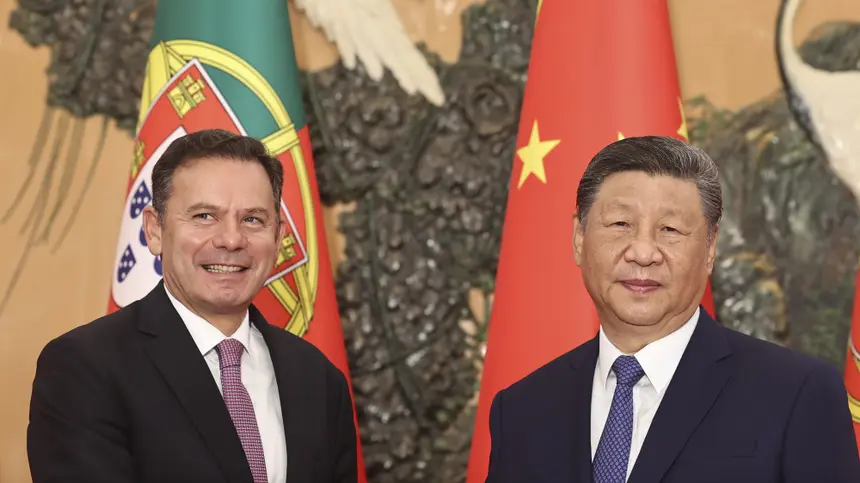
The first stop was arguably the most significant, in that it saw the PM received by China’s president Xi Jinping – a man who rarely receives western prime ministers.
It was clear from the two men’s initial statements, that China holds its relationship with Portugal in some esteem. President Xi referred to the “deep and beautiful impression” a state visit to Portugal in 2018 had left on him; the “important role played by three former Portuguese prime ministers (António Guterres, Durão Barroso and António Costa) in international and regional affairs, and how Portugal was the first country in the west to sign co-operation agreements with China under the Belt & Road initiative, and the first country in the Eurozone to issue bonds in the Chinese currency.
Luís Montenegro, for his part, stressed that Portugal has “not forgotten (…) the investment that China made in the Portuguese economy during the financial crisis” (2010-2014), nor the “strengthening of ties in various sectors of the economy, from energy to banking, from health to water supply” since.
Advancing from this diplomatic flattery, the Portuguese PM struck out for something Europe seeks in earnest: an end to Russia’s relentless attacks on Ukraine. He told the Chinese president: “On behalf of the Portuguese government (…) we are counting on your contribution and on the close relationship that China has with the Russian Federation so that we can build a just and lasting peace in Ukraine as quickly as possible.”
A few moments later, the media was asked to leave the room. But this focus by Portugal at a point where the United States ‘peace initiative’ appears to have imploded comes as Russia has increased its missile and drone attacks on civilian infrastructure and as it is also becoming clear that, on the ground at least, it will take years for the country to achieve its ambitions.
Ahead of the PM’s audience with President Xi, Portugal’s minister for foreign affairs, Paulo Rangel, was making similar attempts with his counterpart, Wang Yi, highlighting “the unique role that China can play in persuading Russia to reach a negotiation commitment with Ukraine”.
China’s position in this war has always been an issue, in that it is clear that Chinese equipment is being used in the legions of ‘kamikaze’ drones attacking Ukraine from Russia – and the country’s ‘friendship’ with Russia is frequently referred to by Mr Putin himself.
But it is also clear that China would be happier to see the war come to an end, for its own reasons. Thus, Portugal’s efforts in this regard could end up being very relevant.
The Portuguese delegation will continue on from China to the Macau Special Administrative Region tomorrow, and is then due to spend Thursday and Friday travelling through Tokyo and Osaka in Japan.