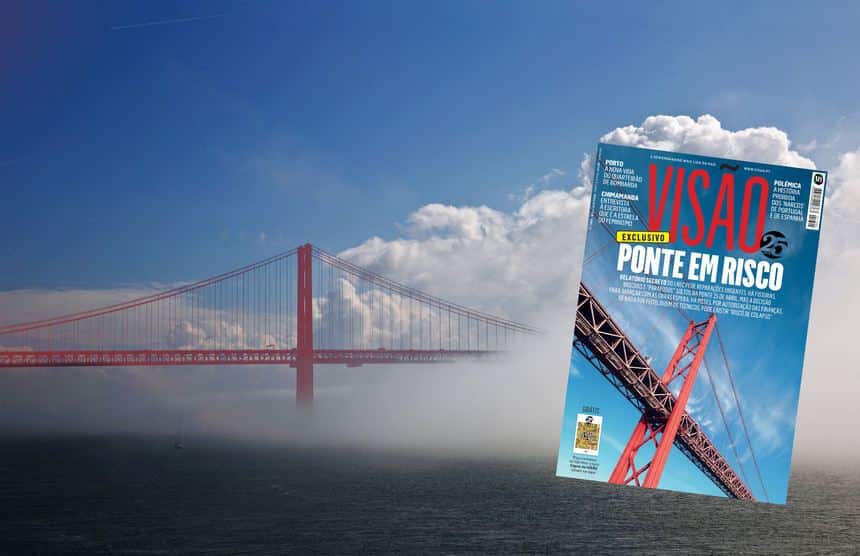
It’s the story of the day. Yesterday television channels talked of nothing else but the latest rapidly-developing corruption ‘scandal’. Today it is the safety – or otherwise – of the country’s busiest thoroughfare, the iconic 25 de Abril bridge straddling the Tejo and carrying over 160,000 cars every day, as well as 174 trains.
Stories breaking in the early hours of this morning carried sensationalist headlines pointing to: “risk of collapse” but since then national media has tried to concentrate on the more helpful message that works are needed ‘now, urgently, without delay’.
Says Expresso – like all other media sources picking up on an exposé in Visão magazine – the failings of the bridge have been known for the last three years.
Indeed, the national laboratory of civil engineers (LNEC) has pinpointed exactly what has to be done, pretty much how it will go forwards and how much it will cost – upwards of €20 million.
But the much-needed green-light for the works to start has been held up for the last six months – and this is what is setting parliament, television chat shows and social media alight today.
Indeed, the atmosphere is one of controlled panic as experts assure news anchors that “everything is fine” now but “it may not be if works don’t start immediately”.
The issues involve “fissures, cracks and loose screws” in a structure that is “a lady of 52 years old”, said civil engineer Tiago Abecassis on SIC morning TV, holding up a rough drawing trying to highlight where the issues lay.
“Is there a danger to the public now?” Asked the anchor. She was assured that “there isn’t, but there will be if works don’t move ahead fast”.
These works will take between two and two and a half years, and will almost certainly condition the lives of hundreds of thousands of commuters and businesses.
“Practically the same day that LNEC’s investigation has been published by Visão”, writes Expresso, “IP (Infrastruturas Portugal) has announced that it will be launching an international public tender to go ahead this month to start the work”.
Lusa says interventions “will focus essentially on the metal elements of the suspension bridge, and pre-stressed reinforced concrete elements of the north access viaduct” – adding that IP has said it will be carrying out the works at night and at weekends, “in order to avoid traffic congestion”.
As this story whirls through national media, the department of culture has announced that the capital’s tourist attraction Torre de Belém is to remain closed for reasons of safety, and Mafra council has revealed that its 92 massive bells are “at risk of falling” from a great height.
The issues for the tower are not so much structural, as to do with damage from the recent spell of bad weather, while the problems of the bells appear to be both structural and weather-weighted. With the high winds expected over the weekend, a perimeter of safety has been ‘erected’ underneath the belltowers as the council effects repairs.
natasha.donn@algarveresident.com