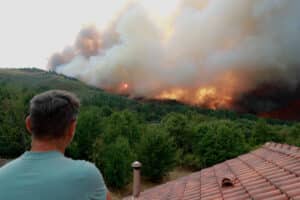
With the Council of Ministers today announcing the extension until next Wednesday of the ‘state of alert’ imposed to reduce wildfire risks in unusually hot temperatures, the fire causing the greatest concern this afternoon is one that broke out early this morning in Vila Pouca de Aguiar, within the ‘Parque Natural do Alvão’. Like so many of the fires that ‘run out of control’, this one is in an area of scrub with limitless combustible material and difficult to access. High winds are adding to firefighters’ challenge. According to fogos.pt fire-watch website, 11 aerial resources have been drafted in to try and halt the rapid progress of this fire.
In the meantime, two further arrests have been made of people suspected of arson, and the ICNF (institute for nature and forestry conservation) has delivered a report showing that a quarter of rural fires investigated this year in Portugal were caused by arson – while the area burned up until the end of July is the 3rd highest figure since 2015.
The ICNF’s provisional report shows that the most frequent causes of fires investigated up to July 31 were burning waste vegetation (32%), followed by “intentional arson” (25%) and re-ignition (8%).
The ICNF reports that of the 4,758 rural fires recorded by the end of July, 2,895 were investigated, of which 61% have had their causes determined.
Between January 1 and July 31, 4,758 rural fires broke out, resulting in 33,224 hectares (ha) of burned area, including settlements (15,545 ha), scrubland (13,704 ha) and agriculture (3,975 ha).
Compared to the same period last year, the flames consumed about seven times more and the fires increased by 85%.
“The year 2025 presents the second lowest figure in terms of number of fires and the third highest figure in terms of area burned since 2015,” the document reads.
The ICNF highlights that 50% of this year’s fires were recorded in July – totalling 2,367 – and 77% of the area burned (25,602 hectares).
The same document also indicates that, by the end of July, there had been 40 ‘major fires’ resulting in 27,150 hectares of burned area.
The largest fire was the one that started on 26 July in the district of Ponte da Barca (Viana do Castelo) and consumed, 5,707 hectares of forest, followed by fires that began on July 28 in the districts of Arouca (Aveiro), with 4,755 hectares, and Penamacor (Castelo Branco), with 2,904 hectares.
The report also indicates that Porto (1,014) was the region with the highest number of fires until July 31, followed by Braga (445) and Viana do Castelo (394) hectares of burned area.
In turn, the region most affected by the area burned is Viana do Castelo, with 7,293 hectares – about 22% of the total area – followed by Aveiro, with 5,790 hectares (17% of the total), and Castelo Branco, with 3,193 hectares (10% of the total).
The ICNF report does not include many fires recorded since the first days of August.
Source: LUSA