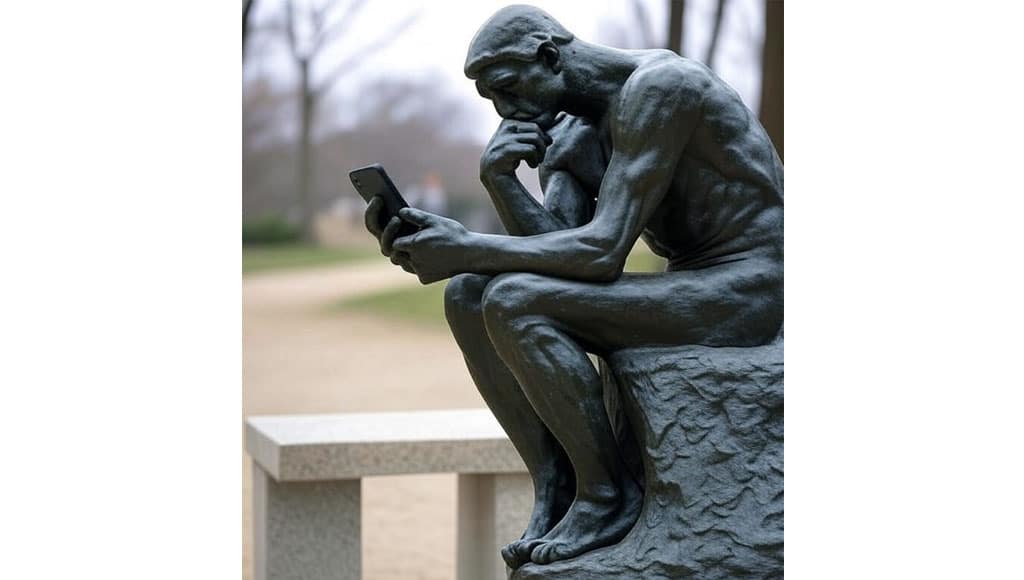
Today, I return as promised to my scrutiny of artificial intelligence. In my month-long murmurings around the topic here, and over on YouTube and the social networkings of Good Morning Portugal!, I’ve endeavoured to share the national position, expert and industry perspectives, as well as points of view of the equivalent of the ‘man on the Clapham omnibus’ in our midst. The latter has proved hard to canvass, waiting I’m guessing, for the inevitable impact on his life, which he can do little about, except deploy some combination of avoidance, adoption and curmudgeonliness.
As you may have seen from my earlier investigations (and if you didn’t, it will come as no surprise), our political leadership is making right and predictable noises that welcome any AI advantage to the society that they oversee, whilst sharing equally obvious concerns about public safety and national security.
I have, with great interest, listened also to contacts of my own like Portugal-based Cauri Jaye of AI firm Artium, who prefers to speak of augmented intelligence, alongside a lot of other engaging and inspiring pragmatism and practicality on the subject; and Tom Evans based in the UK, a prolific metaphysical author, who is looking at how the practice and understanding of meditation can be improved by computing’s cutting edge. In a conversational context as Good Morning Portugal! guests, and like all good fans and proponents of any new phenomenon, both make thoroughly fascinating and convincing AI ambassadors.
Before giving my own final summing up on the matter, let me hand the virtual microphone to a smorgasbord of high-level, great and good, some of whom, you’ll know, and some I expect you’ll meet in the near future.
Something of a grandaddy or godfather within the field, Sam Altman, CEO of OpenAI offers an undramatic but promising: “It looks like we have unlocked an algorithm that can truly learn and that’s gonna keep going.” His corporate colleague Noam Brown adding: “When you give AI the ability to think for longer, it develops emergent capabilities like being able to self-correct its reasoning and it’s clear that this is a scalable direction for future development.”
If these two opening batsmen are a little too techy and non-committal or specific for you, try X commentator Palden Bhutiaa who predicts that: “AI will so profoundly change the future… an economy that is not ten times more than the current economy but an economy that is thousands of times, maybe millions.” Thank you Palden for sticking your neck out there. Let’s add in a little Mitsuhiko, quoted again on X, who further furnishes a vision of the future with: “Right now it’s messy and raw, but the path is clear: we are no longer just using machines, we are now working with them.”
“Artificial intelligence is the new electricity,” says AI thought leader Andrew Ng, whose metaphor is nicely complemented by my least favourite nerd Elon Musk, who nonetheless seems to have his finger on the tech pulse. He adds: “The key is not to stop the machines, but to be the ones who control them.”
I’m guessing he’s not talking about you and I specifically, who’ll be controlling the biggest machines of this “science fiction” that NVIDIA’s Jensen Huang speaks of, saying: “10 years ago, it was a dream. Today, we are living it.”
Last expert witness word goes to MIT Researcher Sherry Turkle on the matter of most concern to many: “Artificial intelligence is growing up fast, as are robots whose facial expressions can elicit empathy and make your mirror neurons quiver.”
I don’t know about you, and your ‘mirror neurons’, but I get more of a clench than a quiver when I hear an update like that, which has me generally dread the inevitable and incoming weirdness she speaks of.
In the short-term, I predict more uncertainty ahead of greater implementation, more insufferable hype in these early and exponential days, and more and more anticipation of this all getting into the ‘wrong’ hands. And I may surprise you now with my final, until now unshared and greatest misgiving or concern.
Learning more about AI has been quite the eye-opener, especially the ‘AI agent’, hailed by some as the big game-changer and about which you’ll no doubt soon hear more. Mark my words, the ‘agent’ will be the next big and shiny thing that will have us all caught in their nerdy crossfire, they who promulgate AI so much and so fervently. This will be the tangible game-changer. First as an app, and web-based, and in time, still Internet-connected, but made manifest as machine, Blade Runner-style.
Those of us, called believers, already have of course the ultimate, all-knowing, smarter-than-us, AI agent in what some of us loosely call God. Sure, the interface to optimal performance is unreliable. It always has been. But if you thought religious belief and spiritual awareness was old-fashioned now, it’ll look positively prehistoric when AI in all its omnipresent and seemingly wise manifestations, including agents, robots and later level GPTs really kick in and possess the minds of mere and vulnerable humans.
In the feverish rush, what we are most likely to fail to see, is that behind the complexity, the code and those quivering neurons, lies that same human frailty, despite innumerous hopes and prayers, that could never quite put its faith in the Almighty, preferring instead this easier and more exciting deity to worship and believe in.
It’s coming, offering progress and change with no guarantee of refinement or transformation, or any hard work. Showcasing the glorious upsides of the world of our imperfect selves, AI will envelop us with its devilish smoke and mirrors, promising to meet our desires and ease our stress, without ever considering context or premise; never asking important questions like ‘why?’ and for what real reason are we doing ‘this’.
To put it prosaically, it’s more “fur coat and no knickers’, as the searing wit and wisdom of a Yorkshire grandmother might put it, with her sudden and humbling blurts. Or as Shakespeare’s (self) tortured king put it, “a tale told by an idiot, full of sound and fury, signifying nothing” (of any true value), just more of the same, but with a newer, ever-updating version.
Our world will be devastated by these new tools, but the quiet, eternal, question will still hang in the air, when the drunken technologists finally sleep: “Why are we here and what are we really here for?”. And AI will not have the answer. Because neither do its programmers and prompters, do they?
And, I might be wrong. Those tears I predict, might be of joy as AI takes care of everything we struggle with, leaving us free to finally skip through the sunny uplands, liberated and empowered, thanking the lucky stars and silicon chips that made it all possible.

Share