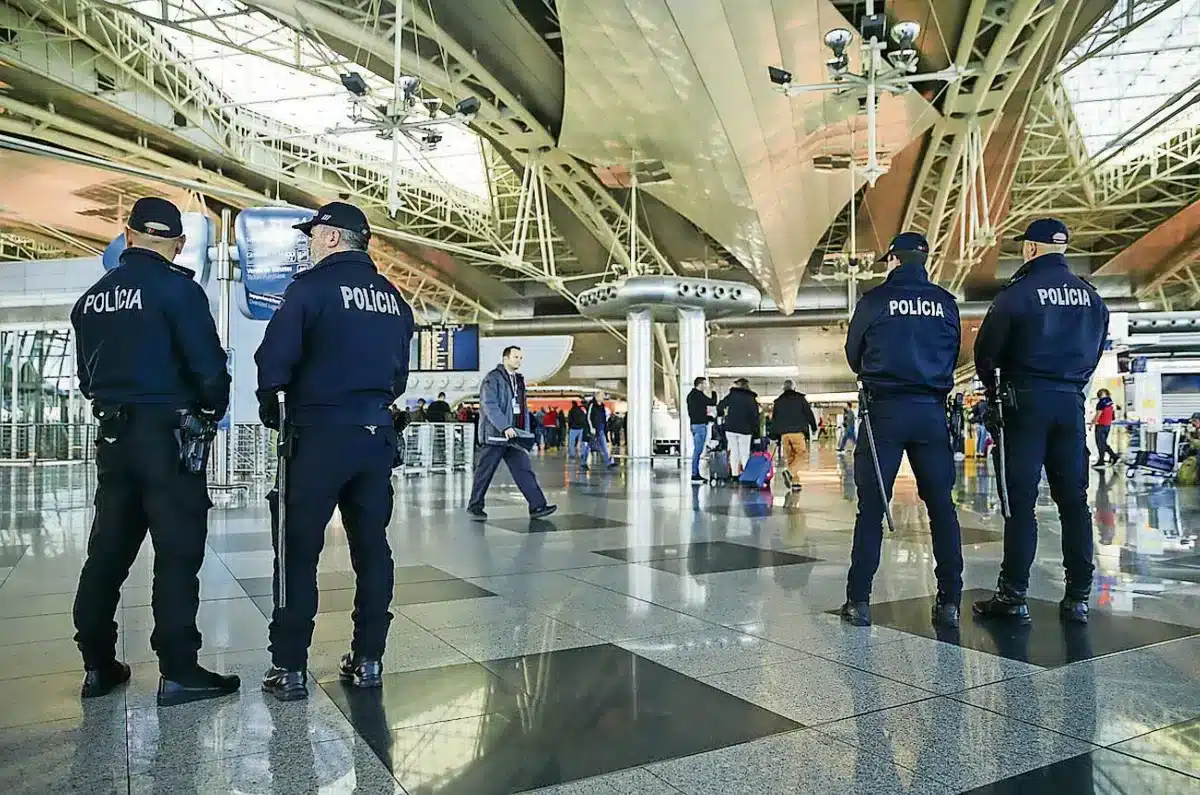
A total of 60 PSP police officers began a course this week on air border control to reinforce Lisbon airport from the end of February, the police force has announced.
The course, which will run until February 22, consists of two classes of 30 PSP agents who already have border guard training.
It will cover topics related to air border control, including human trafficking, security documentation, risk analysis, asylum and foreign nationals’ rights – equipping PSP police officers with “the knowledge and skills necessary to carry out border controls”.
A PSP source has told Lusa that the 60 police will undergo training in the fifth week of the course at Lisbon airport, where they will be stationed.
The force also indicates that the course is part of the human resources training action plan resulting from the (re)entry into operation of the European Entry/Exit System (EES) in April 2026, comprising 10 training courses to train 500 police officers assigned to all airports that constitute air borders in 2026.
The source added that there are no longer any waiting times at Lisbon airport since the suspension of the European border control system for non-EU citizens.
This system was suspended just over a week ago for three months to reduce queues.
It will be reactivated at the end of March, very close to the date when the EES is due to be fully operational throughout the European Union.
Another contingency measure announced by the government at Lisbon airport was the reinforcement of GNR military personnel, with 24 trained as border guards starting work today.
Lisbon airport was also reinforced with 80 PSP officers during the Christmas and New Year period due to the long waiting times.
A PSP source said that this reinforcement will continue and stressed that today “it is clear” that there are “more PSP police officers working at the airport’s Border Control Station than there are service counters available” – an issue that falls within the remit of airports’ management authority, ANA.
As the PSP source explains, ANA “only provides” 16 service counters in arrivals and 14 in departures, in addition to the “e-gates” (biometric gates) – a number that has remained the same for many years in spite of the increase in passenger flows through Lisbon.
The new European border control system for non-EU citizens came into operation on 12 October in Portugal and the other Schengen countries – at which point waiting times became agonisingly intolerable for thousands.
The situation saw the government establish an emergency task force to manage the crisis – but then in December, the second phase of EES got underway (requiring the collection of non-EU passengers’ biometric data) which further complicated problems.
With the suspension of the EES computer system, passengers from outside the Schengen area, who do not belong to the European area of free movement of persons and goods and who need to pass through border controls, are once again being checked by the old system, which does not involve the collection of biometric data.
While the situation has delighted thousands, critics – including political parties of the opposition – have suggested that Portugal’s security is being compromised. An urgent debate on this subject has been requested by PS Socialists in parliament.
Source: LUSA