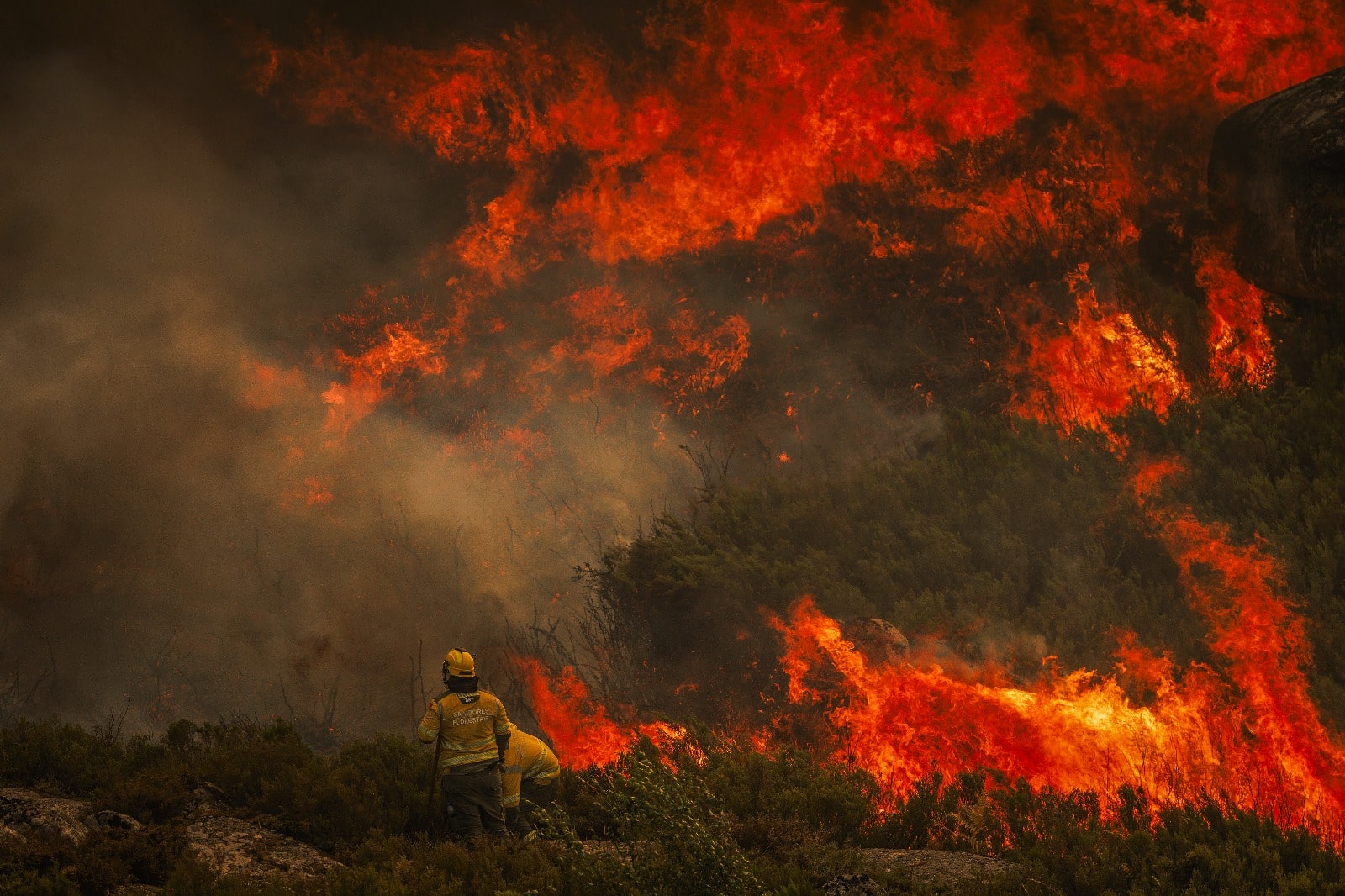
The incomprehension of one Portuguese mayor epitomises this year’s Dantesque wildfire scenario in Portugal. “How can such a small country (…) allow us to be smoldering for ten days”, Vila Real mayor Alexandre Favaois has queried.
Vila Real is just one of the areas battling raging wildfires that keep ‘appearing, and reappearing’ as temperatures reach stultifying 40º-plus levels, and resources, quite clearly, are insufficient.
“It is time for ANEPC (the national civil protection authority), the National Coordination, to say something. It is time for the minister, who told the country that we were all prepared, that resources were sufficient, to say something. We realise today that (what she said) was not the case”, Favaois tells journalists. But most of all, said the mayor, it is time to hear the prime minister – who was being pictured at almost that precise moment enjoying the waves on the so-far-wildfire-free Algarve coast.
With news of Portugal’s wildfires getting international exposure; with all three (rented) heavy-duty Canadairs currently inoperational, the dearth of concern expressed by the nation’s holidaying politicians is becoming remarkable – particularly as the country is so close to municipal elections.
But while Alexandre Favaois’ words are left to sink in (and sink in they will), the country continues to burn: since last Sunday, thousands of hectares have joined the 60,000 that have burnt since the start of the year.
Vila Real’s rich landscapes will take “many, many decades to recover”, warns Favaois. It is the same in other areas: Ponte da Barca, Covilhã, Trancoso, Tabuaço, the Peneda-Gerês natural park. This year’s tally of wildfire damages trails off into the blur of recent memory: new fires are breaking out every day, each one posing more danger to exhausted populations.
Experts have been trotted out into public view to say ‘this is what we have to expect of the future: more heatwaves, closer together, resulting in more wildfires’.
Arsonists are being rounded up with extraordinary frequency, but the drama continues.
Euronews has made much of ‘fire tornados’ photographed swirling through the smoke and devastation; every night national television features villages assailed by flames – and the common thread is that many people complain of ‘being left on their own’: of firefighters not making it into the village; of homes only being saved because of the combined efforts of desperate local people.
As we write, wildfires in Trancoso, Vila Real and Tabuaço are the country’s most serious. By tomorrow those names may have changed, but the reality of a small country in flames looks set to continue for some weeks to come, and there appear to be ‘no solutions’. It is what it is, and we can only do our best not to unwittingly start a fire ourselves, which is why alerts have been put in place to limit movements in forested areas.
Correio da Manhã tabloid carries a large article today, suggesting that some of the chaos in this summer’s fire combat comes from the creation of regional ‘sub-commands’, that substituted former ‘district commands’. Too many cooks in the kitchen, in other words, taking too long to make important decisions, and frequently making the wrong decisions.
“The current system does not work”, president of the League of Portuguese Firefighters António Nunes tells the paper. “It is an aberration from an operational point of view. Everyone recognises this, but no-one has been able to change the situation yet. And the change is easy: it is the return to district command units”.
CM adds that the governments of Luís Montenegro have shown their intention to return to district commands, but they have not had the courage to do so in time for this summer. The results of this lack of courage “are plain to see”, says the paper.
source material: LUSA/ Euronews/SIC Notícias