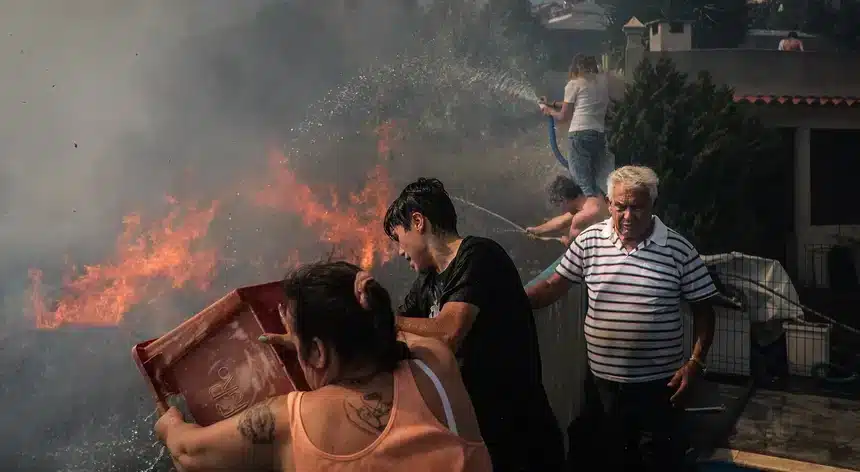
This summer’s forest fires (and those of last year) in mainland Portugal revealed “coordination failures” between the different forces on the ground, which caused delays in response times, increasing their spread, according to a damning OECD report which underscores everything exhausted mayors and firefighters said through the dramas of August and September.
“The creation of forest firefighting forces in Portugal has strengthened the rapid response to fires in forest areas. However, it has also contributed to unclear command structures between civil protection, volunteer and forest firefighting forces,” said the report, entitled “Towards integrated rural fire management in Portugal”.
The preliminary conclusions of this European Union-funded project, carried out in collaboration with the Agency for Integrated Management of Rural Fires (AGIF), were presented today by OECD experts to Portuguese MPs in parliament.
The report notes the existence of “coordination challenges” when specialised teams from the Institute for Nature Conservation and Forests (ICNF) and civil protection forces have to operate together, despite the National Emergency and Civil Protection Authority (ANEPC) having command authority.
“These coordination gaps are further amplified at local level, where volunteer firefighters and other responders (i.e. municipal firefighters and the national guard) do not consistently follow the ANEPC’s hierarchical chain of command, which can lead to fragmented mobilisations, slower response times and less efficient allocation of resources on the ground (…) this lack of clarity posed challenges for the operational management of fires”.
“As a result, resources were allocated late or insufficiently in a context of multiple and complex fires.”
OECD technicians note that Portugal initiated a series of reforms to improve rural fire management after (the killer fires) 2017 with the creation of the Integrated Rural Fire Management System (SGIFR), but they indicate that the fires of 2024 and 2025 revealed that “they could be further contained if actions under the SGIFR were accelerated”.
According to that organisation, the introduction of the SGIFR improved the institutional, regulatory and financial conditions for forest fire management, clarified responsibilities at national, regional and municipal level in terms of prevention and response, created the Agency for Integrated Management of Rural Fires (AGIF) to coordinate all the actors involved and developed a unified strategy.
After 2017, new incentives were created to promote controlled burning and strategic fuel mosaics to reduce fire risk, with public funding for management doubling, with prevention now accounting for almost half of total fire-related expenditure.
However, the extent of the damage caused by recent forest fires points to the need to accelerate the implementation of reforms.
In 2024, 35 fires burned more than 500 hectares, representing 84% of the total area burned annually, and the summer of 2025 again saw fires of exceptional size, exceeding the area burned by the fires that triggered reforms in Portugal in 2017, says the OECD, stressing that these fires revealed “several shortcomings”.
In addition to “coordination failures”, the OECD points to some shortcomings in prevention, such as “a high number of fires caused by humans”, persistent gaps in meeting fuel management targets, and local opposition to the risk of wildfires and hazard maps.
“This delays the adoption of municipal fire management plans, which are essential for obtaining funding and implementing fire regulations,” the document stresses, also regretting that “there is no systematic record of the losses and damage caused by forest fires.”
In order for the country to create “a stronger institutional framework,” the OECD recommends clarifying roles and command structures among firefighters and strengthening their capacity (something firefighters themselves have been demanding for some time).
The organisation also proposes the development of “a long-term financing strategy for forest fires in order to increase the efficiency of expenditure on forest fire management.”
source: LUSA