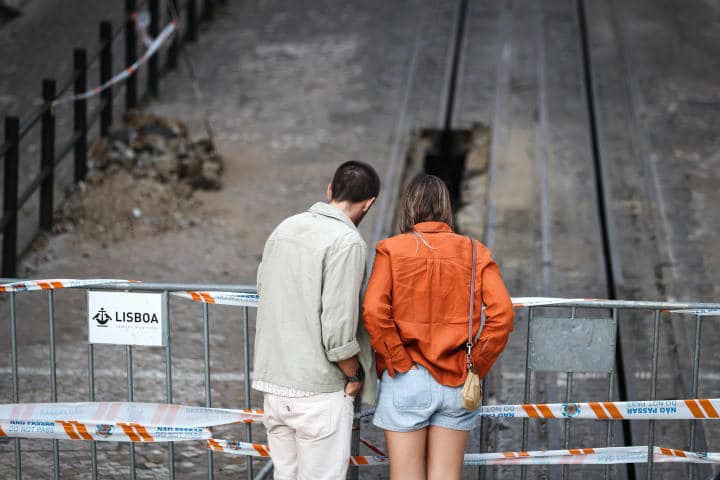
An ‘information note’ on the Glória Funicular tragedy in Lisbon that killed 16 people (most of them tourists visiting the city) has confirmed a number of ‘key details’, without apportioning any kind of responsibility (this can only come once the preliminary report on this disaster has been delivered, in 45 days’ time).
The most important detail is that the cable joining the two cabins – and crucial for the proper functioning of the whole system – did indeed ‘snap’, or at least it “gave way”, according to the note, “at its attachment point”.
This attachment point would not have been visible to whoever undertook daily inspections of the system. It is sited “inside the upper fitting piece of cabin no. 1 (the cabin that hurtled backwards on Wednesday evening, careering out of control, and ultimately coming off the rails and hitting a building)
According to the initial investigation carried out by GPIAAF (the Office for the Prevention and Investigation of Accidents involving Aircraft and Railway Accidents) “the rest of the cable” and the entire system, such as “the reversing wheel and the pulleys on which it runs, were lubricated and had no apparent anomalies”.
“The cable on the upper section of cabin no. 2 (which was next to Praça dos Restauradores, and escaped damage) also had no apparent anomalies”.
The next important detail is that the brakeman in charge of the cabin, André Marques – the first fatal victim to be identified following the disaster – will have been desperately trying to action both the automatic and manual brakes when the cabin started hurtling backwards.
According to the ‘information note’, ‘these actions had no effect’. The cabin continued falling backwards over a distance of 170 metres, reaching speeds roughly five times greater than the 11.5 km/ hour established as the funicular’s normal pace of travel.
Cabin no 1 came off the rails at a bend, crashing into a building (a hotel) at what GPIAAF investigators have estimated at 60 km/ hour.
Normally, the funicular travelled 276 metres, either up or down a 45-metre hill with an average gradient of 18%. Journeys took just over a minute to complete. Last Wednesday’s 6pm trip played out over less than 50 seconds. As some have already observed, had cabin 2 been any further up the hill behind cabin 1, the loss of life and injuries would almost certainly have been even worse. As it was, cabin 2 had barely started the upward journey, and only ‘fell back’ a metre and a half when the cable joining the two cabs gave way. No-one inside cabin 2 was seriously hurt, though passengers will have been terrified, and could be seen in footage on the day scrambling to get out.
GPIAAF’s information note also explains that “at this point in the investigation, it has not yet been unequivocally determined exactly how many people were in each vehicle” (this because at least one of the bodies is believed to have been a pedestrian, caught by cabin 1 as it crashed to a halt).
The note gives the ‘tare weight’ of each cabin – meaning the weight without passengers – at ‘around 14 tonnes – and stresses that the funicular dates back to 1914, not the 1885 previously stated. “ Although it has been subject to various conservation and improvement interventions over the past 111 years, it has also undergone periodic maintenance at each stage”, says the note.
Regarding the moment of derailing, the note explains that the cabin careered into a street-lighting pole, and another supporting the (system’s) overhead electricity network. These two poles, both made of cast iron “caused very significant damage to the cabin”, which “ended its uncontrolled movement against the corner of another building shortly afterwards”.
The information note provided diagrams, but obviously no conclusions. These will come in the preliminary report due to be presented shortly after the municipal elections on October 12.
What was surprising was the reference to the fact that GPIAAF “found that the funicular is not under the supervision of the Institute of Mobility and Transports”, while other systems like it – the ‘elevators of Bica and Santa Justa – are. All these means of passenger transport have been suspended while the various technical inpsections take place.
In the meantime, political forces continue to argue notions of ‘responsibility’.
The last political leader to assume responsibility for a devastating tragedy was Socialist Jorge Coelho (since deceased), hours after the collapse of the bridge at Entre-os-Rios in 2001, where 59 people died – some whose bodies have never been recovered. Mr Coelho was the Minister of Transport of the time, and considered his position was ‘where the buck stopped’.
News outlets have been calling the Glória funicular tragedy ‘the worst in Portugal this century’, but technically the Entre-os-Rios tragedy was even worse.
As leader writer Octávio Ribeiro has commented in Correio da Manhã: “On the Entre-os-Rios bridge, a pillar collapsed. In the Glória elevator it was a cable. Both tragedies howl two indisputable truths: in any vital activity, there is an area that can never be neglected or underestimated: maintenance. And yes, politicians are responsible for the quality of the experts they (choose to) surround themselves with”.
This weekend has already seen the funerals of two of the Portuguese victims. The stories – as all will be – are heartbreaking: brakeman André Marques has been universally described as a truly lovely man, always ready with a smile, always ready to help anyone, and Ana Paula Lopes, one of the Santa Casa da Misericórdia staff to die in the disaster, follows her younger brother to the grave, leaving her distraught parents mourning the death of a second child in two years.
Foreign press have also carried the stories of the tourists who lost their lives last Wednesday, while the implications for Lisbon as a top-class tourist destination will now be on many minds.
“The city has been neglected”, say critics.
This terrible tragedy in the heart of the capital will almost certainly force ‘a new energy for improvements and upgrades’.
But for now, we have to wait for the preliminary report on GPIAAF’s investigation, due in the middle of October.