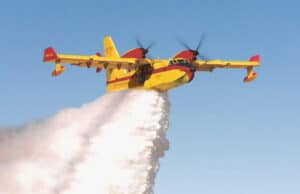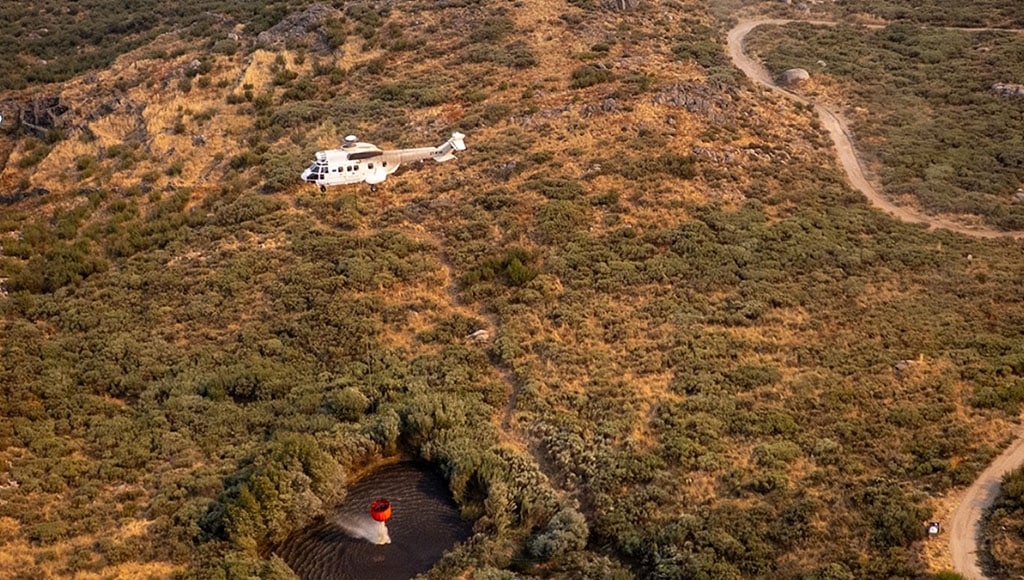
The situation was exacerbated by the difficulty in accessing fire scenes by firefighters on the ground in some areas. Also on occasions, due to the large amount of smoke, it was unsafe for firefighting aircraft to operate. The quick aerial response during the daytime was not available during the nighttime, when several fires broke out.
The result was that fires such as the Arganil and Trancoso fires burned for 12 and 11 days, respectively, during which the intensity of the fires was so great it became beyond the capacity of firefighters on the ground and in the air to extinguish using normal means.
The Arganil fire burned an area of 64,451 hectares, the largest of Portugal’s history. However, it was not all the mainland that was affected equally, with the centre and north bearing the brunt of this, with very few fires in the Algarve.
European experiences
This scenario was not just limited to Portugal, with Spain, Greece, Cyprus and Turkey also experiencing major high-intensity fires. The fires in the Iberian Peninsula broke out in late July. Fuelled by temperatures exceeding 40°C and strong winds, the flames spread rapidly. The area burned by these fires broke records in Spain and Portugal.
A new, very rapid scientific analysis by the World Weather Attribution (WWA) has concluded that these hot, dry, and windy conditions have become more likely and more intense due to climate change caused by human activity.
Clair Barnes, a researcher at the Centre for Environmental Policy at Imperial College London, warns that the “tremendous” scale of these fires is a “sign of things to come”, with hotter, drier, and more flammable conditions becoming more severe due to climate change.
The simultaneous occurrence of highly impactful wildfires across Europe highlights the current strain on firefighting resources in the current climate with 1.3°C of warming.
This year, the EU Civil Protection Mechanism, responsible for coordinating aid and support during emergencies, has been activated 17 times in response to wildfires, including in Greece, Albania, Bulgaria, and Spain over seven days.
Due to demand, Portugal initially had to borrow aircraft from Morocco through a bilateral agreement.
With further warming, more extreme, concurrent fire-weather will continue to challenge firefighting resources and push the limits of adaptation in some places.
Studies show that the hot, dry, and windy conditions that fuelled the fires in Spain and Portugal are now about 40 times more frequent and about 30% more intense than they would be in a world without climate change.
“Climate change is causing more extreme wildfires, but adaptation isn’t keeping pace. We need to see a shift in thinking and a greater focus on prevention,” adds Theodore Keeping, wildfire scientist at the Centre for Environmental Policy, Imperial College London. The scale of the fires in the Iberian Peninsula has put incredible pressure on resources.
The wildfires in Europe show that the current 1.3°C of warming is already incredibly dangerous. If we don’t move away from fossil fuels, which release large amounts of carbon dioxide more quickly, we could reach 3°C this century. Wildfires at this level would be catastrophic.
Burned area
More than 380,000 hectares of land have burned in Spain since the beginning of 2025, almost five times the annual average. In Portugal, more than 260,000 hectares have been lost. This figure corresponds to about 3% of the country’s land mass and is three times greater than the average area burned by forest fires in a year.
The total area lost to wildfires in both countries so far this year is about four times larger than the area of Greater London. Together, fires in Spain and Portugal represent about two-thirds of Europe’s total burned area in 2025, which in August surpassed one million hectares for the first time since records began in 2006, according to the European Forest Fire Information System.
Law revision
The government has announced that it plans to present a revision of the organic law of the National Emergency and Civil Protection Authority (ANEPC) – Decreto-Lei n.º45/2019, of April 1- by the end of the year.
Regarding firefighting, Secretary of State for Civil Protection Rui Rocha admitted that “not everything has gone well,” and that it is also important to look at prevention. He stated that the government has its own vision and ideas on this matter, but despite this, it is listening and gathering all contributions, and is currently focused on firefighting measures.
Current organic law
In the last review in 2019, the introduction to the new law stated that “strengthening the national authority responsible for civil protection is essential to establishing a structure capable of responding to the various areas of intervention within the scope of civil protection, notably the creation of the Special Civil Protection Force, which constitutes an operational force for prevention and response to emergency situations”.
The law includes: the responsibilities of the ANEPC, territorial scope, international activities and co-operation, coordination and collaboration, powers and authority, training and research. Communication and structure and responsibilities of the various bodies involved.
As part of the reform of rural fire prevention and control in the 2019 review, it states that ANEPC is responsible for implementing its founding principles: the principle of bringing prevention and control closer together, the principle of professionalization and capacity-building within the system, and the principle of specialization.
This initiative also highlights the strengthening of the national authority’s operational structure, with increased capacity building for the ANEPC Command and a profound change in the relationship model between the different levels of administration – central, regional, and sub-regional – with the establishment of regional and sub-regional emergency and civil protection commands.
ANEPC monitors international actions in the field of climate change, risk management, and civil protection, adapting the national prevention and response strategy.
Moving forward
As can be seen as a result of climate change, the risk of rural fires, their frequency, their intensity, their duration and impact are all increasing. It is, therefore, essential that the new review not only examines what went right and what went wrong in combatting the fires in August, but also examines the various scenarios in the risk of such fires, with potentially a greater impact occurring in the future, and plan accordingly, both in terms of preparedness and combat.
Much research has already been undertaken, for example through the European FirEUrisk project, which Safe Communities was part of, and these and other reviews should be taken fully into account.