December sees the final countdown in the ‘race for the presidency’: the moment President Marcelo steps down after a 10-year mandate in favour of whoever wins the elections on January 18.
This race, however, is completely different to contests of the past. It has two contenders – already apparently in the lead – who are ‘anti-systemic’.
One, former naval admiral Henrique Gouveia e Melo, has never been in politics before; the other, André Ventura – leader of far-right party CHEGA – has almost single-handedly changed national politics from within, taking his party from nowhere pre-2019 to being the nation’s second largest political force in a matter of six tumultuous years.
Political commentators appear visibly shaken that the ‘status quo’ (of people preferring candidates of the traditional left or right) is potentially crumbling so dramatically. They are already conceding that the anti-systemic candidates could well ‘win’ the first ballot on January 18 – requiring a second-round in February to decide the ultimate winner.
This has only ever happened once before in Portugal (in 1986, when the PS Socialists’ Mário Soares won) – and, of course, it hasn’t happened yet. But the writing is on the wall, and when one reads through it, it is easy to see how Portugal arrived at this crossroads: so little has changed over the last 10 years; years in which so much was promised – the EU cash ‘bazooka’ being just one of the boons billed as taking life for the Portuguese people up a notch. Instead, where are we? In the middle of a housing crisis; the health service floundering as it never has before; a heightened perception of ‘lack of security on the streets’; ditto when it comes to a flood of new foreign residents.
If anything, life for the ‘Portuguese people’ has tangibly deteriorated – and there appears to be little light coming through the tunnel.
Feed into all this the rhetoric of André Ventura – and you can understand the concern etched on the faces of political commentators rolled out every evening to discuss the ‘state of play’ as presidential debates pepper the evening schedules.
Things are changing in a way they never believed possible.
Ventura defends revision of powers for President of Republic
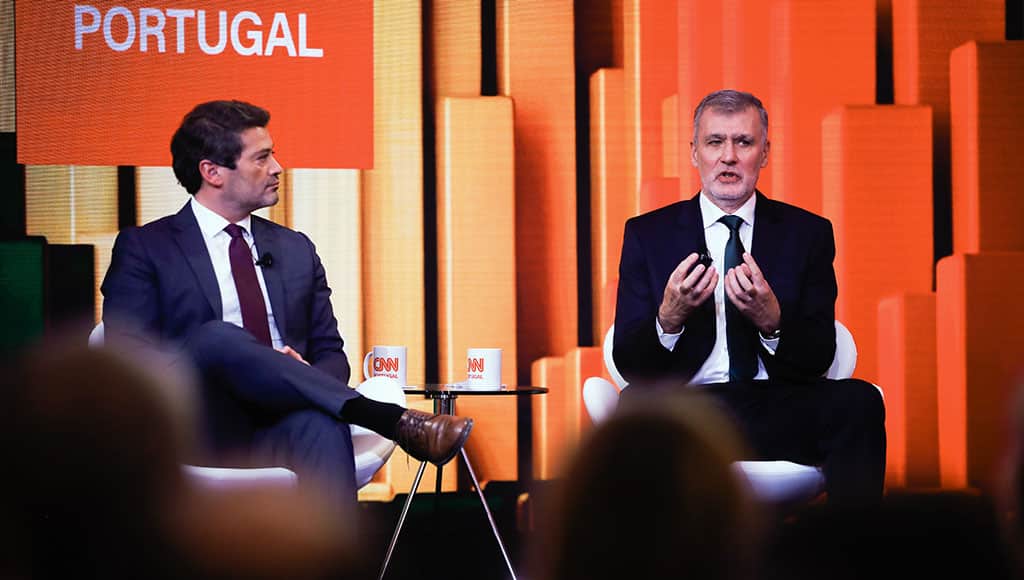
André Ventura is already giving interviews of what he would change if elected president.
Again, this is not what happens in presidential campaigns. Candidates are usually ‘presidential’: ‘careful’, ‘measured’, ‘aware that they need to talk for everyone’. This is not André Ventura’s style: he is talking to (and ostensibly for) the ‘disgruntled’; the have-nots (which now include the younger generations who simply cannot afford a roof over their heads anymore).
Ventura wants constitutional change so that the president has more power. He has told SIC that the President of the Republic should be a “decisive political actor”, insisting he will “lead the party politically” if he wins the election.
“If we want to take the job of president seriously, and justify the salary we pay, and what we pay for the presidency of the republic, the president has to have concrete powers”, he told his interviewers – stressing the Portuguese people will not be content with a president who ‘colludes with the government (…) I am not going to be a president of easy unity, of fine words and cheap talk (…) We cannot cover-up the divisions, the polarisation, the problems…” – which leaves the otherwise ‘fine talkers’ in an immense quandary.
At the outset, Gouveia e Melo was a ‘favourite’. Then came interviews and probing questions, and the realisation – powered by the PSD/ CDS-PP candidate Luís Marques Mendes – that a background in politics may well be a necessary qualification for this job.
Since then, the ‘floodgates’ of political candidates have opened – and failed to impress: Euro MPs Catarina Martins (Bloco de Esquerda) and João Cotrim de Figueiredo (Iniciativa Liberal) have been given 1% and 3% respectively in the recent poll conducted by ICS/ ISCTE; António Filipe (PCP communist) just 2%; António José Seguro (PS) managed 10%; Luís Marques Mendes 16% and the two ‘anti-systemics’ are both neck-and-neck on 18%. (All others have been discounted – even the refreshing Manuel João Vieira who wants to give a Ferrari to every Portuguese citizen, and pipe red wine into the nation’s taps.)
This is where the danger lies: with Ventura riding so high, alongside Gouveia e Melo, what is the latter’s message to the people?
This does appear more in line with the status quo. The former admiral has said he sees the job as “helping the government have stability”, at the same time as “being demanding with the government”. His role, he tells reporters, would be to “balance the system”.
Thus, the careful swallowing of on-screen pundits who have realised that if this contest runs the way latest polling suggests, voters have to be extremely careful.
“There is no point voting for the candidate of a party you like, if it is clear that that candidate has no chance”, one of a panel told SIC this week. “People need to throw their weight behind the strongest candidate who does not represent the extreme right…”
This opens the way again to Luís Marques Mendes (described by commentators this week as ‘just too nice’) and António José Seguro (described as just too ‘weak’: the biggest problem with Seguro is that his own party cannot agree to support him, which is never a good sign).
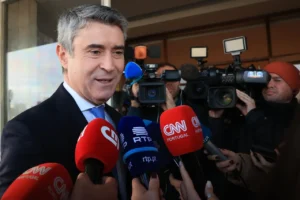
Attention therefore returns to the former admiral – as tongue-tied as his initial dealings with the press have seemed. Henrique Gouveia e Melo does not identify with any extremes, he says.
The ICS/ ISCTE poll predicts that even the undecided do seem to ‘favour’ Gouveia e Melo – and that if things came to a second ballot, the former military man would win hands-down, no matter who he faces
In other words, for all André Ventura’s talk (he has even vowed to give “extraordinary power to the police and other authorities to fight crime”), he seems unlikely to reach Belém Palace in March.
There will, of course, be other polls between now and January 18 – and it needs to be said that certain people (João Cotrim de Figeiredo most vociferously) believe the ICS/ ISCTE poll was rigged, to try and influence people. But this is proving to be one of the most unusual presidential campaigns, as the man who has held the position for the last 10 years recovers, almost allegorically, from an operation to release a strangled hernia.