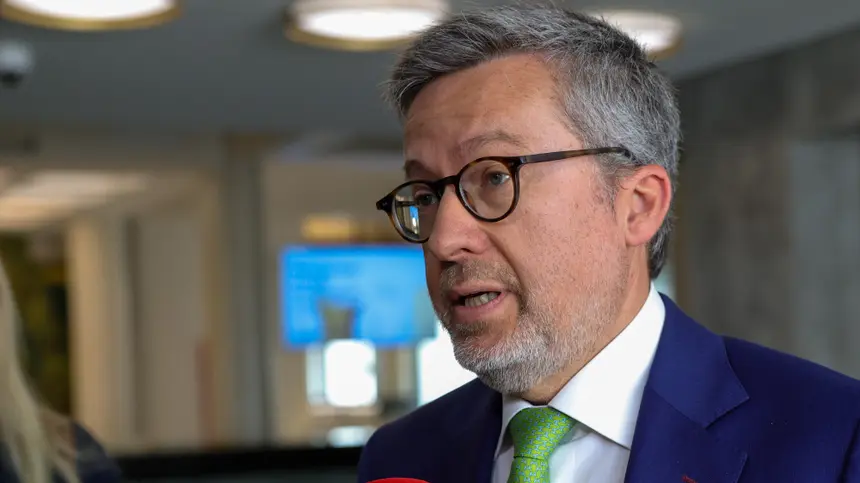
With so much being aired about the political responsibility/ ies for the appalling funicular disaster last week, Lisbon mayor Carlos Moedas said on air last night that he will resign ‘if anyone can prove that the derailment of the ‘Elevador da Glória’, in which 16 people died and 22 people were injured, was the result of an error on his part.
In an interview with SIC – the first given to a media outlet since the accident on September 3 – Mr Moedas insisted that “in this tragedy there is no error that can be attributed to a decision by the Mayor”.
“If anyone can prove that any action I took, anything I did as Mayor in relation to this company (Carris) led to this company not spending enough on maintenance, to this company not doing what it had to do, I will resign on that day,” he said.
The statements reflect Moedas’ attitude to assuming political responsibility. It is a very different attitude, for example, to the one taken by Socialist infrastructures minister Jorge Coelho, in 2001, after the pillar of a bridge over the river Douro gave way, sending 59 people to their deaths in the waters below.
It is also a different one to that espoused by President Marcelo.
Marcelo said yesterday that Carlos Moedas bears “political responsibility” for the incident, essentially because “whoever holds a political office is politically responsible”.
“Whoever is in charge of a public institution (…) is subject to political judgment for anything that goes wrong in that institution, even without any fault or intervention whatsoever,” he told reporters.
All this ‘talk’ reverberates before investigators have come to any kind of conclusion as to what may have led to the snapping of the funicular’s cable, which scuppered the whole system – and, as Marcelo has conceded, the country is so close now to municipal elections (on October 12) that it will be up to the citizens of Lisbon to show how they feel about Carlos’ Moedas’ position generally.
What is important, Marcelo concluded, is that “objective liability doesn’t die a spinster” (ie that no one assumes it). Even though there appears to be no specific fault on the part of anyone for this trafic loss of life and harm inflicted on members of the public, “how many deaths are necessary for accountability to be established,” he quizzed.
Source material: LUSA/ SIC