
Another One Bites the Dust!
Freddie Mercury, possibly the world’s most iconic rock star, would have been 79 this month and his links to London, where he lived most of his life, have been touched on before in this column.
Born on September 5, 1946, as Farrokh Bulsara in Zanzibar, he moved to England in 1964.
After studying art at Isleworth Polytechnic in West London, Mercury went on to study graphic art at Ealing Art College, graduating with a diploma in 1969. In 1970, he joined the band Smile alongside Brian May and Roger Taylor. Freddie put them ‘Under Pressure’ and soon changed the band name to Queen – the rest was history.
Freddie sadly died on November 24, 1991, aged 45 at his Kensington home. He was cremated and the final resting place of his ashes was kept secret.
However, in 2013, fans discovered a plaque in Kensal Cemetery, West London. The plaque reads: “In Loving Memory of Farrokh Bulsara, 5 Sept. 1946 – 24 Nov. 1991, Pour Etre Toujours Pres De Toi Avec Tout Mon Amour – M.” The French part translates to “Always To Be Close To You With All My Love”; the “M” is believed to stand for Mary. Mary Austin was Freddie’s girlfriend and the last known custodian of his ashes.
The plaque has since mysteriously disappeared.
Whac-a-Mole
If you look up the inventor of the game Whac-a-Mole, you would discover credit goes to Kazuo Yamada of Japan, however, the origins go back much further and are rooted in London’s medieval past.
In 1551, drunkenness was made a civil offence. Transgressors were given relatively mild punishments often based on ridicule and pillory. By the early 1570s, the game of ‘wake-o-mole’ was becoming the preferred method of dealing with offenders.
The original format went like this: between five and 10 drunks were put in special barrels called tipples. The top of the barrel had a hole for the prisoner to put his or her head through (later versions also had arm and leg holes). Several members of the public were then given wooden sticks and, at the start of play, banged on the side of the barrels.
The noise was such that each offender had to stick their head out, at which point the player, armed with a pigskin mallet, would whack whichever bonce they could. A three- or five-minute sand timer would set the game time and the scores recorded. More elaborate later versions had a wooden platform above the barrels.
By the late 1600s, the practice had died out, but the statute was never repealed, indeed each London borough is still legally obliged to have wake-o-mole apparatus, however, only Islington still has such a plot, albeit buried under the pavement. It is currently protected by five inspection hatches, and it is hoped the listed structure will be eventually restored. Maybe not to be used for its original purpose though!
A little tricky to see how you could order a drink in those days, but an interesting punishment that would certainly clear the currently overcrowded prisons.
More hot air in Westminster!
Transport in the early 1930s was about to enter a new golden age. The age of commercial aviation was just around the corner. It was felt that London needed a central airport to not only keep up with but lead the world. The airports we now know as Gatwick and Heathrow existed in a fledgling form and would indeed soon run commercial flights. (Heathrow was known as Great West aerodrome and Gatwick had been the base for private flights since 1920).
However, some forward-thinkers felt a more central airport was needed, so MPs and important businessmen could get to their destinations as quickly and easily as possible. But where could it be built? Short of demolishing a large area of Central London, there was nowhere available. This didn’t stop designers coming up with some pretty bold ideas, however. One such idea consisted of a circular cartwheel shaped airport built on top of Kings Cross station. Another, with flying boats using the Thames as a landing strip was soon dismissed because of the danger to shipping.
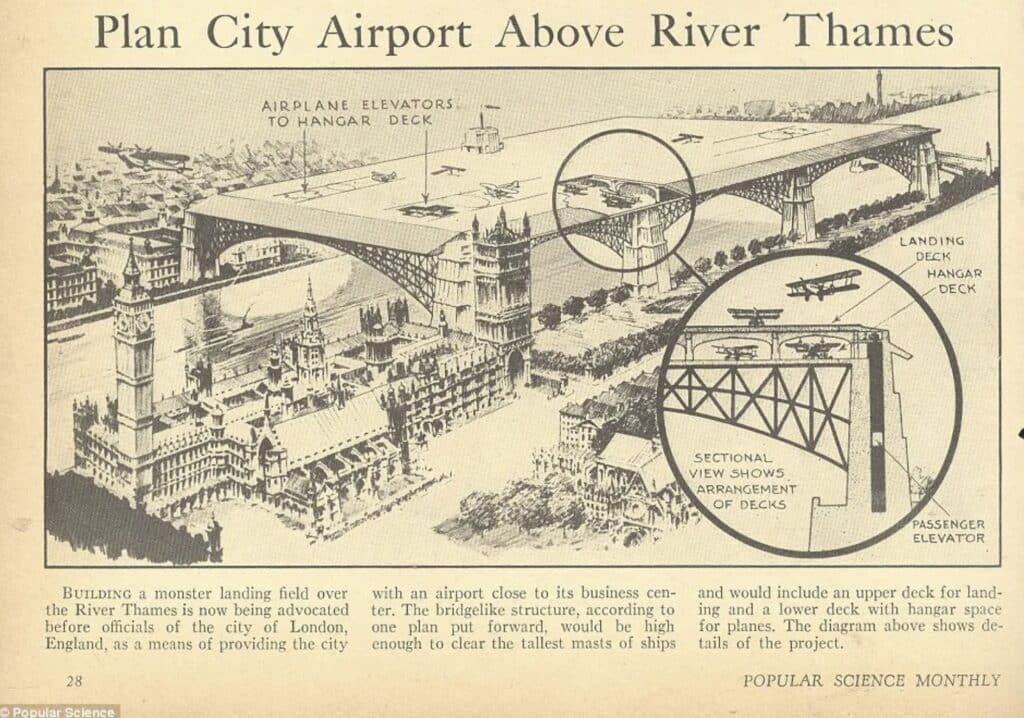
It was an article in Popular Science in 1934 that was the most outlandish though. The proposal consisted of an enormous steel structure straddling the Thames. It was decided that the best location was right outside the Houses of Parliament. Huge steel arches would rise up high enough for the tallest ships to clear, and on top there would a runway. The hangars for the aircraft would be on a second deck underneath and a lift system would bring aircraft up when needed. Passengers would gain access from either riverbank up the legs via lifts.
Ultimately, the plan was rejected. Both Gatwick and Heathrow didn’t like the idea of competition on their new investments and MPs certainly didn’t want an airport almost on top of the seat of government. Not to mention the safety risks if a plane were to overshoot the runway!
If Westminster Airport had been built, it would have quickly become obsolete as the runway’s relatively short length wouldn’t have been able to accommodate the fast-paced development of aircraft.
The Good Olde Days…?
In the 16th and 17th centuries, minor crimes in London were dealt with by regional magistrates. There were various punishments that could be dispensed, a popular one was that of ‘standing’. This involved standing outside the magistrates’ court for anything from a few hours up to several days.
Amazingly, it was done on trust, as the prisoner wasn’t chained or restrained. However, if they did abscond and were caught again, the full weight of the law was brought down on them. The idea was to teach them some self-control and decorum.
Such bizarre crimes punishable by this method, included: slaughtering a pig, oxen or fowl within three perches of a nobleman; jestering to clergy within forte chains of St Pawles; engaging a publican in conversation whilst commanding an empty vessel; frying fish within sight of a public gallows; making unholy signs to a stonemason after dark; making a dwelling in the River Thames for more than three days; having the appearance of an imbecile whilst operating bellows; displaying a ladybeard to a magistrate.